Story
Natto
Last updated
In one pass What makes natto special is the large amount of vitamin K2 (MK-7) that fermentation creates.
Educational content, not medical advice — consult a clinician.
Story path
Chapter 1
What fermentation changes in soybeans
Natto is soybeans rewritten by a bacterium, Bacillus subtilis var. natto. Steamed whole beans are inoculated with it and fermented somewhere warm for about a day, becoming a sticky, stringy, strong-smelling mass. It belongs with miso, tempeh, and soy sauce on soy's fermented branch (for the bean itself, see Soybeans & Tofu).
Mechanism · Three things fermentation changes
The same soybean, after a day's work by the bacillus, goes through three changes:Anti-nutrients fall: fermentation breaks down phytate and similar compounds in soy, so minerals are easier to absorbNew nutrients appear: the bacteria make a large amount of vitamin () during fermentation, natto's signatureLive microbes and their products arrive: live Bacillus, fiber, and an enzyme called nattokinase
In other words, natto is not soy with some flavor added; it is soy deeply reworked by microbes. What truly sets it apart is vitamin K2, whose mechanism is clear, though human evidence that it reduces fractures or heart disease is still limited. The online hype about nattokinase dissolving clots has even less human evidence behind it.
Chapter 2
The vitamin K2 made by fermentation
Vitamin K comes in two main families: the liver uses K1 mainly to switch on clotting factors, while K2 reaches bone and blood vessels more. MK-7 also stays in the blood longer, so blood K2 levels after eating natto are steadier.
Numbers · How much K2 a pack of natto holds
In ordinary natto measured by Tsukamoto 2000, there was about 775 µg of per 100 g. By comparison, most other foods carry in the range of single to tens of micrograms; fermented cheese is another source (see Cheese). One small pack of natto (about 40-50 g) delivers far more K2 than the rest of a typical day's food combined.This MK-7 does not come from the soybean; Bacillus subtilis makes it during fermentation, a real case of fermentation rewriting a food's nutrition.
Mechanism · How K1 and K2 differ
Vitamin K comes in two main families, and they are not the same thing:K1 (phylloquinone): plentiful in leafy greens and mainly for clotting; the liver uses it to switch on clotting factors (menaquinone): plentiful in fermented and animal foods, and more active in bone and blood-vessel tissue
The form has one more trait: a long half-life in the blood (about 3 days, far longer than the few hours of K1), so blood K2 levels after eating natto are steadier and last longer (Schurgers 2007). For the full vitamin K mechanism, see Vitamin K2.
Chapter 3
How K2 sends calcium into bone
The mechanism is clear, but whether eating natto or taking K2 reduces fractures or heart disease is not settled; the human evidence so far is mostly observed associations.
Mechanism · After carboxylation, proteins grip calcium
Vitamin K is the key that puts certain proteins on duty: it helps them through a step called carboxylation, after which they can grip calcium. Two leads:Osteocalcin: in bone, carboxylated osteocalcin pulls calcium into the bone matrix and helps bone mineralizeMatrix Gla protein (MGP): in vessel walls, carboxylated MGP holds back calcium deposits in arteries
After people ate natto, carboxylated osteocalcin in their blood did rise (Tsukamoto 2000), a sign that really takes part in this process.
K2 does not work alone: it is one link in a chain with vitamin D (which helps you absorb calcium, see Vitamin D) and calcium itself (see Calcium). If you take calcium and vitamin D, having dietary K2 sources (natto, fermented cheese) alongside leafy greens for K1 is a sensible pairing. For the full skeletal mechanism, see Bone System and osteoporosis.
Evidence · Does K2 prevent heart disease or fractures
The Rotterdam Study in the Netherlands (Geleijnse 2004) found that people who ate more had a lower risk of coronary heart disease and of calcification in the aorta. That is an observed association and does not show that K2 caused it. There is no large K2 trial with fractures as the outcome, and no large randomized trial has yet answered whether K2 lowers cardiovascular deaths. So the defensible statement is that K2's role in where calcium goes is mechanistically clear and population studies are suggestive, not that eating natto prevents heart disease.The K2 in cheese is not the same form either. Vermeer 2012, a review, reports that the K2 in cheese and curd comes mainly from lactic-acid bacteria (chiefly MK-8 and MK-9) and propionic-acid bacteria (chiefly MK-10); comes almost only from Bacillus subtilis natto; MK-4 comes from animal tissue, not from the lactic fermentation of cheese. Natto is the MK-7 champion among common foods precisely because this bacterium makes that form during fermentation. For the fermented-cheese thread, see Cheese.
Chapter 4
Can nattokinase dissolve clots
But going from cutting fibrin in a test tube to dissolving clots in your blood vessels, or replacing anticoagulant drugs, is far too big a leap, and the human evidence is nowhere close: the few small trials so far measured in-between markers such as blood pressure and blood lipids, not strokes or heart attacks. It cannot replace the anticoagulants a doctor prescribes.
Evidence · What a few small trials measured
Li 2023, a systematic review and published in Reviews in Cardiovascular Medicine, could pool only 6 with 546 people in total. It suggested nattokinase supplements may lower systolic blood pressure slightly (about -3.5 mmHg), while effects on blood lipids were inconsistent.The authors themselves stress that too few studies were included, so the conclusions need caution; most trials were small and measured stand-in markers (blood pressure, lipids, clotting markers), not real health outcomes such as strokes or heart attacks ().
How to read it: nattokinase may show a mild, early signal on blood pressure. Cutting fibrin in a test tube does not translate into dissolving clots in your body.
Safety · It cannot replace anticoagulants
Calling nattokinase a natural clot-buster or a replacement for anticoagulants goes seriously too far. It cannot replace the anticoagulant or antiplatelet drugs a doctor prescribes, and people who already have clots or heart and vessel disease especially must not treat themselves with it.Do not mix up natto's two selling points either: vitamin has a clear mechanism, though human evidence that it reduces fractures or heart disease is still limited; nattokinase has even less evidence and is easier to exaggerate. On warfarin they even point in opposite directions: nattokinase is marketed as clot-dissolving, while the K2 in natto weakens warfarin's anticoagulant effect.
This is general education; for heart and vessel medication and for clotting problems, follow your doctor's judgment.
Chapter 5
If you take warfarin, avoid it
This is not a maybe: clinical observations in Japan recorded that when patients on warfarin ate natto, their anticoagulation was markedly weakened. So people taking warfarin are generally advised not to eat natto, and to keep other vitamin K foods steady and predictable, following their prescribing doctor and anticoagulation clinic.
Safety · How natto weakens warfarin
Warfarin is an oral anticoagulant that works precisely by blocking vitamin K, so fewer clotting factors get switched on: it turns down vitamin K's action to prevent clots. That is why how much vitamin K you eat, and how steady that amount is, directly affects how well warfarin works (for this mechanism, see Vitamin K2).Natto contains extremely high vitamin (), and MK-7 has a particularly long half-life. Clinical observations in Japan (Kudo 1990) found that patients on warfarin after heart-valve replacement had their anticoagulation markedly weakened after eating natto: natto's high K2 worked directly against the warfarin.
People taking warfarin should avoid natto, and should also avoid sudden big swings in other high-vitamin-K foods. The general principle is to keep vitamin K intake steady and predictable, following the prescribing doctor and the anticoagulation clinic.
Clinical · What about the newer anticoagulants
This warning is about vitamin K antagonists such as warfarin. The newer direct oral anticoagulants (for example, direct factor Xa inhibitors) work by a different mechanism that does not go through vitamin K, so vitamin K in food does not change how well they work. First find out which kind of anticoagulant you take; if you are not sure, ask your doctor before eating natto.For healthy people who are not on anticoagulants, natto's high is not a problem. The same food is a nutritional highlight for most people and an interaction to avoid for someone on warfarin; once you know that warfarin works by blocking vitamin K, the reason is obvious.
Chapter 6
The live bacteria and fiber in natto
That is fermentation's other payoff, but probiotic effects depend heavily on the strain and the person, and natto is not a treatment for gut disease.
Mechanism · Why spores reach the gut alive
Natto that has not been heat-sterilized contains live Bacillus subtilis. Bacillus spores withstand acid and heat, so they are more likely than many delicate lactic-acid bacteria to get through the stomach and reach the gut alive. They fall under the broad heading of probiotics in fermented foods (for the strict definition of probiotics and the strength of the evidence, see Probiotics).The Hill 2014 international consensus is explicit: a probiotic benefit depends on the specific strain and dose and is not something every fermented food has. Treat natto as a live fermented bean whose value lies in the overall diet (a variety of fermented foods plus plenty of fiber), not as a miracle that cures gut disease.
Numbers · Fiber, and less phytate
Natto keeps the whole soybean's dietary fiber (USDA: about 5.4 g per 100 g). This fiber feeds gut bacteria and can be fermented into short-chain fatty acids that nourish the gut environment (for how the gut microbiome works overall, see Gut microbiome).Fermentation also breaks down soy's phytate and similar compounds, so the iron, magnesium, and other minerals in natto are absorbed better than in unfermented soybeans, a real benefit of fermentation that is often overlooked. The mechanism is clear, but do not make clinical promises on its behalf.
Chapter 7
How to eat it and who should take care
One pack a day already brings a sizable dose of ; to keep the live bacteria, do not cook it at high heat for long. The one thing to take seriously is warfarin: people on this drug should avoid natto.
A CLOSER LOOK
Stringiness is a visible result of fermentation
This shows natto's whole beans and stringiness. The amount of stringiness cannot measure live bacteria, MK-7 or nattokinase.
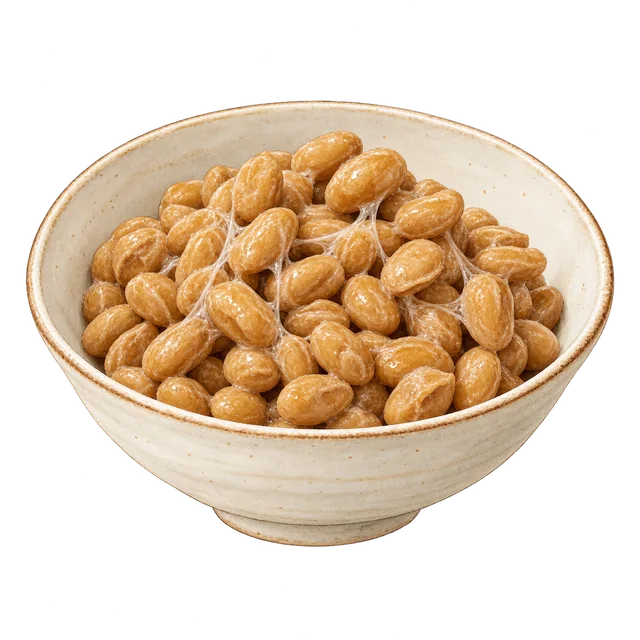
- Fermented beans
- Natto keeps the individual beans' shape and is one form of fermented soybean.
- Sticky threads
- Visible sticky threads connect the beans. This image shows appearance, not live-bacteria or compound measurements.
Illustration for understanding; not to scale. Saved figures include explanations and sources.
In practice · How to eat it without overcooking
A common way to eat it in Japan is over rice, stirred with soy sauce, mustard, chopped scallion, and a raw egg; the seasoning tones down the smell.A pack of about 40-50 g is a common single serving, and 1 pack a day already provides a sizable amount of vitamin To keep the live bacteria, do not cook natto at high heat for long (high heat kills the live bacteria and also destroys some of the nattokinase); stir it into rice and warm it gently at mostFor K2: natto is the best-value natural source; if you dislike natto, K2 can also come from fermented cheese (see Cheese), and the body can convert part of the K1 in leafy greens
Safety · Who should be careful
People on warfarin or other vitamin K antagonists: avoid natto; this is a real interaction, so follow your doctor and anticoagulation clinic. This is the one caution about natto that must be taken seriouslyPeople with a soy allergy: natto is a soy product, so people with the allergy should avoid it (this is an immune issue, unrelated to the myths; for soy allergy and its mechanism, see Soybeans & Tofu)Purines and gout: natto is a fermented bean without especially high purine content, so moderate amounts are usually fine; during an acute gout flare it is still wise to ask a doctor firstPeople with sensitive stomachs or who are new to fermented foods: start with a small amount the first time and let your gut adjustFor most people, natto is a vitamin champion with a clear mechanism, plus a live fermented bean; the one thing to take seriously is the warfarin interaction. This is general information only; for your own medicines and conditions, follow your doctor's judgment.
References · 9
- U.S. Department of Agriculture, Agricultural Research Service. (2019). FoodData Central: Natto (SR Legacy, FDC ID 172443). Fermented whole soybean; ~19.4 g protein, ~5.4 g dietary fiber, ~211 kcal per 100 g. fdc.nal.usda.gov/food-details/172443/nutrients
- Tsukamoto, Y., Ichise, H., Kakuda, H., & Yamaguchi, M. (2000). Intake of fermented soybean (natto) increases circulating vitamin K2 (menaquinone-7) and gamma-carboxylated osteocalcin concentration in normal individuals. Journal of Bone and Mineral Metabolism, 18(4), 216-222. Ordinary natto contained ~775 µg MK-7 per 100 g; intake raised serum MK-7 and carboxylated osteocalcin. 10.1007/s007740070023
- Schurgers, L. J., et al. (2007). Vitamin K-containing dietary supplements: comparison of synthetic vitamin K1 and natto-derived menaquinone-7. Blood, 109(8), 3279–3283. 10.1182/blood-2006-08-040709
- Geleijnse, J. M., et al. (2004). Dietary intake of menaquinone is associated with a reduced risk of coronary heart disease: the Rotterdam Study. Journal of Nutrition, 134(11), 3100–3105. 10.1093/jn/134.11.3100
- Vermeer, C. (2012). Vitamin K: the effect on health beyond coagulation - an overview. Food & Nutrition Research, 56, 5329. Cheese/curd K2 is from lactic-acid bacteria (mainly MK-8 and MK-9) and propionic-acid bacteria (mainly MK-10). MK-7 is almost exclusively Bacillus subtilis natto; MK-4 is from animal tissue (menadione conversion), not cheese lactic fermentation. 10.3402/fnr.v56i0.5329
- Li, X., Long, J., Gao, Q., Pan, M., Wang, J., Yang, F., & Zhang, Y. (2023). Nattokinase supplementation and cardiovascular risk factors: a systematic review and meta-analysis of randomized controlled trials. Reviews in Cardiovascular Medicine, 24(8), 234. Pooled 6 RCTs (546 participants); nattokinase modestly lowered systolic BP (MD ~-3.45 mmHg) but lipid effects were inconsistent; small number of studies limits firm conclusions. 10.31083/j.rcm2408234
- Kudo, T. (1990). Warfarin antagonism of natto and increase in serum vitamin K by intake of natto. Artery, 17(4), 189-201. In patients on warfarin after valve replacement, eating natto markedly weakened anticoagulation via natto's high vitamin K2 (MK-7); warfarin patients should avoid natto. pubmed.ncbi.nlm.nih.gov/2360879
- Booth, S. L., & Centurelli, M. A. (1999). Vitamin K: A practical guide to the dietary management of patients on warfarin. Nutrition Reviews, 57(9 Pt 1), 288-296. & supporting AHA 2003 statement on warfarin + dietary vitamin K consistency. Note: the id says 2004 but this record is the 1999 paper; text that cites 'Booth 2004' means this record. Abstract: patients on warfarin are advised to keep dietary vitamin K intake constant, and a constant intake meeting the then-current recommendation of 65-80 µg/day is the most acceptable practice; a dose-response of vitamin K on warfarin anticoagulation had not been established; plant oils and foods prepared with them (baked goods, margarines, salad dressings) are also sources (abstract, PMID 10568341). 10.1111/j.1753-4887.1999.tb01815.x
- Hill, C., Guarner, F., Reid, G., et al. (2014). The ISAPP consensus statement on the scope and appropriate use of the term probiotic. Nature Reviews Gastroenterology & Hepatology, 11, 506-514. A probiotic benefit is strain- and dose-specific, not a property of all fermented foods. 10.1038/nrgastro.2014.66