Story
Mung Bean
Last updated
In one pass A bowl of iced mung bean soup feels good because it is cold and it is water.
Educational content, not medical advice — consult a clinician.
Story path
Chapter 1
What mung bean is · the summer soup
The mung bean is a small green legume with a special place in Chinese food — iced mung bean soup is almost a symbol of summer in China, and the beans are also sprouted into bean sprouts, ground into mung bean cake, and made into glass noodles.
As a legume, the mung bean is a close relative of lentils and black beans, and its nutrition follows the same logic: plant protein, fiber, and some minerals. Clearing heat and removing toxins is a traditional belief, not a measured mechanism; the bean's real nutrition and that claim need to be looked at separately.
Mechanism · what's inside a mung bean
The same bean can be simmered into soup, ground into cake, drawn into glass noodles, or sprouted into bean sprouts — not because the kitchen tricks are flashy, but because the bean already comes in layers, and each method just takes one of them.Split a soaked mung bean and you see three things:
The outer green skin (the seed coat): mostly fiber, and the green color lives here too. Cook it long enough and the skin splits, the bean flowers, and the soup turns cloudy and sandyThe two large yellowish-white halves inside (the cotyledons): this is the warehouse. Protein, starch, and minerals are all stacked in these two halvesThe small bit sandwiched between the halves (the embryo): the only living part of the whole bean, and the first thing that wakes up after soaking
So those ways of eating it are really each taking what they need from these three layers: simmering soup lets the seed coat split and cooks the cotyledon contents out into the water; mung bean cake grinds the cotyledons into flour and presses it firm; glass noodles pull the starch from the cotyledons; and bean sprouts wake the embryo, which eats through the cotyledon stores as it grows into a new shoot.
This last one is the one worth watching: sprouts and dry beans do not have the same nutrition, because a real stretch of growth sits between them. What that growth actually changes is unpacked in the chapter on sprouts and pairing.
Chapter 2
Nutrition · plant protein and fiber
Protein and fiber: for a staple or soup ingredient, the protein content is respectable, and the fiber helps with fullness and gut healthIron: mung beans contain some iron, but it is poorly absorbed non-heme iron — as with red dates, do not count on it as an efficient iron source (the mechanism is in the Iron story)Potassium, magnesium, and folate: some of each
So in summer, mung bean soup both rehydrates you and brings a little electrolyte and nutrition, which makes it a reasonable cooling drink. But a nutritious soup for hot weather and something that removes toxins are two different things.
A CLOSER LOOK
Green skin around a pale seed
The cut face makes this legume's intact structure concrete. Protein, fiber and mineral amounts require data; green color cannot demonstrate detoxification.
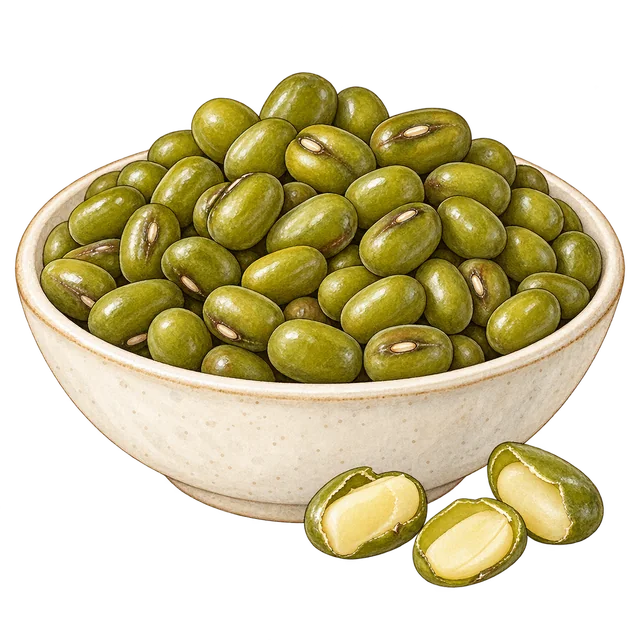
- Whole mung bean
- It supplies plant protein and fiber, with some potassium, magnesium and folate.
- Pale interior
- Mung beans contain non-heme iron. Containing iron and having it readily absorbed are different things.
Illustration for understanding; not to scale. Saved figures include explanations and sources.
Mechanism · why plant iron has a hard time getting in
From mung beans contain iron to you actually absorbing iron, several gates sit in between. This chain is worth walking all the way through — it explains not just mung beans, but the iron awkwardness of almost every plant food.Iron in meat is packed inside a little box called heme. The intestinal wall has a doorway that recognizes this box, takes the whole box in, and nothing along the way can steal what's inside. Plant iron has no box. It is naked, and most of it is in the ferric form — a form that does not dissolve well in water, and in the gut environment readily precipitates and drops out.
So it has to clear two gates:
First gate: stay intact all the way through the gut lumen. Whoever grabs it first, it does not get in. Phytate, polyphenols in strong tea and coffee, and a large load of calcium in the same meal will all bind iron into an insoluble clump in the lumen, and it leaves with the fecesSecond gate: get cracked at the door of the small-intestinal epithelial cell. Reductases on the brush border turn ferric iron into ferrous iron; and the door that carries iron into the cell only recognizes the ferrous form
Vitamin C sits in a handy place, because it works both gates: it is itself a reducing agent, helping crack ferric into ferrous; it also binds iron into a form that stays dissolved in the lumen, so phytate cannot steal it.
In practice: a bowl of mung bean soup with something rich in vitamin C (bell pepper, tomato, citrus) means more than drinking the bowl on its own; and that cup of strong tea before or after the meal is another lock on top of these two gates (the whole iron chain is covered in the Iron story).
Hold this chain, and the chapter on sprouting will make more sense — sprouting is exactly the thing that loosens both of these gates a little.
Mechanism · what the fiber and those electrolytes are doing
Fiber is often vaguely praised as good for the gut, but the fiber in beans does two quite specific jobs in the body, and they are different jobs.The soluble part soaks up water and turns into a gel, wrapping the chyme so it is stickier. Gastric emptying therefore slows, and sugar enters the blood more slowly, so you get hungry later. This is the opposite of a sweet drink — the latter barely needs to be taken apart before it rushes into the blood.
The insoluble part you cannot digest yourself; it travels all the way to the large intestine: some of it is eaten by the bacteria living there, and the rest adds bulk to the stool and makes it easier to pass.
Potassium and magnesium are a different set of things. They are the ions muscles use to contract and nerves use to fire, and they belong to the class that leaves with water when you sweat in summer. A bowl of soup returns water and a little electrolyte together — that is the extra bit mung bean soup has over plain water in fierce heat. Folate is involved in the step of copying genetic material when new cells are made — important over the long run, but you will not feel it the moment you finish a bowl of soup.
So this soup's place is actually quite clear: a summer drink that hydrates and brings a little nutrition. Its virtue is that it is convenient and real, not that it is miraculous.
Chapter 3
Can mung bean soup remove toxins
The true part: a bowl of iced mung bean soup makes you feel better in hot weather mainly because it rehydrates and cools you, plus a little electrolyte and sugar. Cold liquid in the stomach gets warmed to body temperature, and that heat is taken from you; the water you put back brings blood volume up, so your skin can keep sweating and shedding heat. That is a real cooling experience, and nobody denies it.
The unsupported part: detox. The system that actually handles and removes metabolic waste and foreign substances is the liver and kidneys (they are working all the time; see Detox & Cleanse). There is no reliable evidence that mung beans pull out toxins or boost that clearance — words like detox and cleanse in a food context are mostly marketing and folk association, without a clear mechanism. A bowl of mung bean soup feels good because it is cold and it rehydrates you, not because it is drawing out poison.
So the accurate version is: mung bean soup is a very good summer drink for the heat, so enjoy the coolness and the fluid. Do not count on it for any detox need — your liver and kidneys do that job all the time, and they do it better than any food.
Mechanism · Why iced mung bean soup feels good
Let's say this plainly first: the comfort is real. What's worth asking is only where that comfort actually comes from.Summer feels bad because the body is making more heat than it can shed. Heat shedding is mainly handed to the skin, in two steps: blood vessels under the skin dilate, sending blood that carries core heat to the surface; sweat glands sweat, and when sweat evaporates on the skin, it takes the heat needed for vaporization with it. Evaporation is the main force — that's why the same temperature is harder to bear when humidity is high and sweat cannot evaporate.
The trouble is that sweating spends the body's water. Sweat a lot, drink little, and blood volume drops; with less blood, the heart has to work harder, and the blood that can be sent to the skin actually decreases. Heat-shedding efficiency then drops with it — you get hotter, more tired, heart beating faster. That's the start of the road where heat becomes dangerous.
A bowl of iced mung bean soup puts two hands on this chain at once:
It is cold. Liquid that enters the stomach will be heated to body temperature, and that heat is taken from you — direct, but limited in amountIt is water. The water you put back lets blood volume recover, so skin blood flow and sweating can continue — this is the larger half
So what that bowl is really doing is: cooling + hydrating, plus a little sugar and electrolytes. Follow this chain and you can also make a judgment yourself — if you swap in equally iced plain water, weak tea, or dilute salt water, and most of the comfort is still there, then that comfort is not a gift from the mung bean as a species.
Mechanism · what the liver and kidneys are actually doing
To say mung bean does not detoxify, you first have to say who is actually doing this job and how they do it — otherwise detox is only denied, not replaced.Most troublesome molecules are fat-soluble: if they dissolve in oil, they can linger in cell membranes and adipose tissue and not leave. What the kidney sends out is urine, and urine is water. Send something fat-soluble straight to the kidney and it will be reabsorbed. So the liver has to do one thing first — remodel them into something that can dissolve in water.
The liver cell's remodeling has two steps:
First, a family of enzymes that specialize in handling foreign molecules opens a handle on this molecule: add an oxygen, break a bond, expose a site that something can attach toSecond, hang a water-loving tag on that handle (glucuronic acid, a sulfate group, glutathione, and the like). Once tagged, the molecule that used to linger in fat becomes water-soluble, and also harder to reabsorb
After remodeling there are two exits: smaller ones go with the blood to the kidney; the glomerulus filters them into the primary urine, the tubule takes back the water and salt that should stay, and the rest leaves with the urine. Larger ones go with bile into the gut and leave with the feces.
The most important property of this assembly line is: it is always on. It does not need anyone to start it. The word detox in a food context presupposes a wrong picture — as if the body keeps a warehouse of toxins, waiting for some food to empty it once. The real picture is an assembly line that never stops, and it runs on you eating normally, drinking water, and sleeping (the whole system is taken apart more finely in Detox & Cleanse).
Myth · Why this claim has lasted so long
A claim that can circulate for centuries usually isn't wildly wrong. It usually lands on something real, and just credits the wrong party.What's real about mung bean soup is: you did feel better. What's wrong is the attribution — that comfort came from cold and water, but it got credited to the explanation mung beans can pull out toxins. Once that explanation is accepted, it also reinforces itself: next time you're hot you drink another bowl, feel better again, and it feels like another confirmation.
This kind of attribution error has a general way to take it apart, worth taking with you: swap out the praised ingredient and see whether the effect is still there. Equally iced plain water can also make you feel better, so the cooling credit belongs to cold and water, not to the mung bean.
There's a second question you can carry around: if a food could truly speed up some clearance pathway, it should be able to say which pathway, which step is the bottleneck, and which class of molecules is being cleared — as specific as the liver-and-kidney assembly line. When it can't say that, detox is only a feeling-word, not a mechanism.
This is not telling you to stop drinking mung bean soup. Drink it when you want it — just put it in the place of tasting good, relieving heat, and incidentally replacing some water and nutrition, not in the place of cleaning the body. The first it does well; the second your liver and kidneys have been doing all along, and better than any food.
Chapter 4
Sprouts and pairing
First, sprouting: as mung beans sprout, they make vitamin C that the dry bean almost lacked, and the bean's own enzymes break down part of its phytate — the antinutrient that grabs iron, zinc, and calcium in the gut and will not let go. So bean sprouts are actually friendlier than dry mung beans for vitamin C and for how well minerals are absorbed — a real change brought about by the simple act of sprouting.
Second, pairing: like all legumes, mung beans are rich in lysine, the amino acid grains lack. Eat mung beans together with grains (mung bean congee, mung beans with rice) and their amino acids complement each other, so the protein comes close to complete (the mechanism is in the Protein story, and the Millet and Rice stories cover the same point).
So mung beans are a good source of plant protein, and mung bean soup is a good drink for hot weather. Sprouted, they give you more vitamin C; eaten with grains, their protein is more complete — but they do not detox you.
Mechanism · what happens inside the bean after you soak it
A dry mung bean is asleep. It holds almost no water, metabolism is nearly stopped, and it can sit like that for a long time without spoiling — that's a seed's talent.Soaking is the switch that wakes it. Once water gets in, the cells swell again, and a whole set of enzymes that were already stored inside starts working. One of them is called phytase.
To see what it's doing, you first have to know what phytate is. That's the warehouse molecule the seed uses to store phosphorus: a ring in the middle, with six negatively charged phosphate arms hanging off it. When the seed later germinates it will need phosphorus to build new cell membranes and genetic material, so the phosphorus has to be stored first. The trouble is that these negatively charged arms are not picky — in your gut, they grab positively charged iron, zinc, and calcium and don't let go, and they leave together in the feces. That's why it's called an antinutrient.
After sprouting starts, the seedling sends phytase to take apart its own warehouse: the phosphate arms are clipped off one by one, and the phosphorus is put to use. Fewer arms, less grip on minerals. So minerals being released is not the purpose of sprouting — it's a side result of the seed taking apart its own warehouse — but for you eating the sprouts, it's a real benefit.
At the same time, this seed is turning from a store of food into a living tissue that's growing. Living tissue has to handle oxidation itself and build new cell walls, and vitamin C is synthesized at this stage; dry beans have almost none of it, because a sleeping seed doesn't need it.
So two things collide, and they both land on the chain that explains why plant iron is hard to absorb: less phytate — fewer hands grabbing iron in the gut lumen; more vitamin C — more help turning iron into the ferrous form that can enter the door. The same mung bean sprout loosens both of those gates a little. That's the whole reason something as simple as sprouting really does change the nutrition.
Mechanism · why grain plus bean makes the protein complete
Protein complementarity is often treated as a slogan, but the mechanism under it is actually easy to understand — and once you understand it, you can derive other combinations yourself, without memorizing a pairing table.When your body builds a protein, the ribosome follows a blueprint, joining amino acids into a chain one by one. Whichever amino acid the blueprint calls for next, that one has to be on hand; if it isn't, the chain stalls there. So what decides how much protein you can build is never the total of amino acids, but how much you have of the one you're shortest on — the one that holds up the whole job is called the limiting amino acid.
There are several amino acids your body can't make, and can only take from food. Grains and legumes each lack one of them, but not the same one:
Grains like rice, wheat, and millet are short on lysineMung beans and other legumes are short on the sulfur-containing amino acids, and have plenty of lysine
The shortfalls are not in the same place, so putting them together fills each other in. Mung bean congee, mung beans with rice, sweet bean paste with wheat foods — these traditional pairings are not coincidence. At the amino-acid layer they patch each other, and the protein they make together has basically what the blueprint asks for (the full mechanism is in the Protein story; the same logic also shows up in the Millet and Rice stories).
One thing you can derive on the fly: since the point is that the two shortfalls don't overlap, when you see a meal that's only grain, think whether you can add a handful of beans; when it's only beans, think about pairing some staple. That's much more useful than memorizing any one combination.
In practice · Three ways to eat one bean
Put these mung bean mechanisms to work in the pot, and it's roughly three things.As soup: if you want something light and cooling, drink it after a short boil while the broth is still clear; drink it cooled and the cooling feel is stronger. If you want that sandy, soft texture, cook until the beans flower, the seed coat splits, and the cotyledons scatter into the soup. Either is fine — the difference is only texture — but remember this bowl's place is hydrating and cooling, not cleansing.
As a vegetable (mung bean sprouts): the sprouting step lowers phytate and raises vitamin C at the same time, so sprouts are this bean's friendliest form for minerals. Vitamin C itself is afraid of heat and of sitting in water too long, so a quick stir-fry keeps more of it than a long boil.
As half a staple: put mung beans in the pot with grains, and amino-acid complementarity happens on its own — no extra calculation needed. A side benefit is that fiber comes in together, so this meal's blood-sugar rise is also gentler.
One last honest sentence: mung bean is a good thing, but its goodness is ordinary goodness — protein, fiber, a little mineral, a bowl of heat-relief soup in summer. It doesn't need the title detox, and it's still worth putting on the menu.
References · 3
- U.S. Department of Agriculture, Agricultural Research Service. (2019). FoodData Central: Mung beans (mature seeds and sprouts). Plant protein and fiber, non-heme iron; sprouting raises vitamin C and lowers phytate. fdc.nal.usda.gov
- National Institutes of Health, Office of Dietary Supplements. (2024). Iron — Fact Sheet for Health Professionals. Fact sheet (updated September 4, 2025; Wayback snapshot 21 September 2026): RDAs 8 mg/day for men and for women 51+, 18 mg women 19-50, 27 mg pregnancy; UL 45 mg/day from age 14; bioavailability about 14%-18% from mixed diets with meat, seafood and vitamin C and 5%-12% from vegetarian diets; serum ferritin below 30 mcg/L suggests iron deficiency and below 10 mcg/L IDA, but inflammation can raise ferritin; supplemental iron of 45 mg/day or more may cause nausea and constipation; people with hereditary hemochromatosis are at risk of iron overload (fact sheet). Heme vs nonheme: heme iron (lean meat and seafood are the richest sources) has higher bioavailability than nonheme iron, and other dietary components affect it less; calcium might reduce the bioavailability of both forms; heme iron is about 10%-15% of total iron intake in western populations. The sheet gives no separate heme and nonheme absorption percentages (fact sheet, Wayback 2026 snapshot). ods.od.nih.gov/factsheets/Iron-HealthProfessional
- Klein, A. V., & Kiat, H. (2015). Detox diets for toxin elimination and weight management: a critical review of the evidence. Journal of Human Nutrition and Dietetics, 28(6), 675-686. Very little clinical evidence supports detox diets: a handful of clinical studies reported enhanced liver detoxification or removal of persistent organic pollutants, but they were hampered by flawed methods and small samples; evidence for particular foods (coriander, nori, olestra) is preliminary and mostly from animals; and, verbatim, 'no randomised controlled trials have been conducted to assess the effectiveness of commercial detox diets in humans' (abstract, PMID 25522674). 10.1111/jhn.12286