Story
Millet
Last updated
In one pass When millet is simmered into congee, its starch soaks up water and swells, which makes it easy to digest — and for the same reason it raises blood sugar quickly.
Educational content, not medical advice — consult a clinician.
Story path
Chapter 1
What millet is · the ancient grain
Millet is the hulled grain of foxtail millet, an ancient crop grown in northern China for thousands of years, and the star of millet congee. The grains are small and golden, and it is a different cereal from rice and wheat.
It is naturally Gluten-Free, so for people with celiac disease or gluten sensitivity it is a safe whole grain (but gluten-free does not mean healthier — that myth is taken apart in the Gluten-Free story). As a whole grain, millet keeps its bran and germ, which bring fiber and some minerals. In Chinese it often wears a halo of nourishing the stomach and building strength; which parts of that hold up is checked one by one in the later chapters.
Mechanism · Who truly needs a gluten-free grain
That millet is naturally Gluten-Free is, for most people, a cold fact. For a small group it is a real slot on the staple list. Where the difference sits is worth making clear.What gluten actually is
Gluten is not one substance. It is the collective name for a group of storage proteins in the wheat seed. When you knead dough, these proteins take each other's hands and weave an elastic net — dough can stretch, and it can trap bubbles and rise, all because of that net. Barley and rye carry related proteins with similar properties.
Millet is not on this branch. Its storage proteins cannot hold up that net (so pure millet flour will not make a stretchy dough; something else has to bind it), and they do not carry the fragment that causes trouble.
That trouble-making fragment — where the trouble is
One stretch of gluten is especially resistant to digestive enzymes and is still largely intact after the stomach and the upper small intestine. In people with a particular genotype, the immune system reads this intact fragment as an invader and attacks — and what gets attacked is the lining of their own small intestine.
That lining is normally carpeted with villi: structures that multiply the absorptive surface many times over, like turning a flat field into a dense forest. After repeated attack, the villi shorten, flatten, and go bald.
The outward signs then follow on their own
Absorptive area collapses, and iron, calcium, and folate — nutrients absorbed mainly in the upper small intestine — take the first hit, so anemia, fatigue, and falling Unabsorbed sugar and water stay in the gut lumen, so bloating and diarrheaThe damage is ongoing and immune-driven, not the instant rash-after-eating kind of reaction, so it often drags on for years before anyone finds it
That is also why there is only one way to handle it: avoid gluten for life, so the lining has a chance to grow back. For these people, a naturally Gluten-Free whole grain is not a wellness choice. It is a necessity for filling out the staple list.
The other way around
People who do not have this immune reaction get no benefit from dropping gluten itself. And in practice, Gluten-Free processed foods, trying to put back the texture that net provided, often add more starch, sugar, and oil, and less whole grain — that myth is taken apart in more detail in the Gluten-Free story.
One last reality that is easy to miss
Naturally Gluten-Free and Gluten-Free when it reaches your hand are two different things. Millet may share a mill, a production line, and transport with wheat. People who need to avoid gluten strictly should look at the Gluten-Free certification on the package, not at the name of the grain.
Chapter 2
Nutrition · magnesium, iron, fiber
Magnesium: whole grains are a good source of magnesium, which takes part in hundreds of enzyme reactions, in energy metabolism, and in nerve and muscle functionIron: millet contains some iron, but it is poorly absorbed non-heme iron; fruit or vegetables rich in vitamin C in the same meal clearly help it get absorbed (the mechanism is in the Iron story)Fiber and B vitamins: the bran brings fiber and some of the B vitamins, which is where whole grains beat refined grains
It is not a superfood, but rotated in as a staple it gives you somewhat more fiber and minerals than white rice at every meal — the value of whole grains lies in this everyday, cumulative difference.
Mechanism · What whole grain keeps that white rice loses
A grain has three layers from outside in. Hold these three, and every difference between whole grain and refined grain follows on its own:Bran: the outermost protective layer. Fiber, most of the minerals, and some of the B vitamins live hereGerm: the small patch of living tissue that will germinate. Oils, vitamin E, and more B vitamins live hereEndosperm: the storage warehouse that makes up most of the volume. Its contents are almost pure starch, plus a little protein
Milling and refining do only one job: strip the first two layers and keep the endosperm. What is left is white, fine, and keeps well (oil in the germ oxidizes and goes rancid easily; take it off and shelf life lengthens), but most of the fiber and minerals leave with those layers.
So a whole grain's advantage is not some magic compound. It is that those two layers are still in the bowl. Millet as a whole grain keeps its bran and germ. Rotate it in as a staple and what you get is this difference — trivial in a single meal, measured over years of accumulation.
What magnesium actually does in the body
Saying magnesium takes part in hundreds of enzyme reactions sounds like empty phrasing. It points at something quite specific: in almost every energy-using reaction in the cell, the enzyme does not grab a bare energy molecule. It grabs the complex of that molecule bound to magnesium. The energy molecule carries a string of negative charges that repel each other and twist around; magnesium is positively charged, like a clip that pinches that string together and holds the shape still, so the enzyme can get a grip and act.
So magnesium is not used up a little in each of hundreds of reactions. Those hundreds of reactions share the same clip. When clips run short, things drop out all over the place — which is why signs of a magnesium shortfall scatter with no pattern.
One more line the body can feel more easily
Muscle contraction is triggered by calcium rushing into the muscle cell, and magnesium sits at the channel where calcium comes in, acting as a brake. When magnesium is short the brake loosens, calcium leaks in more easily, and the muscle is more likely to twitch on its own. So people who are truly low in magnesium do get cramps, but only once the deficiency has become more severe. It does not work in reverse: an ordinary calf cramp or a twitching eyelid cannot be read as low magnesium.
Cramps have many causes. Recurring ones need the cause looked into, not a direct trip to buy magnesium tablets.
Mechanism · Iron on the label vs iron you absorb
Millet contains iron, but treating it as a main iron source will disappoint. The reason is not the amount. It is which road this iron takes.Iron in plants is bare
Iron in meat is wrapped in a ring-shaped cage. The gut wall has a dedicated entrance that takes the whole cage in. Plant iron has no such wrapping. It has to take another transporter door on the gut wall — and that door only recognizes ferrous iron. Most plant iron in food is ferric; at the door it first has to be reduced one step before the door will recognize it.
The bran also carries things that hold it back
A whole grain keeps the bran, and so it keeps the phytate too. Phytate is the seed's warehouse for storing phosphorus, and it carries a lot of negative charge. The moment it meets positively charged minerals — iron, zinc, calcium — it holds on and will not let go, hugging them into an insoluble clump. The clump never even reaches the door; the whole thing leaves in the feces.
Polyphenols in tea and coffee do the same job. So a whole-grain meal with a cup of strong tea is stacking two holding-back factors on top of each other.
That is why iron on the nutrition label and iron you actually absorb so often sit far apart: a whole grain has more iron than polished white rice, but the discount it applies is also steeper.
A few things that can rewrite the ending
Pair vitamin C in the same meal: it binds iron into a soluble complex before phytate can, and at the same time reduces ferric to ferrous — escort and unlock in one. Same meal is the key: both the reduction and the escort happen in a short window in the gut lumen. Take vitamin C a few hours after the meal and the iron has already passed that stretch of intestineSoak, sprout, ferment: these treatments let the seed's own enzymes or microbes take some of the phytate apart. Soaking millet before cooking congee, and traditional fermented rice paste, both sit on this lineMove strong tea and coffee to some time after the mealAdd a little meat: iron from meat takes the other door, is not bothered by these interferences, and it also incidentally raises absorption of plant iron in the same meal
One boundary
Everything above raises the absorption fraction. It does not create iron from nothing. The iron eaten in the first place is limited, so the absolute gain from a better fraction is limited too. People already found to be iron-deficient should take the doctor-and-tests road. Pairing technique is only the everyday floor.
Chapter 3
Does millet porridge soothe the stomach
One direction is easy to digest: once the structure loosens, digestive enzymes can reach the starch over a large surface, and the gut does not have to work hard to grind it. So when appetite is poor, after surgery, or when the stomach is upset, millet congee really is a gentle, hydrating food to get through the stretch.
The other direction is a fast rise in blood sugar: for the same reason it breaks down easily, sugar also floods into the blood quickly (a high glycemic index, ). A big bowl of plain millet congee is not gentle for someone who needs to manage blood sugar.
These are not two separate conclusions but two sides of one event. Once that is clear, you can judge where it belongs: good when the stomach needs a rest, not good as a staple for blood-sugar control.
As for millet congee nourishes and heals the stomach: the comfort comes mainly from warmth, water, and easy digestion, not from millet repairing the stomach. If you have ongoing stomach symptoms, see a doctor to find the cause rather than relying on congee.
A CLOSER LOOK
Water softens millet into porridge
The dry-grain and porridge comparison shows the visible change after gelatinization. Softness, warmth and hydration do not mean stomach repair. These are not equal weights or recommended portions.
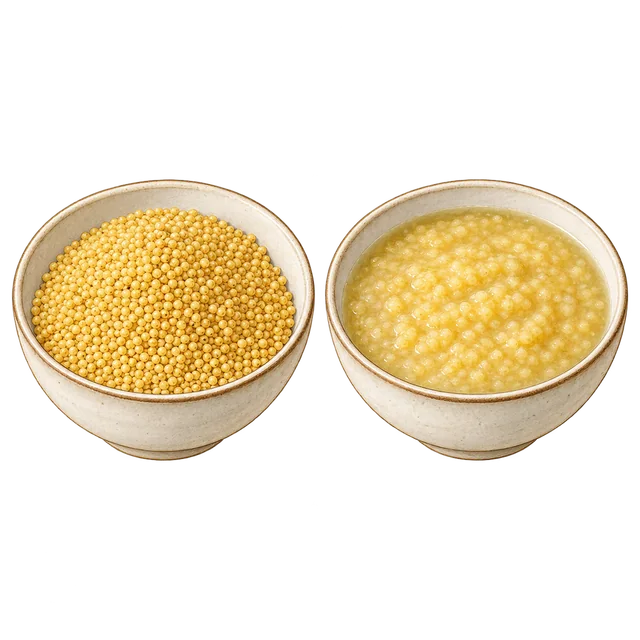
- Firm dry grain
- The grain is firm before cooking. Water and heat change the structure of its starch.
- Hydrated porridge
- Starch absorbs water, swells and loses its tight structure: the gelatinization described in the article.
Illustration for understanding; not to scale. Saved figures include explanations and sources.
Mechanism · gelatinization: one event, two consequences
Raw grain is hard to chew and hard to digest; cooked into congee it is soft and easy to absorb. The step in between is worth seeing clearly — once you see it, a pile of questions about congee you can answer yourself.Raw starch is locked little balls
Starch in the grain is not loose. It is packed into dense granules. Inside a granule, starch molecules line up in layers, and a substantial share of the regions is crystalline — packed so tight that water cannot squeeze in, and digestive enzymes cannot get near. So to the body, raw starch is basically inert material.
Add water and heat, and the lock is forced open
On heating, water first seeps into the loosely packed regions; as temperature keeps rising, water pushes into the crystalline zones and pries open, one by one, the hydrogen bonds that held the crystals. The granule then takes up a lot of water, swells far past its original volume, and finally bursts, and the starch molecules inside spread out into the water.
Congee turning thick, sticky, and starting to coat the spoon — that texture is these escaped molecules. In other words, when you see the congee thicken, you are seeing gelatinization finish.
One cause, two consequences
Molecules spread out, so digestive enzymes can plaster themselves over a large area, so breakdown is fast, so the gut's load is light, and it is easy to digestBreakdown is fast, so glucose floods into the blood fast, so the glycemic rise is fast
So easy digestion and a fast glycemic rise are not two independent conclusions. They are two ways of saying the same sentence. Any move that makes congee easier to digest also makes it raise blood sugar faster — that conversion cannot be walked around.
The following then follow on their own
Simmer it longer and softer: both directions get pushed fartherBlend it into a paste, smash it in a high-speed blender: granules are taken apart mechanically, same direction as simmering longerAdd beans, add vegetables, pair an egg: fiber and protein slow gastric emptying, and the same bowl's blood-glucose curve flattens a little. This is the most practical way to keep congee on the table without it hitting so hardAfter congee cools: some of the spread-out molecules pull back together and line up into tight structure again (retrogradation). That part becomes hard to break down, so cooled congee raises blood sugar a little more slowly than hot congee just out of the pot, and the texture firms up. The size of the shift is limited; do not eat cold congee just for thisReheating: some retrogradation is reversed, but it does not go all the way back to the just-cooked state
One reminder
Everything above tunes how steep or gentle the curve is. It does not turn congee into a low-glycemic food. For people who need to manage blood sugar strictly, the staple you choose in the first place matters more than congee-cooking technique.
Myth · Four meanings of 'nourishing the stomach'
'Nourish the stomach' is one of the vaguest phrases in Chinese. It is usually saying four things of completely different strength at once, and those four are not equally true:Comfortable to eat, not heavy on the stomachNot irritating, does not worsen symptomsRepairs the gastric mucosaCures gastritis and gastric ulcers
The first two stand. The reason is plain: warm, watery, starch already gelatinized, so the stomach does not have to spend effort grinding mechanically, emptying is faster, and that stuffed, pressing feeling is naturally less. This is the direct result of being easy to digest, and the gelatinization section already showed where that comes from.
The last two do not stand. To see why, you first have to know how the stomach wall protects itself.
The defense the stomach wall already carries
Gastric juice is acidic enough to corrode tissue, and the stomach itself is not digested because of a barrier sitting against the inner wall: surface cells keep secreting mucus, laying down a sticky gel; the mucus also secretes alkaline material that neutralizes acid seeping in. So the thin layer right against the cells stays near-neutral, while a short distance away it is strong acid.
Epithelial cells under this film turn over extremely fast; local damage is quickly patched by new cells.
So what does repair actually rest on
On this secretion-and-renewal system keeping running, and on taking away the factors that keep damaging it. Congee takes no part in secreting mucus, and no part in epithelial renewal — it is only an easy-to-digest food that lets the stomach do a little less work for a while. Doing less work and being repaired are two different things.
So the correct reading of 'nourish the stomach' is that this meal is easy to digest, not that this meal is repairing the stomach.
A reminder in the other direction
Living on congee for a long time has a cost: chewing drops, protein and fiber get diluted, and the same stomach volume holds less energy and fewer nutrients, so appetite and stamina can get worse the more you 'nourish'. Congee fits as a transition, not as a long-term staple strategy.
There is also a common clash of advice: people who need to manage blood sugar are often told to drink some congee to nourish the stomach, and that is precisely one of the fastest-rising staple forms. When the two pieces of advice collide, put glucose control first, then pair the congee with beans, vegetables, or an egg so the curve is a little flatter.
Chapter 4
How to pair it with beans
The fix is simple, and Chinese cooking has done it for a long time: eat grains and legumes together. Legumes (mung beans, black beans, lentils) are rich in lysine and fill exactly the gap in grains, while grains supply the sulfur-containing amino acids that legumes run low on — together, the amino-acid makeup of the protein comes close to a complete protein. A handful of mung or adzuki beans in millet congee, or beans with rice, all work on this principle (the mechanism is in the Protein story).
So millet is a good whole-grain staple, and rotating it in is worth more than believing in a single stomach-nourishing effect; to make its protein more complete, add some beans.
Mechanism · Why one missing amino acid stalls it all
Pairing grains with legumes is an old piece of kitchen wisdom, but the mechanism under it is hard. Once it is clear, you will see it covers more than dressing a bowl of congee.Building protein follows a sequence table; you cannot skip a step
When the body builds a protein chain, the ribosome follows a sequence table and joins amino acids on one by one. When the next slot calls for lysine and there is no lysine on hand, the chain stops there — it cannot skip ahead, and it cannot put another amino acid in its place.
That is what essential means among the essential amino acids: the body cannot make them, so they have to come from food; if they are not there, there is no fallback.
So yield is decided by the shortest one
How much of a food protein the body can finally use is not about the total. It is about the essential amino acid it is shortest on — that one is called the limiting amino acid. Any surplus of the others can only be taken apart and burned as energy, or turned into something else.
A metaphor that teaches only one thing: like assembling a machine from a drawing. Missing one screw of a specific size stops the line; a mountain of other parts will not get the job started.
Grains and legumes are short in different places
Grains (millet, rice, wheat): the limiting amino acid is usually lysineLegumes (mung beans, adzuki beans, lentils, soybeans): lysine is plentiful, but the sulfur branch (the methionine family) runs low
The holes do not overlap. Eat them together and each one's short board is filled by the other — that is the whole of grain-legume complementarity. A handful of mung beans in millet congee, beans with rice, sesame flatbread stuffed with tofu: all the same fact.
It also solves another thing along the way
Legumes bring more than lysine: they also bring fiber, potassium, and a slower digestion speed. So adding beans to millet congee, besides completing the protein, also flattens the blood-sugar curve of millet congee a little — one move, two gains.
An outdated claim needs correcting
The early popular version said you had to pair them precisely in the same meal, so some people made eating very complicated. The consensus now is much looser: the body keeps a short-term pool of free amino acids, and protein from different sources arriving over the course of a day is enough. So grain-plus-legume is everyday dietary-structure advice, not homework to calculate meal by meal.
For people who eat mainly plant foods, this is more worth remembering: the problem is not that plant protein is incomplete. It is that a single plant source is incomplete. Rotate the kinds, and it largely solves itself.
References · 3
- U.S. Department of Agriculture, Agricultural Research Service. (2019). FoodData Central: Millet (foxtail/proso, raw and cooked). A gluten-free whole grain supplying magnesium, non-heme iron, and fiber. fdc.nal.usda.gov
- National Institutes of Health, Office of Dietary Supplements. (2022). Magnesium — Fact Sheet for Health Professionals. ods.od.nih.gov/factsheets/Magnesium-HealthProfessional
- National Institutes of Health, Office of Dietary Supplements. (2024). Iron — Fact Sheet for Health Professionals. Fact sheet (updated September 4, 2025; Wayback snapshot 21 September 2026): RDAs 8 mg/day for men and for women 51+, 18 mg women 19-50, 27 mg pregnancy; UL 45 mg/day from age 14; bioavailability about 14%-18% from mixed diets with meat, seafood and vitamin C and 5%-12% from vegetarian diets; serum ferritin below 30 mcg/L suggests iron deficiency and below 10 mcg/L IDA, but inflammation can raise ferritin; supplemental iron of 45 mg/day or more may cause nausea and constipation; people with hereditary hemochromatosis are at risk of iron overload (fact sheet). Heme vs nonheme: heme iron (lean meat and seafood are the richest sources) has higher bioavailability than nonheme iron, and other dietary components affect it less; calcium might reduce the bioavailability of both forms; heme iron is about 10%-15% of total iron intake in western populations. The sheet gives no separate heme and nonheme absorption percentages (fact sheet, Wayback 2026 snapshot). ods.od.nih.gov/factsheets/Iron-HealthProfessional