The most useful thing to know about chickpeas is that their starch is locked inside cell walls. It digests slowly, blood sugar rises gently after a meal, and part of it reaches the colon intact to feed gut bacteria. The later chapter on why chickpeas raise blood sugar slowly takes that packaging apart.
The beige dip you may have had in a Middle Eastern restaurant (hummus), the golden fried balls (falafel), and the round beans in an Indian curry are all chickpeas.
A single chickpea is a staple, a protein source and a fiber source at once. It also brings folate, iron, magnesium and potassium, and its fat is low and mostly unsaturated.
A CLOSER LOOK
The small point behind the name
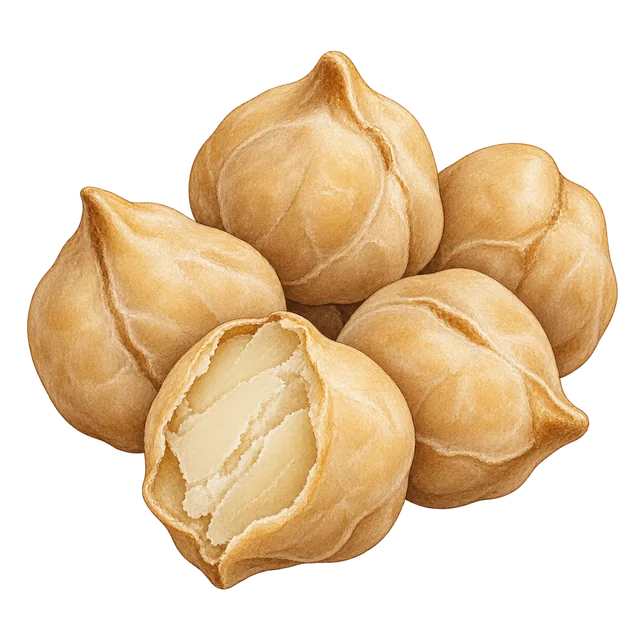
This large-scale cut identifies the chickpea and its interior. It cannot directly show the microscopic cell walls that enclose starch.
1Pointed tip
The small tip resembles a beak, a useful cue for recognizing the seed.
2Floury interior
A chickpea supplies starch, plant protein and fiber together, rather than serving only as a protein substitute.
Illustration for understanding; not to scale. Saved figures include explanations and sources.
Background · The bean named for a beak
The chickpea is a legume, and each seed has a small point at one end shaped like a beak, which is where its Chinese name comes from (scientific name Cicer arietinum; also called the garbanzo bean). It has been a staple in the Middle East, the Mediterranean and South Asia for thousands of years.
Bite into a cooked chickpea and the inside is floury, not soft enough to melt on the tongue like rice. That texture is itself a clue: the starch has not come apart. It is still wrapped in cell walls and protein, so it digests slowly.
Chickpeas are showing up more and more around the world, partly because plant protein is popular and partly because they are cheap, keep well and cook many ways. Whether their protein is good enough, why they are kind to blood sugar, and what to watch with hummus and canned chickpeas each get a chapter later in this story.
Chapter 2
Its protein is complete only with grains
Chickpeas are high in protein, but on their own they are not a complete protein — one that has all nine essential amino acids in proportions close to what the body needs. They are rich in lysine but low in the sulfur-containing amino acids, methionine and cysteine.
Grains such as rice and wheat are the reverse: short on lysine, with enough of the sulfur amino acids. So chickpeas with rice or flatbread fill each other's gaps.
You do not have to match them at every meal. Eating both legumes and grains over the day is enough. If you eat little or no meat, you do not need to worry that chickpea protein is "not good enough" — just eat it alongside grains.
Numbers · How much protein, and what it lacks
By amount, chickpeas really do stand out: protein is about 17-22% of the dry seed (higher once the hull is removed), and carbohydrate plus protein together make up about 80%, which is unusual for a staple food.
But protein quality is not about the total. It is about whether the essential amino acids are all there. The one in shortest supply is called the limiting amino acid, and it sets how much of that protein the body can use. For chickpeas the limiting ones are the two sulfur-containing amino acids (methionine and cysteine); for grains it is lysine.
Everyday Middle Eastern and Indian cooking already pairs them this way: hummus with flatbread, curry with rice, falafel wrapped in bread. Each side covers the other's limiting amino acid, and the meal's protein comes close to complete.
Chapter 3
Slow to raise sugar, feeds gut bacteria
Chickpeas raise blood sugar slowly because their starch is locked in. Even after cooking, the starch granules are still wrapped in cell walls and protein, so digestive enzymes have to squeeze through that packaging to reach them. Soluble fiber also makes the gut contents thicker and slower. Glucose therefore enters the blood gradually, and the after-meal peak is flattened. That is what it means when chickpeas are classed as a low glycemic index () food.
Some of the starch is out of reach of small-intestine enzymes altogether; this is called resistant starch, and there is more of it after cooking and cooling. It travels to the colon intact, where gut bacteria ferment it into short-chain fatty acids such as butyrate, a fuel for the cells lining the colon (see Gut microbiome).
In practice · Swapping it in for white rice
Resistant starch is not the only thing that reaches the colon. Chickpeas also contain oligosaccharides (short sugar chains) that gut bacteria ferment. Besides fueling colon cells, the butyrate they make helps maintain the gut lining. The same fermentation also makes gas, so people with a sensitive gut may bloat if they eat a lot; the later chapter on who should take care covers this.
Add the fullness that comes from their protein and fiber, and chickpeas are one of the few staple-type foods that keep you full and steady your blood sugar.
At the table:
Swapping part of your white rice or white flour for chickpeas is usually an upgrade, not a sacrificeCooking them and eating them cool (in a cold dish or salad) gives a little more resistant starchWhole chickpeas, stewed, keep that packaging better than a smooth purée
Chapter 4
Hummus, whole and canned compared
It is the same chickpea, but the form changes the nutrition math. Whole chickpeas, boiled or stewed, are the base: the most fiber and fullness, and the cheapest.
Hummus is fine in itself. The thing to watch is that it is easy to overeat: it usually has tahini and olive oil added, which raises its calorie density a lot, and how much you eat depends on what you dip into it.
Canned chickpeas are convenient. The thing to watch is sodium, and a rinse with water before you eat them is all it takes.
In practice · What to watch in each form
Whole chickpeas (boiled or stewed): the most complete nutrition, the most fiber and fullness, the best value.Hummus: tahini (sesame paste) and olive oil clearly raise its calorie density. It is not unhealthy, just easy to eat too much of: dipping carrot sticks is a completely different thing from scooping it up spoonful after spoonful with chips.Canned chickpeas: they keep their nutrients well, but sodium is often high. Rinsing them with water removes a good share of the sodium, and some of the gas-causing oligosaccharides along with it. Whole chickpeas are the base; with hummus, it depends on what you dip and how much you eat; canned ones should get a rinse.
Chapter 5
Who should take care
For almost everyone, chickpeas are a dependable source of plant protein and fiber. Three things deserve extra attention:
People with a sensitive gut or irritable bowel syndrome () can get gassy if they eat a lotDuring an acute gout flare, be more cautiousAlways cook the beans through; do not eat undercooked beans Beyond that, using chickpeas as an everyday food that replaces part of your refined staples and adds plant protein is a very solid choice. This page is general education, not a substitute for individual nutrition advice.
Safety · Gas, gout and raw beans
Sensitive gut / : chickpeas are a high- food. FODMAPs are short-chain carbohydrates that the small intestine absorbs poorly and that bacteria ferment in the colon, making gas. In chickpeas they are mainly oligosaccharides such as raffinose, which cause gas and bloating in sensitive people. Start with small amounts, cook them thoroughly, rinse canned ones, and let your gut adapt gradually (see Irritable Bowel Syndrome).Gout / high uric acid: legumes have a moderate purine content. In large observational studies, purines from plant foods were not clearly linked with gout risk, so moderate amounts are usually fine; be more cautious during an acute flare.Anti-nutrients in raw beans: lectins are proteins, and thorough cooking destroys them; phytate is more heat-stable, so soaking and cooking remove only part of it. Soaking and cooking through is a safety step and a nutrition step.
References · 3
U.S. Department of Agriculture, Agricultural Research Service. (2024). FoodData Central: Chickpeas (garbanzo beans, Bengal gram), mature seeds, cooked. USDA. ~15-22% protein, high fiber, folate, iron, magnesium, potassium. fdc.nal.usda.gov
Jukanti, A. K., Gaur, P. M., Gowda, C. L. L., & Chibbar, R. N. (2012). Nutritional quality and health benefits of chickpea (Cicer arietinum L.): a review. British Journal of Nutrition, 108(S1), S11-S26. Protein is 17-22% of dry seed mass before dehulling (25.3-28.9% after); carbohydrate plus protein together ~80% of dry seed mass. Rich in lysine, limiting in sulphur amino acids — complementary to cereal grains. Describes chickpea as a low-GI food; does not report PDCAAS or a GI of 28. 10.1017/S0007114512000797
Halmos, E. P., Power, V. A., Shepherd, S. J., Gibson, P. R., & Muir, J. G. (2014). A diet low in FODMAPs reduces symptoms of irritable bowel syndrome. Gastroenterology, 146(1), 67-75. Randomized controlled cross-over trial; a low-FODMAP diet significantly reduced overall IBS symptoms versus a typical Australian diet. Onion and garlic are among the highest-fructan (FODMAP) foods. 10.1053/j.gastro.2013.09.046