Story
Buckwheat
Last updated
In one pass The most important thing about buckwheat is where it comes from.
Educational content, not medical advice — consult a clinician.
Story path
Chapter 1
Buckwheat is not really wheat
Despite the name, buckwheat is not wheat, and not even a cereal grain. It belongs to the knotweed family, related to sorrel and rhubarb, and what we eat is its fruit (an achene), which is why it is called a pseudocereal, alongside quinoa and amaranth. In China it shows up mostly as buckwheat noodles in the north and southwest (cold buckwheat noodles, pressed hele noodles) and as buckwheat groats and porridge.
Because it has no gluten, it is a common staple on Gluten-Free diets. For people with celiac disease, though, that holds only if no wheat flour was blended in and no wheat was picked up during processing (and Gluten-Free does not mean healthier; see Gluten-Free).
A few people are allergic to buckwheat, and the reaction can be severe. If your lips or throat swell, you have trouble breathing, or you feel dizzy and cannot stay standing after eating it, call emergency services right away.
A CLOSER LOOK
Triangular fruit with wheat in its name
Buckwheat is a Polygonaceae plant eaten as an achene, making it a pseudocereal. Its appearance cannot certify that a product is free of added wheat or cross-contact.
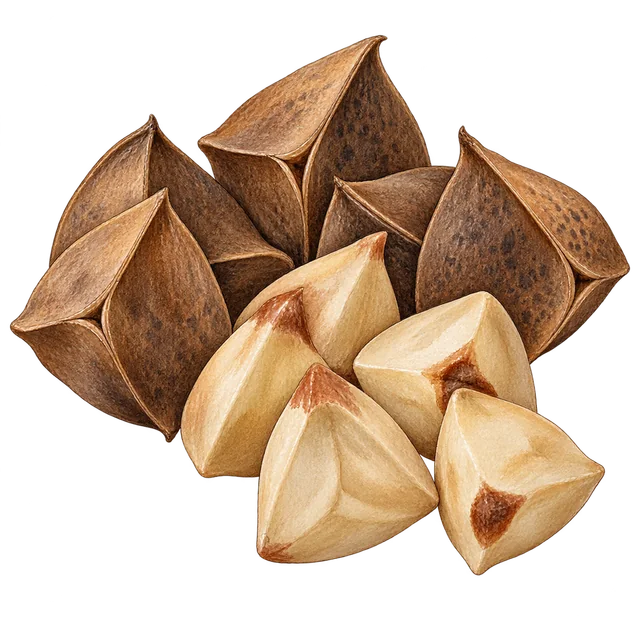
- Triangular hull
- The shape helps identify this fruit, which differs from rice and wheat grains.
- Hulled groat
- Hulled groats can serve as a staple. Buckwheat noodles may also contain wheat flour, so check their ingredients.
Illustration for understanding; not to scale. Saved figures include explanations and sources.
Mechanism · not a grass, so it has none of gluten's parts
Buckwheat is much further from wheat than wheat is from rice. Wheat, rice, maize, and oats all belong to the grass family, one family by descent; buckwheat belongs to the knotweed family, next to sorrel and rhubarb.The first consequence of that distance is gluten. Gluten is not a general property of grains as a loose category. It is the seed storage protein of the wheat branch of the grass family: prolamins and glutelins. Buckwheat is not in that family, so its seed has no blueprint for making those proteins at all. Buckwheat is Gluten-Free not because of processing but because of its lineage: it needs no removal step and no special variety. It is simply born that way.
The second consequence is structural. A grass grain is a caryopsis, where the fruit wall and the seed coat grow together and cannot be peeled apart. What you eat of buckwheat is an achene: a hard, three-sided hull on the outside and the kernel inside, and the two come apart. So buckwheat groats are the whole kernel left after hulling, and buckwheat flour is that kernel ground. On the shelf you can buy whole-kernel buckwheat, not only flour.
Keep these two points in mind and the later chapters read much more easily: being Gluten-Free and relatively high in lysine both follow directly from this lineage, and the high fiber and gentler blood-sugar rise also have to do with eating the whole seed.
Chapter 2
Grain-like carbs, better protein
At 13 g per 100 g, its protein is close to quinoa's and wheat's and higher than rice's (about 7-8 g). The rarer strength is lysine: grains are generally short on this essential amino acid (which is why rice and wheat are traditionally eaten with beans), yet buckwheat's lysine is unusually high for a grain.
Fiber, at about 10 g per 100 g, is in the top tier among grains; the same weight of white rice has only 1-2 g. That is one reason buckwheat raises blood sugar more gently than white rice, which the chapter on blood sugar covers in detail.
Once cooked into groats or noodles it takes up water, so the numbers have to be converted to cooked weight. Buckwheat noodle flour is often blended with wheat flour (pure buckwheat is hard to shape), so check the ingredient list: once wheat flour is blended in, it is no longer Gluten-Free.
Mechanism · why lysine is not missing in buckwheat
Grains are generally short on lysine. The reason is not the soil and not how they are grown; it is the form in which the seed stores its protein.Most of the protein in a seed is not enzymes doing work. It is inventory stored for later, to be broken down as raw material on the day the seed sprouts. In grass-family seeds such as wheat and maize, prolamins make up a large part of that inventory, and this class of protein is naturally low in lysine. What you eat is that inventory, so the amino-acid ratio you get is basically the ratio the seed stored.
Buckwheat is not a grass, and it stores protein differently: its main storage proteins are not prolamins, so the lysine slot is not pushed down. The result is that among all the things casually called grains, buckwheat's amino-acid profile is surprisingly even.
Why this one slot matters: the body builds protein by joining amino acids one at a time from a blueprint, and wherever one is missing, construction stops at that step. It does not produce a slightly worse protein; that chain simply never gets finished. So the amino acid that runs out first decides how much of the whole protein can actually be used. It is called the limiting amino acid. For people whose staple food is grain, that slot is usually lysine.
So buckwheat's real selling point is not its high protein content (though it is not low), but that its protein's weak spot does not fall on the usual slot.
Chapter 3
Gentle on blood sugar, if eaten right
Buckwheat's glycemic index () is lower than that of white rice and white wheat; whole groats land roughly in the middle, depending on the form. The reasons are its high fiber and protein and a starch structure that differs from white rice's. But GI is not the whole story:
Whole or coarsely ground groats: the gentlest riseBuckwheat noodles: depend on the flour mix (pure buckwheat or blended with wheat) and on how they are cookedWhat goes with the noodles: cold noodles come with a dipping sauce, hot noodles with broth; a bowl of noodles on its own versus noodles with vegetables and an egg can give very different blood-sugar results after the meal
For the framework behind GI and glycemic load (), see Glycemic Index & Glycemic Load. Its conclusion applies here too: look at the whole meal, not a single food.
For people whose blood sugar runs high, buckwheat is one of the staples that beat white rice. But the claim that buckwheat is a blood-sugar-lowering food needs taking apart: it raises blood sugar more gently; it is not a glucose-lowering drug (see Bitter Melon for how the natural-glucose-lowering pitch is taken apart; the structure is the same).
Mechanism · the moment starch is cooked open
Raw starch is packed tight: long chains fold segment by segment into tiny crystalline zones, like a tightly wound ball of yarn. Digestive enzymes bite from the surface. Facing a tight ball, they can only nibble the outer ring, and efficiency is low.Once it hits the pot, water and heat arrive together. The starch granule takes up water and swells, the crystalline zones are forced open, the yarn ball comes apart — this step is gelatinization. After it opens, the chains that were hidden inside are fully exposed, and the number of sites enzymes can work at once multiplies. So the act of cooking itself raises the speed of the glycemic rise, and overcooking keeps adding: the longer and softer it cooks, the more complete the gelatinization, the easier the enzymes' job.
That is why the kitchen advice pull it when the center just loses its white core is actually a metabolic suggestion. That bit of not-fully-gelatinized core in the middle of a noodle really does slow the breakdown of some of the starch.
Cooling is a step in the opposite direction. After the noodles cool, some of the opened starch chains rearrange back into ordered structure. That is retrogradation. The part that lined back up is again hard for enzymes to take apart, so it skips the small intestine and travels to the large intestine — in behavior it is closer to fiber, and becomes feed for gut bacteria. This class of starch has a name: resistant starch.
So cold buckwheat noodles and hot buckwheat noodles just out of the pot are not quite the same thing in the body: the bowl that went through cold water and was eaten after cooling has already changed the identity of some of its starch. The difference is not large enough to count as a treatment, but the direction is real.
Put gelatinization and retrogradation together and you have a general ruler: the same staple, the finer you grind it, the softer you cook it, the more you eat it straight from the pot, the faster sugar enters the blood; keep the shape, cook it just enough, let it cool once, and entry into the blood is slower. This ruler works the same on rice, noodles, and potatoes.
Chapter 4
Rich in what · rutin, magnesium, copper
Rutin: a flavonoid, and buckwheat is one of the few foods high in it. In cell and animal studies, rutin shows antioxidant and blood-vessel-related activity, but human evidence is limited: take it as a fact that buckwheat carries a distinctive compound, not as a conclusion that buckwheat treats vascular diseaseMagnesium: about 230 mg per 100 g, near the top among grains; magnesium takes part in hundreds of enzyme reactions (see magnesium for the mechanism)Copper: also plentiful; 100 g of dry buckwheat already holds more copper than an adult's recommended amount for a dayB vitamins: niacin (B3) and others; the niacin on a label is not always fully available to you, and corn is the example (see corn)
Buckwheat is often packaged as a health grain that lowers blood sugar, blood pressure, and blood lipids, but most of those claims come from observational studies and extrapolation from its ingredients; there is no human evidence that eating buckwheat treats disease. Its real value is better protein, fiber, and magnesium, which makes it a good swap for part of your staple food. That is good enough; it does not need to be turned into a miracle.
To compare grains, see Oats and quinoa.
Mechanism · what magnesium is actually doing
Takes part in hundreds of enzyme reactions sounds like filler, but for magnesium it is true, and the reason is specific.Every job in the cell that costs something (contraction, transport, building, repair) is paid for in the same currency: . The key point is that enzymes usually do not recognize bare ATP. They recognize ATP holding on to a magnesium ion. Magnesium works like a clip here: it neutralizes part of the negative charge on ATP and sets the molecule in a position the enzyme can recognize and act on.
So magnesium is not the raw material of one pathway. It is a precondition for every reaction that spends ATP. That also explains why the symptoms of a real magnesium deficiency are so scattered: early on come vague complaints such as poor appetite, nausea, and fatigue, and only when the deficiency gets worse do numbness, cramps, and an irregular heartbeat appear. The reverse reasoning does not hold: healthy people rarely become deficient enough to have symptoms just from eating too little, and everyday cramps and tiredness cannot be read as a sign of low magnesium.
Buckwheat really does deliver on this one, and the reason is the same as before: you eat the whole kernel. Refined wheat flour sifts out the magnesium-rich bran and germ, while buckwheat groats are the kernel itself, so they never take that loss.
For the full mechanism of magnesium, see magnesium.
Evidence · Rutin: a real compound, an unproven benefit
Rutin is a flavonoid, one of a large and common class of plant polyphenols. Plants make it mainly for their own use: to block ultraviolet light, to handle oxidative stress, and to color flowers and seed coats. Buckwheat stands out here; its leaves, flowers, and outer layers all hold a fair amount of rutin. Buckwheat honey, dark and strong-tasting, is one side of this chemistry.Antioxidant, said of flavonoids, has a precise chemical meaning: these molecules carry several hydroxyl groups whose hydrogens are relatively easy to take. When one meets a free radical that is grabbing electrons, it gives up its own hydrogen first and becomes a fairly stable form that causes no further trouble, like sending in a mild player to replace an aggressive one.
Up to this point it is chemistry, and it is settled. But getting from chemistry to eating buckwheat is good for your blood vessels still takes several steps, and those steps have no human evidence to cite:
How much rutin a serving of buckwheat noodles actually containsHow much is left after cooking (water-soluble compounds run into the broth)How much of what you eat really gets into the blood, and in what form it circulatesHow much you would have to eat to reach the concentrations used in experimentsWhether there are results on outcomes in people, not just a small shift in some marker
So here is what can be said about rutin: buckwheat contains a compound that other grains rarely have, and that is a fact; therefore buckwheat protects your blood vessels is an inference that has not been completed. The distance between those two sentences is exactly the stretch that food-health pitches love to jump in a single step.
Mechanism · niacin: why corn's does not count
Niacin (also called vitamin B3) is not especially plentiful in buckwheat, but it opens up a principle worth understanding: being in the food and being available to you are two different things.Corn does contain niacin. The problem is that most of it is in a bound form: the niacin molecule is attached to other molecules, and the human gut cannot cut that link. If it cannot be cut, it cannot be absorbed, so it leaves with the food residue. The traditional practice of soaking and cooking corn in alkaline water frees it: that step is not only about texture; it turns a nutrient you cannot use into one you can.
So when you read a nutrition label, how much is only the first question. The second is always in what form. Iron comes as heme and non-heme iron, folate as natural food folate and synthetic folic acid, niacin as free and bound forms: the form decides whether your body can actually take it up. The niacin on a buckwheat label is no different; the number tells you the content, not necessarily how much of it you get.
For the full corn story, see corn.
Chapter 5
What it lacks · how to pair
A few practical pairings:
With legumes: buckwheat is not short on lysine to begin with, so pairing it with beans is not about filling that gap; it gives the meal more protein and fiber (for how rice and wheat complement beans, see lentils)With eggs or meat: adds complete animal protein and B12 and rounds out the mealWith leafy greens: adds calcium and vitamin C
One trap: many store-bought buckwheat noodles are blended with wheat flour (pure buckwheat is hard to shape). If you need Gluten-Free, look for 100% buckwheat; if you are managing blood sugar, blended buckwheat noodles are not much different from ordinary noodles.
One more thing to take seriously: buckwheat allergy is real, and it is reported more often in East Asia (Japan, Korea, China), where buckwheat is eaten a lot. Reactions range from a rash to a severe whole-body allergic reaction. If your lips or throat swell, you have trouble breathing, or you feel dizzy and cannot stay standing after eating it, call emergency services right away. People with a known allergy should avoid it completely.
For how to balance the whole plate, see Fruit & vegetables.
Safety · Allergy and intolerance are not the same thing
Buckwheat allergy deserves a few words of its own, because it is in a different league from the other ate it and felt bad situations in this story.Intolerance is a digestive matter: you lack an enzyme, or some carbohydrate travels all the way to the large intestine and gets fermented by bacteria into gas. The result is bloating, rumbling, and trips to the toilet. It is unpleasant, but the body has not treated the food as an enemy, and a smaller amount is usually fine.
Allergy is an immune matter: the immune system has opened a file on this food protein and decided it is an invader. From then on, every encounter, even with a very small amount, can set off the full reaction, and it can come on fast, from a rash and tingling lips to a tightening airway. In severe cases it can be life-threatening.
That is the practical difference: with an intolerance you can try eating a little less; with an allergy you cannot. Immune memory gives no discount because you only had one bite. So the thought I only had a little, it should be fine makes sense for an intolerance and not for an allergy.
As for why buckwheat allergy is reported more often in East Asia, one common explanation is that buckwheat is eaten most there, so it is also most likely to be recognized, rather than that some population is naturally more prone to it. Anyone with a known buckwheat allergy should avoid it completely. If your lips or throat swell, you have trouble breathing, or you feel dizzy and cannot stay standing after eating it, call emergency services right away. How to avoid it day to day, and whether to carry emergency medicine, is something to decide with your doctor.
Chapter 6
Why it is naturally gluten-free
That identity brings two things. First, it is naturally free of gluten: not because gluten was removed, but because its seed never had the blueprint for those proteins. Second, its nutrition profile does not look much like a grain's (more lysine, plenty of fiber), which also has to do with that different lineage.
For people with celiac disease, the first point is not about taste; it is about whether treatment can be kept up. It holds on one condition: this bag of buckwheat has not picked up wheat anywhere along the way. Buckwheat itself has no gluten; the trouble is wheat flour blended in, and cross-contamination picked up during processing. Buckwheat noodles blended with wheat flour, and products made on lines shared with wheat, do not count.
Clinical · Can people with celiac disease eat it
For people with celiac disease and others who need to avoid gluten, buckwheat can be a safe staple, provided it has not been contaminated with wheat.What gluten is, and which staples contain it
Gluten is a group of storage proteins in wheat, barley, and rye (prolamins and glutelins, gliadin and glutenin). Buckwheat, quinoa, rice, and corn do not contain it.
Why this is a safety question
Celiac disease is an immune-mediated disease, and a strict Gluten-Free diet is currently the only established treatment. As long as gluten keeps coming in, the immune attack continues, and so does the damage to the lining of the small intestine. So for someone with celiac disease, whether a food is Gluten-Free is not a matter of preference; it is the treatment itself.
What to do when you buy it
When you switch to buckwheat, choose products clearly labeled gluten-free or 100% buckwheat. Believing something is Gluten-Free when it actually contains wheat is more dangerous than knowing it contains gluten. That is the core warning of the Gluten-Free story, applied to buckwheat.
One honest boundary
The Gluten-Free property is real, and so is the rutin in buckwheat; but marketing that says buckwheat lowers blood sugar, blood pressure, and blood lipids is extrapolation from its ingredients with no clinical conclusion behind it. The chapter on whether buckwheat lowers those three covers this in detail.
Mechanism · Celiac disease: why traces matter
Celiac disease is often compressed into the words immune-mediated disease and moved past, but what sits inside those words is exactly why even a little contamination is not acceptable. Walk through it in four steps.Step one: it does not get cut up cleanly. Gliadin, a gluten protein, is unusually dense in proline and glutamine, and human digestive enzymes cannot cut the kind of bond next to proline. Other food proteins get cut into very short fragments and absorbed; this one leaves behind a batch of peptides that are still fairly long.
Step two: it goes through the wrong door. These long peptides get into the tissue beneath the gut lining, a place food is not supposed to reach. There, an enzyme called tissue transglutaminase (tTG) chemically modifies them, and after that change they stand out sharply to the immune system.
Step three: the enemy is misidentified. In people who carry certain immune-recognition genes, the immune system treats this peptide as an invader and targets the enzyme itself as well. The trouble is that the peptide is not alive; it cannot be killed or driven away. What actually takes the beating is the place where it sits, the person's own small-intestinal lining.
Step four: the carpet is worn flat. The inner wall of the small intestine is covered with villi, a carpet that stretches the absorbing surface to a very large area. Repeated immune attacks flatten the villi bit by bit, the surface area collapses, and absorption collapses with it.
Only after these four steps do two things really make sense.
Why even a little wheat flour is not acceptable: a strict Gluten-Free diet is the only established treatment for celiac disease. As long as gluten is present, the immune attack goes on. The villi take time to grow back, and small, repeated amounts of gluten can keep the gut stuck in a state of starting to repair and being interrupted. So a little wheat flour blended in is not a near miss here; it is a no.
Why it often shows up first as anemia: iron and folate are absorbed mainly in the first stretch of the small intestine, which is exactly where the villi are most often flattened. So many people are first found to have iron-deficiency anemia and only reach celiac disease by tracing the cause, and their belly may not hurt at all. The intuition that no belly pain means no celiac disease is not reliable.
This page covers mechanism only and does not replace a diagnosis. If you suspect celiac disease, see a doctor before deciding whether to change your diet: the relevant tests are easiest to read while you are still eating gluten, and cutting it out on your own first can leave the results unclear.
Chapter 7
Choosing, cooking and how much to eat
Buying: read the ingredient list to see whether it is 100% buckwheat or blended with wheat flour (blended is not Gluten-Free, and the nutrition is watered down too). If you need Gluten-Free, look for a Gluten-Free label and a statement about preventing cross-contamination.
Cooking:
Groats: cook them like rice (you can mix in some glutinous rice or regular rice to adjust the texture), or make porridgeNoodles: drop them into boiling water and take them out as soon as the center loses its white core; rinse in cold water for cold noodles, or serve straight in brothDo not overcook: the more completely the starch gelatinizes, the faster your blood sugar rises
How much: treat it as a swap for your staple, not a snack; 50-80 g dry weight per meal (about one bowl once cooked) is a typical serving. If you are managing blood sugar, replacing part of your white rice or white flour with it already helps; there is no need to swap everything.
Who can lean on it more: people with celiac disease or gluten sensitivity (pure buckwheat only), and anyone who wants more protein and fiber from their staple food. Who should be careful: people allergic to buckwheat; this allergy is uncommon but real, and it can be severe. For specific medical questions, ask a doctor.
Mechanism · why pure buckwheat is hard to form
Why are store-bought buckwheat noodles so often blended with wheat flour? Because pure buckwheat is hard to shape. That is worth explaining, and it is also the shared difficulty of every Gluten-Free noodle and pasta.Wheat flour can be rolled into strands, pulled into noodles, and rolled out into wrappers because of gluten's net: two classes of protein link up into a continuous network when they meet water, so the dough can stretch and spring back. When dough has strength, that net is what is inside it.
Buckwheat does not have these proteins, so buckwheat flour plus water is just a damp lump of flour with no strength. The noodles break easily once they hit the pot and easily cloud the water. There are three traditional fixes: blend in some wheat flour to borrow its net; use another sticky ingredient to hold the particles together; or rely on technique and water temperature to gelatinize some of the starch first and use it as its own binder.
The first fix is the least fuss and the most common, so wheat-blended buckwheat noodles became the norm. For someone who only cares about texture, that does not matter; for someone who needs Gluten-Free, that step rules it out: buckwheat's freedom from gluten comes from its identity, and blending in flour dilutes that identity away.
So reading the ingredient list for buckwheat is not about picking a slightly better one. It is about confirming it is still the thing it claims to be.
Chapter 8
Can buckwheat lower sugar, fats and BP
Pitch one: buckwheat lowers blood sugar, blood pressure, and blood lipids. This is extrapolation from ingredients: buckwheat has fiber, rutin, and magnesium, all nutrients that are friendly to those markers, but friendly is not the same as treating disease. For rutin and D-chiro-inositol, the compounds most often cited for lowering blood sugar, the evidence comes mostly from animal experiments and small human studies; there is no clinical evidence that eating buckwheat brings people with those conditions to their targets (the Bitter melon and Superfoods stories take the same kind of pitch apart more fully). The right place for buckwheat: a staple that beats white rice, not a health product that stands in for medication.
Pitch two: buckwheat noodles will not make you fat, so eat as much as you like. Pure buckwheat noodles raise blood sugar more gently than ordinary noodles, but they are not low in calories: the calories in a bowl come from the amount of noodles, the sauce, and the oil. The dipping sauce for cold noodles contains sugar, the broth for hot noodles contains salt, and the toppings make up half the meal. Buckwheat equals low calorie swaps a gentler blood-sugar rise for low calories.
One way to judge all pitches like these: separate the compound is there from eating it works. It is true that buckwheat contains rutin, but whether a serving of buckwheat noodles holds anything close to the doses used in studies, and whether there is human evidence, are separate questions.
Evidence · Four gates between compound and benefit
This food contains that compound is usually true as a sentence. The hole in the pitch almost never sits in that sentence; it sits in the jump from there to so eating it works. Take that jump apart and there are at least four gates.The first gate is dose. The natural amount in a food and the dose used in a study are often far apart. Many active compounds are tested after being extracted and concentrated, and eating the whole food often cannot reach that amount.
The second gate is survival. Cooking, stomach acid, and digestive enzymes all change molecules. Water-soluble compounds can end up in the broth and get poured away; heat-sensitive ones can be gone before they leave the pot.
The third gate is absorption. Reaching the gut is not the same as reaching the blood. Many polyphenols are poorly absorbed, and once they get in, the liver quickly converts them into other forms, so the molecule that finally reaches the tissue may no longer be the one you saw on the ingredient list.
The fourth gate is the outcome. Even if the first three gates are passed, did the study look at a marker that moved a little, or at an outcome people actually care about (less illness, fewer hospital stays, a longer life)? The two cannot be treated as automatically equal.
Buckwheat's rutin is stuck among these four gates, so what can be said about it stops at it contains rutin and goes no further.
Remember these four gates and you do not need to understand every compound to judge whether most superfood pitches made it all the way through. One fair point to end on: these gates are not a way to dismiss foods. Whether buckwheat is a good staple and whether rutin can treat disease are two independent questions, and the answer to the first is yes.
References · 3
- U.S. Department of Agriculture, Agricultural Research Service. (2019). FoodData Central: Buckwheat (SR Legacy, FDC ID 170286). Per 100 g dry groats: 343 kcal, 13.2 g protein, 3.4 g fat, 71.5 g carbohydrate, 10.0 g fibre, 231 mg magnesium, 1.1 mg copper, 2.4 mg zinc, 2.2 mg iron. fdc.nal.usda.gov
- National Institutes of Health, Office of Dietary Supplements. (2022). Magnesium — Fact Sheet for Health Professionals. ods.od.nih.gov/factsheets/Magnesium-HealthProfessional
- Lebwohl, B., Sanders, D. S., & Green, P. H. R. (2018). Coeliac disease. The Lancet, 391(10115), 70-81. A strict gluten-free diet is the established treatment for celiac disease; diagnosis requires serology and biopsy. 10.1016/S0140-6736(17)31796-8