Story
Black Beans
Last updated
In one pass A rumbling belly after black beans does not mean you cannot digest them; it means the bacteria in your colon are eating.
Educational content, not medical advice — consult a clinician.
Story path
- 1What are black beans · nutrition from skin to core
- 2How its protein pairs with grains
- 3The gut pathway · how resistant starch feeds microbiota
- 4Anthocyanins, iron and magnesium
- 5What it lacks · how to pair
- 6Why beans cause gas and how to reduce it
- 7Choosing, cooking and how much to eat
- 8Does gas mean your body rejects beans
Chapter 1
What are black beans · nutrition from skin to core
Black beans have three highlights: protein, fiber that feeds gut bacteria, and anthocyanins in the black skin. They belong to the same species as green beans and red kidney beans, and the raw beans contain a plant lectin, so always soak dried beans and cook them until completely soft before eating.
Background · Black beans from skin to core
Black beans (Phaseolus vulgaris) are the black-skinned variety of the common bean, with long culinary traditions in Latin America (Mexico, Brazil, Cuba) and in China. The skin is deep black or purple, and the seed inside is creamy white. That dark skin is not just for looks: it carries a fairly high concentration of anthocyanins.Nutritionally, the three highlights still stand: protein (plant protein that needs grains to complement it), fiber (a good amount, including fermentable fiber that feeds gut bacteria), and the anthocyanin polyphenols in the skin.
Compared with lentils, black beans have slightly more starch and especially more resistant starch; their fiber mix is also a little different, with a larger share of raffinose-family oligosaccharides (RFO). That may be one reason they cause more gas than lentils, and these are also exactly what gut bacteria like to eat.
Chapter 2
How its protein pairs with grains
They do not have to be matched in the same meal: as long as beans and grains both show up during the day, the body's amino-acid pool pulls them together. Black beans with rice at lunch and rice with tofu at dinner work just as well (see Protein & Amino Acids).
Numbers · What 100 g of cooked black beans holds
Cooked black beans contain, per 100 g, about 8.9 g of protein, 23 g of carbohydrate (of which about 8.7 g is dietary fiber), 0.5 g of fat, and 132 kcal.Dried black beans swell to about 2.5 times their weight when cooked, so dry beans hold about 21-22 g of protein per 100 g.
Incomplete does not mean useless; it means one of the nine essential amino acids runs short. Black beans are rich in lysine and low in methionine, while grains are low in lysine and higher in methionine. Put together, all nine essential amino acids are covered. For the biochemistry of complementary proteins, see Protein & Amino Acids.
Chapter 3
The gut pathway · how resistant starch feeds microbiota
Gas is a by-product of this road: the same sugars that make gas are also a favorite food of Bifidobacterium.
Mechanism · How resistant starch becomes butyrate
The first road is resistant starch. Black beans contain plenty of type 1 resistant starch (starch granules shut inside intact cell walls, out of the enzymes' reach) and type 3 (starch that recrystallizes after cooking and cooling). This starch passes through the small intestine largely undigested and reaches the colon as food for bacteria.Gut bacteria ferment it into short-chain fatty acids (), mainly butyrate, propionate, and acetate. Butyrate is the main fuel for the cells lining the colon and matters for keeping the gut's mucosal barrier intact. For the full SCFA mechanism, see Carbs & Fiber.
Mechanism · Who eats the sugars humans cannot split
The second road is fermentable oligosaccharides (RFO). Black beans contain raffinose, stachyose, and related sugars. Humans lack the enzyme that splits them (alpha-galactosidase), so they arrive at the colon intact, where Bifidobacterium and similar bacteria ferment them first. That is why black beans are seen as a natural prebiotic, a food that feeds beneficial bacteria in particular.Both roads lead to the same place: black beans are good food for gut bacteria. Gas is a by-product of this road, not your body rejecting the beans; where the gas comes from and how to reduce it are in the chapter on why beans cause gas.
Chapter 4
Anthocyanins, iron and magnesium
Between the anthocyanins in the black skin and heart and vessel risk, there is only an observed association so far: people who eat a lot of dark-colored plants tend to eat more healthily overall, and this kind of study cannot rule that out.
Evidence · Do anthocyanins protect the heart
The black skin is the main source of anthocyanins, much like blueberries and other dark berries. Anthocyanins are polyphenols that show anti-inflammatory and antioxidant effects in cell and animal studies; in population studies, people who eat more of them often have fewer heart and vessel events.Cassidy 2013 is one of those studies: among young and middle-aged women, those who ate more anthocyanins had a lower risk of heart attack. That is an observational cohort, not a randomized trial. People who eat more berries and dark plants often eat and live more healthily overall; this design cannot rule out that kind of , so it does not show that black beans or anthocyanins lower heart and vessel risk.
Cooking destroys some anthocyanins, and some dissolve into the cooking water, so drinking the broth keeps more of them.
Numbers · Iron, magnesium, and folate
Iron: about 2.1 mg of non-heme iron per 100 g of cooked black beans. Phytate holds it back here too, and a food rich in vitamin C helps it absorb, by the same mechanism as in lentils (see Iron).Magnesium: about 70 mg per 100 g cooked, roughly 17-22% of the adult daily need (320-420 mg). Magnesium takes part in more than 300 enzyme reactions, including making and nerve and muscle signaling (see Magnesium).
Other nutrients: folate about 149 µg per 100 g cooked, potassium about 355 mg, zinc about 1.0 mg, and a good amount of phosphorus.
As a whole food, black beans pack protein, fiber, anthocyanins, magnesium, and iron into one small seed, a very nutrient-dense choice in plant-based eating.
Chapter 5
What it lacks · how to pair
The other gaps can all be covered by pairing: very little fat, almost no vitamin C, and not much methionine. Add grains, add vegetables rich in vitamin C, and add a little good oil.
In practice · What to pair to cover the gaps
Fat is very low (about 0.5 g per 100 g), with almost no omega-3, so good fats need to come from nuts, olive oil, flaxseed, or, for people who eat fish, fatty fish. There is almost no vitamin C, which is exactly why pairing on purpose pays off: a food rich in vitamin C also solves iron absorption. The methionine gap is covered by grains (rice, corn, wheat foods); as the protein chapter explains, pairing within the same day is enough, not necessarily the same meal.Some practical pairings: black beans and rice is protein complementation and a Latin American classic; black bean soup with tomato or bell pepper uses vitamin C to help iron absorb; avocado or olive oil adds unsaturated fat and helps polyphenols absorb.
For the wider ecology of the gut microbiome, see Carbs & Fiber.
Chapter 6
Why beans cause gas and how to reduce it
The same sugars are also a favorite food of Bifidobacterium. To get less gas, the most useful steps are to soak the beans and pour off the soaking water, cook them thoroughly, and start with small portions so your gut bacteria can adjust.
Mechanism · Where the gas comes from
Black beans cause more gas than lentils, a common reason people shy away from beans. The main cause is RFO (raffinose, stachyose, verbascose). The human small intestine lacks alpha-galactosidase to split them, so they arrive at the colon intact. Gas-producing bacteria there (mainly Bacteroides and Clostridium species) ferment these sugars, giving off carbon dioxide, hydrogen, and methane, which is where bean-related gas comes from.One thing worth knowing: RFO also happen to be a favorite food of Bifidobacterium, so they are both a gas source and a prebiotic. As your gut bacteria adapt, gas usually drops while beneficial bacteria increase. The early gas is a sign that the bacteria are at work.
In practice · How to get less gas
Practical ways to get less gas:Soak and change the water: soak for 8-12 hours, pour off the soaking water, and cook in fresh water. RFO dissolve in water, so part of them ends up in the soaking water, and pouring it off removes part of the gas-making materialCook thoroughly: undercooked beans still contain a plant lectin that causes nausea, vomiting, and diarrhea, so always cook them until completely soft; this is a safety matter firstStart small: your gut bacteria need time to adapt. Begin with small portions a few times a week and build up slowly; after a few weeks, most people have noticeably less gasStore-bought digestive aids: products containing alpha-galactosidase, taken before a meal, supply the enzyme the body lacks; they are worth a try, and results vary from person to person
This is general information only and does not replace a doctor's guidance.
Chapter 7
Choosing, cooking and how much to eat
Canned black beans are already cooked and ready after a rinse. When buying dried beans, look for plump, glossy ones.
A CLOSER LOOK
Black common beans still need thorough cooking
These are dry-bean specimens, not cooked beans ready to eat. A cut face or color change cannot prove lectins have been inactivated.
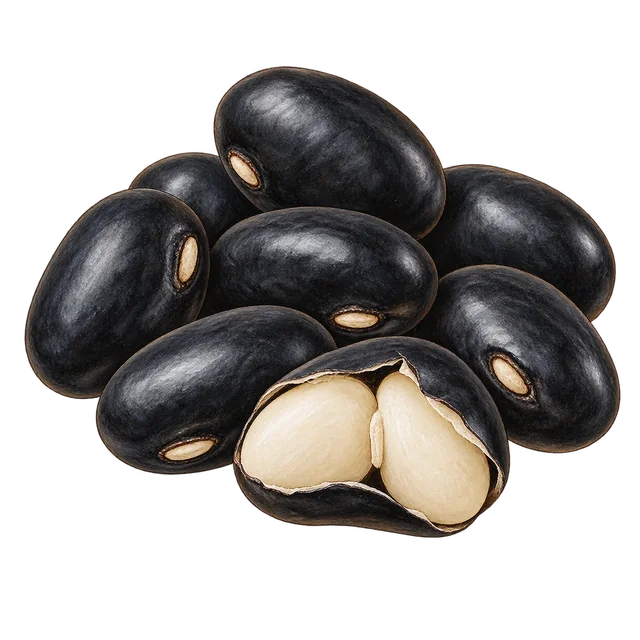
- Black common bean
- This is the black common bean related to green beans and red kidney beans, rather than black soybean.
- Cook thoroughly
- Soak dry beans, discard the soaking water, then cook in fresh water until completely soft. Thorough cooking is essential.
Illustration for understanding; not to scale. Saved figures include explanations and sources.
In practice · Soaking, cooking, and portions
Choosing: dried black beans should be plump, glossy, and not shriveled, and sealed away from light they keep for a year or two. Canned black beans are already cooked and can be used after a rinse.Cooking:
1. Soak 8-12 hours (overnight is easiest), then pour off the soaking water
2. Add fresh water, bring to a boil, then turn down to a medium-low simmer
3. Cook 45-90 minutes, until completely soft (older, harder beans take longer)
4. Add acidic seasonings such as lemon juice only in the last 10 minutes; added early, they keep the beans from softening
A pressure cooker cuts the time a lot (about 20-30 minutes after soaking). If you use a slow cooker, first bring the soaked beans to a full boil on the stove and keep them boiling for a while before switching to slow cooking: the US FDA's handbook on foodborne toxins records outbreaks where slow cooking at too low a temperature failed to destroy the lectin. If you have severe vomiting and diarrhea after eating undercooked beans, or become dehydrated, get medical care promptly.
Cooked beans keep for 5 days in the fridge or 3 months in the freezer without losing quality; cooking a big batch at once saves the most time.
How much: 80-150 g of cooked beans per serving (about half a bowl to one bowl). As a main plant protein, 3-5 times a week is reasonable. People with normal kidney function can rely on beans as an everyday protein source.
High uric acid or gout: beans have a moderate purine content (lower than organ meats and most seafood). During an acute flare, cut back for a while and ask a doctor; between flares, eating them normally is generally fine.
This is general information only and does not replace a doctor's guidance.
Chapter 8
Does gas mean your body rejects beans
For most people this is an adjustment period, not a reason to stop: people who have not eaten beans for a long time have few of the bacteria that specialize in these sugars, so a sudden large helping produces a lot of gas. Some people with irritable bowel syndrome (, a gut disorder with recurring belly pain and changed bowel habits) are a real exception, especially those with the diarrhea-predominant type (IBS-D) and those sensitive to (a group of short-chain carbohydrates that ferment easily in the gut).
Myth · Does gas mean beans are not for you
Beans give me gas, so my body is not suited to them: this reading is very common and quite inaccurate.Gas is not a digestive failure; it is the bacteria in your colon fermenting fiber and oligosaccharides, and gas is a normal by-product of fermentation. For people with a normal gut microbiome, moderate gas is a sign that the bacteria are at work.
Why some people notice it more: if you are eating beans for the first time, or have not eaten them for a long time, the bacteria that specialize in fermenting RFO are relatively few. A sudden large helping floods in material faster than the bacteria can multiply, and gas spikes. This is a transition while the microbiome adapts, not your body rejecting the beans.
Adaptation does happen: people who eat beans regularly produce noticeably less gas than people who eat them suddenly. Start with small portions a few times a week, and after a few weeks the gas usually drops a lot.
Clinical · Who is a real exception
Irritable bowel syndrome (, a gut disorder with recurring belly pain and changed bowel habits) is the exception: for people with diarrhea-predominant IBS (IBS-D) or IBS where bloating dominates, high- foods (short-chain carbohydrates that ferment easily in the gut, including the RFO in beans) can genuinely make symptoms worse. This is a real group of people, not everyone. People with IBS can test how much they tolerate, slowly, while symptoms are calm, and use a low-FODMAP diet when needed.So gas does not mean your body is rejecting beans. For most people it is a passing stage while the microbiome adapts, not a reason to give up beans.
This is general information only and does not replace a doctor's guidance.
References · 8
- U.S. Department of Agriculture, Agricultural Research Service. (2024). FoodData Central: Beans, black, mature seeds, cooked, boiled, without salt (FDC ID 173735). fdc.nal.usda.gov/food-details/173735/nutrients
- Institute of Medicine. (2005). Dietary Reference Intakes for Energy, Carbohydrate, Fiber, Fat, Fatty Acids, Cholesterol, Protein, and Amino Acids. National Academies Press. nap.nationalacademies.org/catalog/10490/dietary-reference-intakes-for-energy-carbohydrate-fiber-fat-fatty-acids-cholesterol-protein-and-amino-acids
- National Institutes of Health, Office of Dietary Supplements. (2024). Iron — Fact Sheet for Health Professionals. Fact sheet (updated September 4, 2025; Wayback snapshot 21 September 2026): RDAs 8 mg/day for men and for women 51+, 18 mg women 19-50, 27 mg pregnancy; UL 45 mg/day from age 14; bioavailability about 14%-18% from mixed diets with meat, seafood and vitamin C and 5%-12% from vegetarian diets; serum ferritin below 30 mcg/L suggests iron deficiency and below 10 mcg/L IDA, but inflammation can raise ferritin; supplemental iron of 45 mg/day or more may cause nausea and constipation; people with hereditary hemochromatosis are at risk of iron overload (fact sheet). Heme vs nonheme: heme iron (lean meat and seafood are the richest sources) has higher bioavailability than nonheme iron, and other dietary components affect it less; calcium might reduce the bioavailability of both forms; heme iron is about 10%-15% of total iron intake in western populations. The sheet gives no separate heme and nonheme absorption percentages (fact sheet, Wayback 2026 snapshot). ods.od.nih.gov/factsheets/Iron-HealthProfessional
- National Institutes of Health, Office of Dietary Supplements. (2022). Magnesium — Fact Sheet for Health Professionals. ods.od.nih.gov/factsheets/Magnesium-HealthProfessional
- Cassidy, A., Mukamal, K. J., Liu, L., Franz, M., Eliassen, A. H., & Rimm, E. B. (2013). High anthocyanin intake is associated with a reduced risk of myocardial infarction in young and middle-aged women. Circulation, 127(2), 188-196. Observational; ~93,600 women over 18 years. 10.1161/CIRCULATIONAHA.112.122408
- National Institutes of Health, Office of Dietary Supplements. (2021). Vitamin C — Fact Sheet for Health Professionals. ods.od.nih.gov/factsheets/VitaminC-HealthProfessional
- U.S. Department of Agriculture & U.S. Department of Health and Human Services. (2020). Dietary Guidelines for Americans, 2020-2025 (9th ed.). www.dietaryguidelines.gov/sites/default/files/2020-12/Dietary_Guidelines_for_Americans_2020-2025.pdf
- U.S. Food and Drug Administration. (2012). Bad Bug Book: Foodborne pathogenic microorganisms and natural toxins handbook (2nd ed.) — Phytohaemagglutinin. Onset is typically 1 to 3 hours after eating, with vomiting, diarrhoea and abdominal pain; recovery is usually rapid. As few as four or five raw kidney beans can trigger it, and inadequate cooking — including slow-cooking at temperatures too low to denature the lectin — has caused outbreaks. www.fda.gov/food/foodborne-pathogens/bad-bug-book-second-edition