Story
Watermelon
Last updated
In one pass Watermelon is about 92% water, so although its sugar reaches the blood quickly, the total in one serving is small, and its real effect on blood sugar is modest.
Educational content, not medical advice — consult a clinician.
Story path
Chapter 1
What is watermelon · 92% water
The water is also why it tastes very sweet yet is very low in calories: only about 30 kcal per 100 g. The gap between feeling like you ate a lot and not actually taking in much energy is exactly what makes watermelon satisfying.
The red of red-fleshed watermelon comes from lycopene, the same pigment that makes tomatoes red. Yellow-fleshed watermelon has almost no lycopene, and its other nutrients are much the same. If lycopene matters to you, choose red.
Background · where it comes from, red or yellow
Watermelon (Citrullus lanatus) is an annual plant in the gourd family, a relative of cucumber, melon, and pumpkin. It is native to Africa and is now one of the most widely grown fruits in the world.Its defining feature is almost written into its name: about 92% of it is water. So a 300 g wedge of watermelon carries about 90 kcal and about 21 g of sugar. You swallow a large volume, but not much energy comes in with it.
The difference between red and yellow flesh is in the pigment. The red comes from lycopene, a carotenoid and the same molecule that makes tomatoes red; even among red-fleshed melons, lycopene content varies quite a bit from one variety to another. Yellow-fleshed watermelon has almost no lycopene, its yellow comes from other pigments, and its other nutrients are much the same as red-fleshed melon.
Chapter 2
Lycopene and citrulline
The first is lycopene, the pigment behind the red of red flesh. It is fat-soluble, so whether this meal contains a little fat directly affects how much you absorb. It is not like vitamin C and other nutrients that fear heat and soaking: tomatoes need heating before their lycopene is released easily from the cells, while watermelon works eaten raw.
The second is L-citrulline. Watermelon is the richest source in the diet, and the white band next to the rind holds even more than the red flesh. Once in the body it does not stay put: it is first converted into L-arginine, and the cells of the innermost layer of the blood vessels then turn arginine into nitric oxide (). NO is a gas; it slips from that inner layer into the smooth muscle of the vessel wall and lets the tense muscle relax, so the channel widens and resistance to blood flow drops.
Every link in this chain is real, but on whether eating watermelon can bring blood pressure down, there are only a few small, short human studies so far, and the evidence is still preliminary.
A CLOSER LOOK
Red flesh and pale rind differ
Red lycopene and citrulline near the rind follow different mechanisms. The cut face cannot predict a blood-pressure effect.
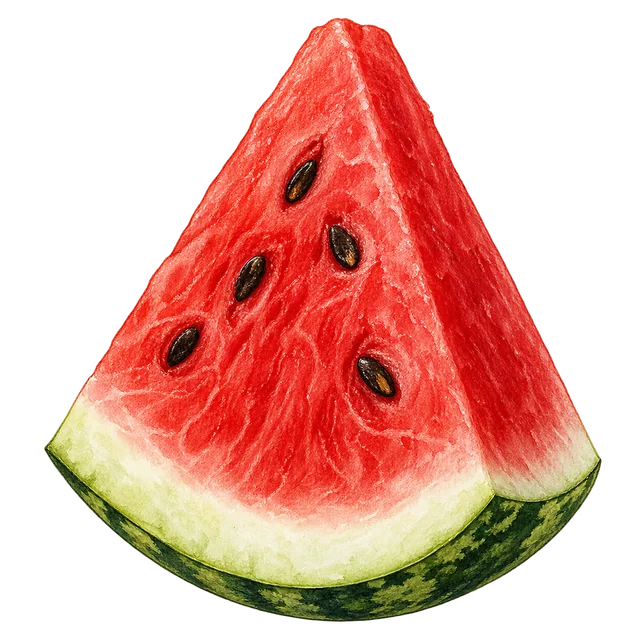
- Lycopene in red flesh
- Lycopene gives red flesh its color. It is fat-soluble, and fat in the same meal affects absorption.
- Pale inner rind
- Citrulline is higher in the pale flesh near the rind. A real mechanism does not mean one wedge lowers blood pressure.
Illustration for understanding; not to scale. Saved figures include explanations and sources.
Numbers · how much of each there really is
Lycopene: raw watermelon holds about 4-6 mg per 100 g. That is comparable to raw tomato or even higher (raw tomato about 2.6-3.4 mg per 100 g), and watermelon's lycopene does not need heating the way tomato's does to absorb well — eating it as is works fine. Lycopene is a fat-soluble carotenoid, and it absorbs better with a little fat.Why fat-solubility deserves its own note
Most people picture nutrient loss the vitamin C way: afraid of heat, afraid of a long soak, gone if you cut it and leave it out. That is how water-soluble nutrients lose points. Lycopene's weak spot is not on that line at all. It can take heat (heat actually helps release it from the cells); what it fears is a meal with no fat at all.
The reason is that it has to dissolve in fat before it can move. Fat in the small intestine is broken into tiny droplets, and fat-loving lycopene dissolves into them and hitches a ride; only then does it have a chance to be taken up at the gut wall. In a meal with no fat at all, even pigment that has already left the flesh cells simply rides the digesting food straight through. So pairing watermelon with feta or a few nuts is not fussiness. It is a link this road really cannot skip.
Citrulline: watermelon is the richest dietary source of citrulline, about 250 mg per 100 g of flesh, and more in the rind. Note that this is the amount per 100 g of flesh, and people rarely eat just one bite of watermelon: the serving size itself is what makes watermelon special on this pathway compared with other fruit.
Other nutrients: vitamin C about 8-10 mg per 100 g (moderate); beta-carotene, a precursor of vitamin A (lycopene itself cannot be turned into vitamin A); vitamin B6; a little potassium. Fiber is scant (about 0.4 g per 100 g), and calcium and iron are present only in traces.
Mechanism · why citrulline beats arginine itself
There is a counterintuitive point on this chain: if the goal is to raise arginine in the blood, eating arginine itself works less well than eating citrulline.The reason lies in two checkpoints, the gut and the liver. What the gut absorbs does not go straight into the general circulation. It first collects in the portal vein and is sent to the liver as a batch: the liver is the customs port, and it gets to process the shipment before letting it through. Both gut-wall cells and liver cells hold an enzyme that specializes in taking arginine apart (arginase), and a large share of oral arginine is broken down at these two checkpoints, so the extra amount that actually reaches the general circulation is limited.
Citrulline takes another road. It is not a substrate for that enzyme, so it passes the checkpoints largely untouched and rides on into the general circulation; later, in the kidney, two enzymes take over, convert it back into arginine, and release it. That is a way around the port, and arginine in the blood ends up rising higher and staying up longer.
So what matters about watermelon is not that it contains arginine. It is that it contains arginine's upstream precursor.
This point is worth lifting off watermelon and keeping: between how much you ate and how much the body got lies a whole metabolic route. Same destination, different entrance, and the share that arrives can differ a lot. Many of the precursor ingredients on a supplement shelf rest on this same idea.
Mechanism · what NO does inside the vessel wall
The line lets the smooth muscle relax is the link on this chain most easily brushed past, and the one most worth seeing clearly. Zoom in.First, tell the two layers of the vessel wall apart
Endothelium: the innermost layer of cells, sitting directly in the blood flow. This is where arginine is made into NOSmooth muscle: a ring of muscle wrapped around the outside of the endothelium. When it tightens, the channel narrows; when it relaxes, the channel widens
NO is a gas, so it does not need to knock
Most signaling molecules have to find their own receptor on the cell surface before they can pass on a message. NO does not: it is a tiny gas molecule, and once it is made inside an endothelial cell it simply diffuses across the membrane into the smooth-muscle cell next door.
The price is that it cannot travel far and does not last long; it only talks to its neighbor. That explains something practical: blood flow can be adjusted one stretch of vessel at a time, widening where work is being done, instead of switching every vessel in the body on and off together.
Once it is inside the smooth muscle
In the smooth-muscle cell, NO finds a signaling enzyme that has been waiting for it and switches it on; that enzyme starts making a second messenger (cGMP); cGMP then lowers the calcium inside the cell. Muscle contraction runs on calcium: once calcium drops, that ring of muscle relaxes as a whole, and the channel widens with it.
What follows from a wider channel
The same heart pushing the same amount of blood meets less resistance if the vessels downstream are looser overall. This is exactly peripheral resistance, and the diastolic half of blood pressure depends on it especially.
Here the brakes have to go on: everything above is mechanistically plausible, and it is still several steps short of eating watermelon lowers blood pressure.
Evidence · where this chain stops
The more smoothly the mechanism runs, the more important it is to say where it stops.In a small feeding study (Collins 2007), adults who ate watermelon daily for a period had higher arginine in their blood. That is an intermediate marker: it shows the first half of the chain really does work in people — eat watermelon, and arginine in the blood goes up. That study did not measure blood pressure.
Whether blood pressure came down too is a separate question, and it needs an endpoint. On eating watermelon to lower blood pressure, there are only a few small, short human studies so far; the evidence is still preliminary and the certainty is low. It is an interesting mechanism, not an established clinical conclusion.
Why intermediate markers and endpoints have to be kept apart
Any link on a pathway can be offset by something else:
Arginine went up, but the endothelium may not make proportionally more NO went up, but the smooth muscle may not relax proportionally moreThe vessels relaxed, but the kidneys and nervous system are regulating blood pressure at the same time and may cancel out that small change
Every extra link adds uncertainty on the way from a marker moved to a person benefited. That is also why the same mechanism is not equally convincing in a test tube, in a mouse, in a human blood sample, and on a human blood-pressure cuff.
This distinction is not only for watermelon
Most proven by research claims in supplement ads and health news stop at the intermediate-marker station. Next time you see one, ask one extra question: did this study measure a marker, or an outcome? That alone puts your judgment ahead of most of the people who shared it.
Chapter 3
Why watermelon barely moves blood sugar
The glycemic index () compares how fast and how high blood sugar rises from the same amount of available carbohydrate. In the test, every food is first measured out in a portion containing the same amount of digestible carbohydrate, and then blood is drawn to plot the blood-sugar curve that follows. So the GI describes the temper of that sugar, and has nothing to do with how much you actually eat.
The glycemic load () is what multiplies how much carbohydrate is actually in your serving back in. It answers how high blood sugar gets pushed after you eat this serving.
Watermelon became the textbook case because the two numbers sit especially far apart for it: its GI is in the high band, but watermelon is almost all water, so a serving holds little real carbohydrate, and its GL lands in the low band.
So when you see a GI number, hold off on conclusions and ask first: how much of this food do you eat at once, and how much carbohydrate is in it?
Numbers · here is the arithmetic
Watermelon's glycemic index () is about 72-76, which makes it a high-GI food. That leads many people, especially people with diabetes, to keep watermelon at arm's length.The glycemic load takes one line of arithmetic:
= GI × digestible carbohydrate (g) per serving / 100
Watermelon is 92% water, so a 120 g serving holds only about 8.5 g of digestible carbohydrate:
GL = 76 × 8.5 / 100 ≈ 6.5, which counts as a low glycemic load (GL < 10 = low).
For comparison: a bowl of white rice (200 g cooked) holds about 46 g of carbohydrate. Its GI sits in the same high band as watermelon's, yet its GL is several times that of this serving of watermelon.
Notice what each number does in that comparison: white rice and watermelon share the same high GI band, and the gap opens entirely through the how much carbohydrate is in this serving term. Same formula, same high GI, and the results differ several-fold.
The reasonable conclusion: a normal portion of watermelon (one or two pieces, about 200-300 g) has very little real impact on blood sugar and should not be ruled out wholesale because of its GI number. For people with diabetes, the approach is to control the portion, check their own blood sugar, and follow their doctor's advice.
The claim that watermelon spikes blood sugar is technically half right (the GI is high) but often misleading in practice (the GL is low).
Mechanism · how can the same thing be both fast and little
High , low sounds like a contradiction. Walk it back through the body and it opens.Why fast (high GI)
A piece of watermelon enters the stomach, and almost all of it is liquid. The stomach empties liquid much faster than it empties solids, so this bite of food is sent into the small intestine quickly — and the small intestine is exactly where sugar is absorbed into the blood. Arrive early, and the blood-glucose curve climbs steep.
Add that watermelon has almost no fiber, and almost no fat or protein:
Fiber makes the chyme in the gut viscous, slowing how fast sugar molecules meet the gut wallFat and protein make the stomach slower to release what is below
Watermelon has none of these, which means no speed bumps the whole way.
Why little (low GL)
But in that same piece of watermelon, the total amount of sugar is small — most of its weight is water. Fast is about the speed those sugar molecules reach the blood; little is about how many arrived in all. How high blood glucose is pushed depends on how many extra glucose molecules are in the blood at the same moment, which speed and quantity decide together, and watermelon is small on the quantity term.
Put another way
GI is like asking how wide the tap is open. GL is asking how much water is in this bucket. Tap wide open, only a cup in the bucket, and the floor still will not flood.
How to use this tool on other foods
Same high GI, a serving of watermelon and a slice of white bread are not the same thing at all — the difference is carbohydrate density in the same weightDry goods (rice, noodles, biscuits, dried fruit) are born with high carbohydrate density, so a high GI translates directly into a high GLWatery whole fruit (watermelon, strawberry, melon), even when GI is not low, usually has a low GL per servingJuice changes it: fiber is filtered out, volume is compressed, the same amount of sugar is packed into a smaller sip — one of the few moves you can make in your own kitchen that pushes GL up
One last honest sentence: GI and GL are both numbers in an average sense. The same serving of watermelon — cold versus room temperature, on an empty stomach versus after a meal, one person versus another — will not draw the same blood-glucose curve. They are tools for ruling out cutting everything with one number, not precision predictors.
Chapter 4
What it lacks and what to pair it with
Pairing ideas:
With foods that contain fat (cheese, nuts): this helps lycopene absorb; watermelon with feta is a traditional Mediterranean combination, and it makes nutritional senseWith protein (yogurt, beans): this adds the protein watermelon almost entirely lacksWatermelon juice is not watermelon: juicing strips out what little fiber there is, the sugar is dissolved in liquid, and it reaches the blood faster. Eating the wedge beats drinking the juice
On the seeds: black watermelon seeds contain some zinc, magnesium, and plant protein, and roasted they make a good snack. Seedless watermelon comes from conventional hybrid breeding (it is triploid), not genetic modification.
On the rind: the pale inner band next to the skin holds even more citrulline than the red flesh, and in some places it is stir-fried (as in Chinese stir-fried watermelon rind). It has nutritional value too; it just needs different textures and cooking methods.
Watermelon's greatest value is low-calorie water with some lycopene in it during hot summers: it is a good way to cool down, not a nutritionally complete staple.
Numbers · how short the shortfalls actually are
Watermelon has almost no protein or fiber, and this is the scale: protein about 0.6 g per 100 g, fiber 0.4 g per 100 g.Those two numbers are small enough that even if you eat a large piece of watermelon at one sitting, its contribution to your day's protein and fiber totals is still close to zero. So watermelon's place is a fruit added to your diet, not something that replaces a meal: use it in place of a meal and what you knock out is protein and fiber, the two things hardest to make up elsewhere.
Mechanism · almost all water — why that is the function
Treating almost all water as watermelon's flaw is reading its place wrong. In summer, that is the job it does.Sweat does not take water alone
Sweat also carries off electrolytes like potassium and sodium. Plain water only replaces the water half; watermelon sends in water that already carries potassium and sugar.
The sugar here is not entirely a burden. When small-intestine epithelial cells absorb glucose, they drag sodium in with it; once sodium is in, water is pulled along in the ions' direction. That is also why oral rehydration salts contain both sugar and salt — the sugar is not there for sweetness. It is sodium's carrying partner, and water follows sodium.
But the scale has to be clear
Watermelon is not a sports drink. Its potassium is only at the small-amount level; do not use it as an electrolyte supplement. Where it actually works is something else: in the heat, many people simply do not want to drink water, and a piece of watermelon lets you take in a large glass of water without noticing. The biggest bottleneck in hydration has never been how much of what you drank can be absorbed. It is whether you will drink at all.
On juicing, one more mechanism note
Juicing does three things at once: filters out the already-scant fiber, compresses the volume, and lets sugar reach the small intestine faster. The first two put more sugar in the same cup; the third makes it arrive sooner — exactly the two directions that push glycemic load up, moving together. Eating the whole piece still takes teeth and time, and that itself is a speed bump.
Chapter 5
How to pick, cut and store
Choosing a cut watermelon: look for flesh that is deep red and even, and avoid pieces with lots of white streaks, which are fibrous and have a poor texture. Large, plump seeds are usually a sign of ripeness.
Storing:
Whole and uncut: a few days to two weeks at room temperature (depending on ripeness)Once cut: wrap the cut face in plastic wrap right away, refrigerate, and finish within 3-5 days. Chilled watermelon tastes betterFrozen: cut it into chunks and freeze for smoothies, but it turns soft and watery once thawed
Watermelon cannot be eaten with other foods: there is no nutritional basis for this. Watermelon with yogurt, with mint, or with lemon juice are all perfectly fine combinations.
How much: one or two wedges (200-300 g) is a reasonable portion as a fruit dessert. Eating a lot at once (say, more than 1 kg) adds up to a lot of sugar. On hot summer days when you are not drinking enough water, watermelon is a very good way to take in fluid.
Myth · no-pairing rules have no basis in the body
Watermelon must not be paired with shrimp, watermelon with peach will poison you — claims of this kind make the rounds every summer. Rather than memorizing, item by item, what can pair with what, it is better to see where they share the same hole.What you swallow does not line up in separate queues
The first thing food does in the stomach is get churned into a mash. The stomach-wall muscles contract, one layer across, one layer diagonal, mixing everything from the meal with gastric juice into one even chyme, then releasing it into the small intestine a small portion at a time. Which means, by the time digestion actually starts, which bite was watermelon and which bite was shrimp, the body can no longer tell.
Further down, digestion divides labor by molecule class: the enzyme that takes protein apart only handles protein; the enzyme that takes starch apart only handles starch; fat has to wait for bile to emulsify it. No enzyme works by meeting watermelon and then changing how it handles shrimp.
So the real questions are three concrete ones
Amount: how much in one sitting? A whole basin of iced watermelon in one go, and an upset stomach is the result of cold + large volume + a lot of sugar, not of pairingYou: were you already allergic or intolerant to one of the items? That is a problem of that one thing, not antagonismHygiene: watermelon left cut for a long time is a fine culture medium for bacteria on the surface. A summer stomach bug is far more likely from this than from any pairing
Remembering this way of asking is more useful than remembering the conclusion
Next time you see A must not be eaten with B, you do not have to look up true or false. Ask first: which step in the body does it say went wrong? If it cannot name that step, it is only a sentence that sounds like knowledge.
References · 5
- U.S. Department of Agriculture, Agricultural Research Service. (2019). FoodData Central: Watermelon, raw. ~30 kcal/100 g; ~92% water; lycopene ~4-6 mg/100 g; L-citrulline ~250 mg/100 g flesh; vitamin C ~8-10 mg/100 g; fiber ~0.4 g/100 g; glycemic index ~72-76. fdc.nal.usda.gov
- Collins, J. K., Wu, G., Perkins-Veazie, P., Spears, K., Claypool, P. L., Baker, R. A., & Clevidence, B. A. (2007). Watermelon consumption increases plasma arginine concentrations in adults. Nutrition, 23(3), 261-266. Feeding study in 23 adults: watermelon consumption raised plasma L-arginine and L-citrulline; citrulline (~250 mg/100 g flesh, more in rind) is converted to arginine and subsequently to nitric oxide. Small-scale mechanistic study; blood-pressure endpoints not assessed here. 10.1016/j.nut.2007.01.005
- Perkins-Veazie, P., Collins, J. K., Pair, S. D., & Roberts, W. (2001). Lycopene content differs among red-fleshed watermelon cultivars. Journal of the Science of Food and Agriculture, 81(10), 983-987. Lycopene varied by cultivar (~3.8-7.1 mg/100 g fresh weight), establishing red-fleshed watermelon as a lycopene source comparable to tomato. 10.1002/jsfa.880
- Edwards, A. J., Vinyard, B. T., Wiley, E. R., Brown, E. D., Collins, J. K., Perkins-Veazie, P., et al. (2003). Consumption of watermelon juice increases plasma concentrations of lycopene and beta-carotene in humans. The Journal of Nutrition, 133(4), 1043-1050. A 19-week controlled crossover feeding study: lycopene from non-heat-treated watermelon juice was as bioavailable as lycopene from heat-processed canned tomato juice. 10.1093/jn/133.4.1043
- Foster-Powell, K., Holt, S. H. A., & Brand-Miller, J. C. (2002). International table of glycemic index and glycemic load values: 2002. The American Journal of Clinical Nutrition, 76(1), 5-56. Comprehensive reference table of GI and GL values for 750 foods tested in human subjects; GL = GI × available carbohydrate per serving / 100, providing an integrated measure of blood-glucose impact per realistic portion. 10.1093/ajcn/76.1.5