Story
Strawberry
Last updated
In one pass A plate of strawberries is roughly a day's worth of vitamin C.
Educational content, not medical advice — consult a clinician.
Story path
Chapter 1
What a strawberry is and does well
In numbers: 100 g of raw strawberries holds about 58-89 mg of vitamin C. The same handful of blueberries has only 9.7 mg, and grapes even less. On this measure strawberries are in the same class as oranges (about 53 mg/100 g), yet they carry only about 32 kcal/100 g, so even a heaping plate is almost no calorie burden.
There is also a structural oddity: the red part you bite into is not, strictly speaking, the fruit. That piece of trivia does not change how you eat it, but it explains three other things about strawberries at once: why they do not keep, why they must be washed, and why they top pesticide-residue lists year after year.
A CLOSER LOOK
Tiny fruits outside, fleshy receptacle inside
The red fleshy part is an enlarged receptacle. Each tiny achene on its surface encloses a seed.
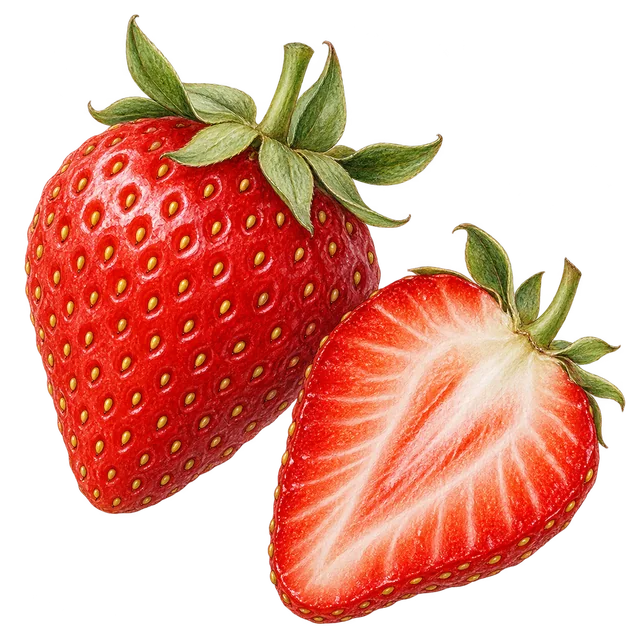
- Surface achenes
- These are the botanical fruits, each holding a seed.
- Fleshy receptacle
- The red part you eat has no thick peel to remove. Bruising, moisture and damage affect how well it keeps.
Illustration for understanding; not to scale. Saved figures include explanations and sources.
Background · The red part you bite is not the fruit
Strawberry is a herbaceous plant in the rose family. When it flowers, the small pad under the petals is called the receptacle; after pollination, what swells into that red, juicy thing is this receptacle — not the fruit. The true fruits are the tiny grains dotted across the surface (achenes, in botanical terms), each holding one seed. That is why, in botany, strawberry is called a false fruit.It sounds like pure trivia, but it explains three very practical things about strawberries in one stroke.
It has no peel you can take off. Peel an apple and it is clean; peel an orange and it is clean — because most of what landed on the outside left with that layer. Strawberry cannot do this step: its surface is the flesh you eat. So for strawberries, rinsing is not optional. It is the only step.It does not keep. Other fruit has a firm shell outside, holding water in and mold out. Strawberry flesh sits exposed; a nick on the surface and mold walks straight into the meat. One berry grows white fuzz in the fridge, and the ones next to it follow soon after, for the same reason.It bruises on contact. That dark patch your finger pressed in is the flesh itself crushed. There is no cushion in between.
So this piece of trivia is worth keeping — not so you know what to call it, but because it decides how you wash it, how you store it, and why it keeps showing up in pesticide-residue news.
Background · How to read a composition table
This article will show quite a few content numbers. Before you read on, here is how to use them.A food composition database gives representative values — results pooled from many samples. The same fruit, different variety, different ripeness, a few days off the plant, those days spent at this or that temperature: every one of those variables moves the number. So figures like these are ranges by nature, not constants. Strawberry's vitamin C range came about this way.
What they can answer steadily is this kind of question: on vitamin C, is strawberry in the same tier as orange, or the same tier as blueberry? That answer will not flip because the berry in your hand changed variety.
What they cannot answer: how many milligrams, exactly, did I take in from the strawberries I ate today? That question has no answer, and does not need one — you are not compounding a medicine. You are eating fruit.
This way of reading applies to every food, and to any composition table you meet anywhere.
Chapter 2
What nutrients strawberries carry
A 150 g serving of strawberries (about 8-10 berries) gives you 87-134 mg of vitamin C, while an adult needs 75-90 mg a day, so one serving covers it. Better still, strawberries are almost always eaten raw, so no cooking step shaves the vitamin C down (see Vitamin C).
What vitamin C does in the body is not one vague good deed but three specific jobs: twisting collagen into strong rope, turning plant iron in the small intestine into a form that can be carried in, and standing first guard against oxidation in the fluid outside cells.
There is also folate (about 24 µg per 100 g), the anthocyanins that give strawberries their color, and a class of polyphenols that only become usable with help from gut bacteria.
The sugar is not high: about 4.9-7 g per 100 g, with a glycemic index (, a measure of how fast a food raises blood sugar) of about 40, which puts strawberries in the lower tier among fruits.
Mechanism · how vitamin C twists collagen tight
Collagen is the body's building rope: the deep layer of skin, vessel walls, gums, tendons, and the new layer growing over a wound all hold because of it.Its shape is three chains twisted into one rope. But the chains just synthesized are soft. To twist tight and stay together, they first have to hang a batch of small hooks (hydroxyl groups) at specific spots on the chain. The hooks pull on each other, and only then is the rope formed.
The enzyme that hangs those hooks keeps an iron atom in its active site. Each hang oxidizes that iron one notch, into a state that no longer works. Vitamin C's job is to walk over and reduce it back, so the line lights again.
Watch the division of labor: vitamin C is not collagen's raw material — the raw material is amino acids. It is the match that restarts the line. That distinction matters. The two inferences below both come from it.
Inference one: you can derive what vitamin C deficiency looks like. If the hooks cannot hang, the rope cannot twist tight; the first places to fail will be those that both turn over constantly and carry load. Gum collagen turns over fast, so gums bleed first; capillary walls are held by collagen, so small bleeds appear under the skin; a new wound has to make collagen on the spot, so it is slow to close. Scurvy is not an abstract deficiency. It is the cascade from one rope that will not twist tight (see Vitamin C).
Inference two: once you have enough matches, more matches do not make the line run faster. Vitamin C guarantees that collagen can be made normally. It does not mean the more you eat, the more collagen you make. That is the step a lot of beauty marketing quietly skips.
Mechanism · folate is the courier that moves one carbon
Folate's job in the body, in one sentence, is to move one carbon.For a cell to divide, it first has to copy its DNA; copying means making bases on the spot, and one step of making a base is attaching a carbon atom to the molecule. Folate carries that carbon over and delivers it. Not enough folate, and this step jams. The copy stops halfway.
So the first cells to fail in a folate shortage will be the ones dividing fastest. That is not coincidence. It follows straight from the chain above:
Red-cell precursors in bone marrow: the cells grow but cannot divide, so the red cells released are oversized and too few. That is where the name megaloblastic anemia comes from — large, because they did not split when they should have.The neural tube closing in the earliest embryo: those weeks are the fastest cell division in the whole body, and the window is extremely narrow. By the time you confirm a pregnancy, that zipper has often already closed. Paying attention to folate while planning a pregnancy, rather than waiting to supplement after confirmation, is because of this time gap.
Strawberry has a structural advantage here. Natural folate in food both fears heat and dissolves in water: drop leafy greens in a pot, and some is destroyed by heat, some dissolves into the soup, and the soup is often poured away. Strawberries are almost always eaten whole and raw, so both losses are skipped together (see Folate).
Mechanism · Gut bacteria decide if polyphenols count
Strawberry's red comes from anthocyanins, mainly pelargonidin. It has been studied less than the blueberry class of anthocyanins, but it belongs to the same large polyphenol family. Strawberries also carry another class of polyphenols, called ellagitannins.A judgment tool more valuable than the strawberry itself is hiding here.
A composition table tells you how much is in this fruit, not how much your body can get. Several gates sit in between: the molecule has to dissolve out of the cell first, and it has to be small enough to cross the gut wall. Polyphenols as a class usually lose at these gates — they are large, and many never enter the blood as themselves.
Ellagitannins are the typical case. They are too big; your digestive enzymes cannot handle them, so they travel all the way to the colon. What actually remakes them into absorbable small molecules (urolithins) is not you. It is the bacteria living in your colon. This step is outsourced.
That is where the line that often gets waved past comes from: this conversion varies from person to person. Opened up: the same plate of strawberries, and some people show these small molecules in blood, some show almost none; the difference is not in the strawberry. It is in the person. That also explains, by the way, why human studies on this class of polyphenols so often fight each other — in every cohort, how many people carry bacteria that can do the job was never the same.
The rule you can take with you: next time you see a claim that some food is rich in some antioxidant, the question to chase is not how much it has, but whether it can reach the place in the body that is supposed to use it (dive: polyphenols).
Mechanism · Vitamin C will not keep, so daily wins
Vitamin C is water-soluble: it dissolves in the water between blood and cells, and the body has no dedicated warehouse for it, unlike the fat-soluble vitamins, which can be stocked and used slowly.Push this one step and you get two consequences that point opposite ways and land on the same conclusion.
Eat a lot at once, and you keep little of it. The larger a single intake, the lower the fraction the gut can absorb; and the part that enters the blood and exceeds what the kidney can reclaim leaves with the urine. So the marginal return of a binge drops fast.Stop, and the level walks down. No stock means your vitamin C level is held up mainly by what you ate in the last few days, not what you ate last month.
Together they point at the same thing: on vitamin C, a steady daily habit beats the occasional raid.
That is also strawberry's real value. Its point is not a first-place ranking for content. It is that it is easy to eat every day — rinse and it is ready, no stove, and almost no calorie burden (see Vitamin C).
Chapter 3
Should pesticide residues worry you
Strawberries sit at the top of EWG's Dirty Dozen list every year, and many people stop buying them because of it, or buy only organic. EWG is a US environmental advocacy group, and the list is its own ranking: it measures whether a residue was detected, not whether the amount is high enough to cause harm. It is an advocacy list, not a yardstick for risk.
The one action that actually matters is simple: rinse them under running water for 20-30 seconds, rubbing gently with your hands as you go. No salt water, no baking soda; plain water is enough. What you want to remove is stuck on the surface, and that takes the mechanical scrubbing of running water.
One more thing to say up front: organic strawberries are not more nutritious. Organic is a set of standards about how to farm, not about how much nutrition a fruit contains.
Background · Why strawberries top the list
Put one easily skipped fact on the table first: half the reason strawberries make the list is written in their anatomy.Apples can be peeled, oranges can be peeled, and a banana's flesh never even meets your hand. Most of what landed on those fruits leaves with that layer. Strawberry has no such layer — its surface is the flesh itself (the chapter on what a strawberry is explains why).
So on the detection yardstick, strawberry is born at a disadvantage against fruit with a shell or a thick peel: others get one physical reset. It does not. All it can do is rinse.
That is also why that half minute of rinsing is worth it. Not because strawberries are dirtier than other fruit, but because for them, rinsing is the only step.
Myth · detection rate is a number that can lie
The list is scored this way: look at official monitoring data, see how high a share of samples of a given crop showed a pesticide residue, and rank the ones with more detections at the front. The whole problem sits in that word, detected.First, detected is not over the limit. The US and the EU run residue monitoring every year. Strawberry's detection rate is indeed high; but in the EU's annual report, for example, the great majority of sampled foods had residues inside the legal limits. What the monitoring reports themselves care about is exactly this: how many samples crossed the limit. The list skips that column entirely.
Second, detection rate can be pushed up by the instrument. The same strawberry, twenty years ago the instrument could not see it, today's instrument can. So this situation is entirely possible: the detection-rate number is rising, while the actual residue amount is falling. An indicator that grows automatically with better technology cannot be read as a risk indicator on its face.
Third, the list does not weigh. It does not ask which substance was found, how much, or how far from the limit. And the most basic line in toxicology is that the dose makes the poison — the same substance, a trace and a large amount, are not the same thing in the body at all. Toxicologists have criticized EWG's method; the core is right here.
This move's real value is not about strawberries. Next time you see a news item that something was detected in something, you can ask three questions in passing: how much was found? what is the limit? how far is this amount from the limit? A report that cannot answer all three carries almost no information.
Myth · Organic is about farming, not nutrition
Evidence first: Smith-Spangler 2012, that systematic review, put the nutrient content of organic and conventional produce side by side. It concluded that there is no strong evidence that organic foods are more nutritious.Think about it and it is not strange. The organic label sets what a farmer may and may not use — it is a set of rules about how to grow. It does not set, and was never meant to set, how much vitamin C a fruit must contain.
And how much vitamin C is left in a strawberry is decided more by what happens after it is picked: how many days it sat, at what temperature those days were spent. The chapter on how to pick them, and whether frozen is fine, goes into this.
So should you buy organic? That is a fair question. The reason just does not sit in the nutrition column. Two kinds of reason stand up: one is wanting to push your own pesticide exposure down further (children and pregnancy are mentioned especially often); the other is concern for the environment and for farmworkers. Neither kind needs a more-nutritious claim to hold it up.
Turned around: if you cannot find organic, or cannot afford it, there is no need to worry. Conventional strawberries, rinsed well, are healthy food.
Chapter 4
What it lacks and how it helps iron
But it has one very specific use you can apply today: helping the plant iron in the same meal get absorbed better. When you eat iron-containing plant foods such as spinach, oats or beans, add a handful of strawberries and iron absorption rises clearly (see Vitamin C).
The part most easily missed is the same meal: this is a reaction that happens in the gut on the spot, not a matter of storing vitamin C in the body.
Other easy pairings: unsweetened yogurt adds protein and calcium, oats add soluble fiber, and nuts add fat and fullness. Strawberries with yogurt and oats fill the gaps strawberries leave, all in one bowl.
Mechanism · How strawberry walks spinach iron in
Iron in plants and iron in meat do not walk through the same door.Iron in meat is wrapped in a small cage called heme; the gut wall has an entrance that recognizes this cage, and the whole thing is carried in. Iron in plants is a bare ion. To enter the gut wall it has to meet two conditions at once: it has to be dissolved in water, and the valence has to match.
It usually meets neither.
Wrong valence: most plant iron is the 3+ form, and the door on the gut wall that moves iron only recognizes the 2+ form.It clumps and sinks: as food leaves the stomach and moves down, the environment goes from very acid to near-neutral in a hurry. In that environment 3+ iron huddles with hydroxide, forms insoluble specks, and sinks. Iron that sank was not eaten.
Vitamin C settles both at once: it hands 3+ iron an electron and reduces it to 2+; at the same time it wraps itself around the iron into a soluble little cage, so the iron does not clump on the stretch where the gut turns neutral, and is walked steadily to the door.
Look back at the words same meal and it is clear: this is a chemical reaction in the gut lumen, and the reactants have to be present together. Strawberries in the morning and spinach at night do not meet. An iron supplement tablet with a glass of juice is the same logic — they count only if they go down together.
Push one step further and you can derive a more general rule: pairings that act on the spot in the gut all care about the same meal; nutrients that fill a store slowly care about the long-run total. Which class a tip belongs to decides whether you should watch the clock.
Myth · jam cannot stand in for strawberries
Turn fresh strawberries into jam and what happens in between, taken in order, is three steps, and all three walk the same way.Boiling down: water is cooked off, what remains is concentrated. Sugar stands heat well, so after concentrating, the sugar in each spoonful is several times denser than in the original strawberries.Adding sugar: the traditional method adds still more sugar. So the sugar in that last spoonful is far more than what the strawberries themselves brought.The heat itself: vitamin C is lost in quantity at this step. It fears heat, fears oxygen, and dissolves in water, and making jam happens to line up all three at once.
Add that fiber drops substantially in crushing and sieving, and it no longer even asks you to chew — a spoonful slides down fast, and the body has no time to give you much feedback.
So the comparison is not as simple as which is better, fresh strawberry or jam. It is: you kept the sugar and lost the part that was worth the most.
Jam is fine to eat. But file it under sweet condiment, not under fruit — file it in the wrong class, and a chain of later judgments will go wrong with it.
Chapter 5
How to pick, and whether frozen is fine
Do not wash them when you get home; put them straight in the fridge and eat them within 2-3 days. Wetting them early makes them rot faster: the surface is the flesh, and once water gets into a break in the skin, mold follows it in. Rinse them when you are about to eat them.
Frozen strawberries are not necessarily less nutritious than fresh. A picked fruit does not stop its metabolism right away: enzymes in its cells keep working, and vitamin C drops a little every day. Flash-freezing hits pause on that downward curve on the day the fruit was ripest. On the other hand, out-of-season fresh strawberries that traveled a long way to the shelf may well hold less vitamin C. For smoothies and oat bowls, frozen is perfectly fine.
Eat them however you like: as a snack, stirred into yogurt, blended into a smoothie or scattered over oats. They are low in sugar and calories, so most people (including those who need to watch their blood sugar) can eat them without worry.
Mechanism · Time and temperature matter, not fresh
The moment a strawberry is picked, it has not died. The cells are still alive, the enzymes inside are still working, and vitamin C happens to be one of the things enzymes and oxygen in the air most easily take apart together. So from the stem to your mouth, each extra day knocks a little off this berry.Temperature is the master switch on this chain: enzyme reactions speed up as temperature rises, and run slower the colder it is. Three inferences follow.
Into the fridge the moment you get home beats sitting on the table by a lot. Not for looks. To flatten that deduction curve.Flash-freezing is not processing. It is pause. It is usually done on the day of harvest; the moment it is frozen, the vitamin C in the fruit roughly stops at that level.Out-of-season fresh strawberries have already run the curve a long time. Picked at origin, boxed, shipped a long way, then a few more days on the shelf — the whole road is deducting, only it still looks fresh.
So the word fresh is not a reliable nutrition label. It describes form (not frozen), not history (how long since it left the stem, and at what temperature that stretch was spent). The latter is what to ask.
Line the three cases up by this logic and the order is not quite what intuition says: in-season local fresh strawberries beat frozen strawberries, and frozen strawberries beat out-of-season long-haul fresh ones. The ranking is not because freezing itself is good or bad. It is how long each deduction curve has already run.
In practice · Washing: order beats tools
On this small job of washing strawberries, what most people get wrong is not which water, but the order.Rinse first, hull after. Many people habitually pull the green hull off and then soak — that is backwards. Once the hull is off, that spot is an open wound, and water drills into the flesh along it. Vitamin C dissolves in water; sit it in water and it walks out; the water that drilled in also washes the taste thinner. Rinse the whole berry, pat it, then hull.Rinse, do not soak. What you want off is what is stuck on the surface, and that takes the mechanical force of running water. Sit them in a basin and the force is gone, while the water-soluble things have plenty of time to walk out.Plain water is enough. Salt water and baking soda do not make the rinse stronger, and after using them you still have to rinse again.
One last line is not about the wash, but it points the same way: eat strawberries raw when you can. Vitamin C fears heat, fears oxygen, and dissolves in water; once they hit a pot, all three happen together. And the good thing about strawberries is that they never needed a reason to be cooked.
Myth · Do strawberries and milk clash
The claim that two foods fight each other has a fixed template on the Chinese internet: eat these two foods together and you will be poisoned, form stones, or cancel the nutrients out. Strawberry with milk is only one of the lines, and it has no nutrition-science basis.The reason it does not stand is actually plain. Food that enters the stomach is already dozens of components mixed in one pot. Everything you ate this meal already ate with everything else in the stomach. If two common foods caused trouble the moment they met, the frequency would be high enough that it could not have gone unnoticed.
Real interactions between foods look nothing like these rumors. They usually only change the fraction of one specific nutrient that is absorbed, rather than producing toxicity out of nowhere; the size can be measured, and the direction is clear — vitamin C raising plant-iron absorption, which this article keeps returning to, is a standard sample. In other words, a real interaction is addition and subtraction, not an accident.
So stir strawberries into yogurt as you like. As a pairing it is actually quite sensible: strawberry brings vitamin C and flavor; yogurt brings exactly the protein and calcium strawberries lack most.
References · 6
- U.S. Department of Agriculture, Agricultural Research Service. (2019). FoodData Central: Strawberries, raw. ~32 kcal/100 g; among the highest vitamin C of common berries (58-89 mg/100 g); folate ~24 µg/100 g; sugar ~4.9-7 g/100 g; glycemic index ~40. fdc.nal.usda.gov
- National Institutes of Health, Office of Dietary Supplements. (2021). Vitamin C — Fact Sheet for Health Professionals. ods.od.nih.gov/factsheets/VitaminC-HealthProfessional
- National Institutes of Health, Office of Dietary Supplements. (2022). Folate — Fact Sheet for Health Professionals. ods.od.nih.gov/factsheets/Folate-HealthProfessional
- Environmental Working Group. (2023). EWG's 2023 Shopper's Guide to Pesticides in Produce — Dirty Dozen. Strawberries consistently ranked #1 for pesticide residue detection frequency. Note: the EWG methodology counts the presence of residues, not whether levels exceed regulatory safety limits or represent harm at typical exposure; toxicologists have criticized the ranking for not accounting for dose. www.ewg.org/foodnews/dirty-dozen.php
- Smith-Spangler, C., Brandeau, M. L., Hunter, G. E., et al. (2012). Are organic foods safer or healthier than conventional alternatives? A systematic review. Annals of Internal Medicine, 157(5), 348-366. Found no strong evidence that organic foods are more nutritious; organic produce had lower pesticide-residue detection. 10.7326/0003-4819-157-5-201209040-00007
- European Food Safety Authority. (2023). The 2021 European Union report on pesticide residues in food. EFSA Journal, 21(4), 7939. The large majority of sampled foods were within legal residue limits. 10.2903/j.efsa.2023.7939