What sets pear apart is sorbitol. This sugar alcohol is absorbed slowly and incompletely in the small intestine; what is left pulls water into the gut and is fermented by bacteria into gas. So some people get bloated after a lot of pear, and a pear when you are constipated can loosen things a little. The chapter on sorbitol and gas walks through the whole chain.
Pear is a pome fruit and a close relative of apple: juicy flesh around a small cluster of seeds, about 84% water. Its fiber includes a good deal of pectin, plus a little vitamin C and potassium. Many people reach for a pear when their throat feels dry; how much truth there is in "pear moistens the lungs and stops coughs" is taken apart in the chapter on whether pears help a cough. If a cough has dragged on for weeks, or you cough up blood or are clearly short of breath, see a doctor rather than relying on stewed pear.
A CLOSER LOOK
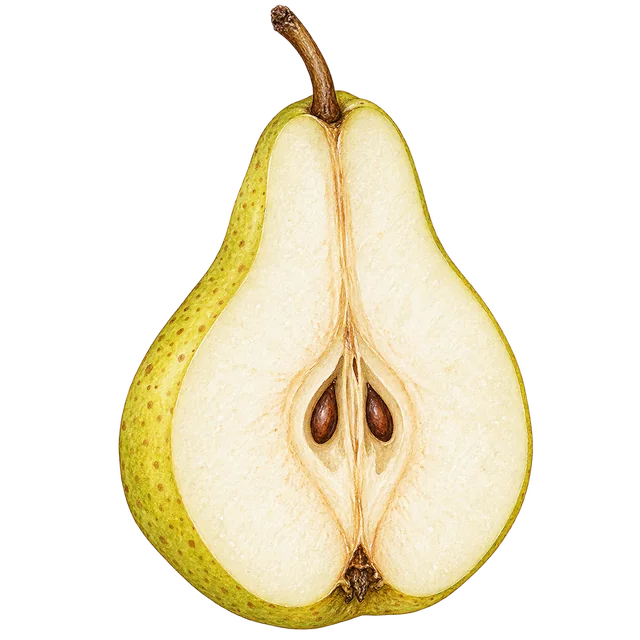
Pear and apple share a pome structure
The cut face shows pome structure, without presenting pear as a food that repairs lungs or treats cough.
1Water-rich flesh
Pear is more than four-fifths water; its pale flesh surrounds a small seed-bearing core.
2Intact outer layer
A pear with its skin retains its outer layer and flesh. Whole fruit and juice have different structures.
Illustration for understanding; not to scale. Saved figures include explanations and sources.
Background · How much pear resembles apple
Pear and apple are both pome fruits, built almost the same way: juicy flesh around a small cluster of seeds in the middle. They are alike in nutrition too: both have a good deal of pectin in their fiber, both have sugar that is mostly fructose, and both contain some sorbitol.
The difference is mostly in amounts. Pear is on the high side for sorbitol and is very high in water, crisp and juicy, which is why many people reach for it when their throat is dry or they feel "heaty", in the Chinese folk sense.
So the two things really worth making clear about pear are: first, the loosening, gassy effect of sorbitol on some people; and second, how much truth there is in the deeply rooted belief that "pear moistens the lungs and stops coughs".
Chapter 2
Nutrition · water, pectin, gentle sugar
Pear is a classic high-water, high-fiber fruit. A good share of its fiber is pectin, which forms a gel in the gut that slows sugar on its way into the blood, helps you feel full, and feeds gut bacteria, the same way it works in Apple.
Eating the skin beats peeling it, and eating the pear whole beats juicing it.
Mechanism · Whole pear versus pear juice
A medium pear eaten with its skin supplies a fair amount of fiber. The skin and the layer just under it are where fiber and polyphenols concentrate, so eating the skin beats peeling.
Pear sugar is mostly fructose, but a whole pear carries fiber and intact cell structure, so its sugar is released fairly gently and its glycemic index (, a measure of how fast a food raises blood sugar) is not high. That is the key difference between whole fruit and juice: juice a pear and the fiber is lost and the cells are broken up, so blood sugar rises much faster.
Chapter 3
Mechanism · sorbitol and gas
Pear is fairly high in sorbitol, a sugar alcohol. It is absorbed slowly and incompletely in the small intestine; the part that is not absorbed moves into the large intestine, where it pulls water into the gut (an osmotic effect) and is fermented by gut bacteria into gas.
So after a lot of pear, some people get bloating, a gurgling gut, even mild diarrhea. The same thing explains why a pear when you are constipated does loosen the bowels a little for some people: no magic, just sorbitol's osmotic laxative effect. For most people, a normal amount is perfectly fine.
Mechanism · Sorbitol and FODMAPs
Why is sorbitol absorbed so poorly? The small intestine has no dedicated carrier for it, so it can only seep slowly through the gaps between cells, and absorption is slow and incomplete. The part left in the gut has a high osmotic pull and draws in water especially hard.
Nutrition science groups short-chain carbohydrates like this, which the small intestine cannot fully absorb and which bacteria in the large intestine ferment, under the name . Sorbitol and excess fructose are both on the list, and pear has both. The fructans in onion and garlic are FODMAPs too, just a different kind (both Onion and Garlic cover them).
For people with irritable bowel syndrome (, a common condition in which the gut is unusually sensitive to stretching and brings repeated pain and bloating) or with FODMAP sensitivity, a lot of pear can set off bloating and pain. Other people usually do not feel the same stretch at all. Knowing the mechanism simply keeps you from being puzzled when "pear makes me bloat".
Chapter 4
Do pears help a cough
"Pear moistens the lungs and stops coughs" and "stewed pear with fritillaria cures a cough" are very widespread, but they mix a real comfort with a claim that has no support.
The true part: when your throat is dry or sore, eating a pear or sipping a bowl of warm stewed pear does feel soothing. That comfort comes from fluid, warmth and a little sugar, the same reason a warm sweet drink soothes the throat. The unsupported part: there is no reliable clinical evidence that eating pear treats a cough or repairs the lungs.
Red flag: if a cough lasts more than a few weeks, or comes with fever, coughing up blood, marked shortness of breath or weight loss, see a doctor to find the cause; do not rely on stewed pear. This is general education, not a diagnosis.
Myth · Which part of the cough claim holds up
First, separate two things: soothing the throat and treating a cough.
The first is real. For a mildly dry, tickly throat, fluid plus warmth eases things a little. A pear, stewed pear water or a cup of warm water can all do that; pear is not special.
The second has no support. A cough is a symptom with many possible causes: colds, allergies, asthma, acid reflux, infections and more. A bowl of stewed pear does not reach any of those causes, so it cannot "moisten the lungs" either. The biggest risk in treating stewed pear as cough medicine is delay: a cause that truly needs attention gets covered up by a bowl of sweet water.
So use it the right way: sip it to soothe a dry throat, knowing what it does, and if a cough does not clear up, go and find out why.
References · 1
U.S. Department of Agriculture, Agricultural Research Service. (2019). FoodData Central: Pears (raw, with skin). High water and pectin (soluble fiber); contains sorbitol. fdc.nal.usda.gov