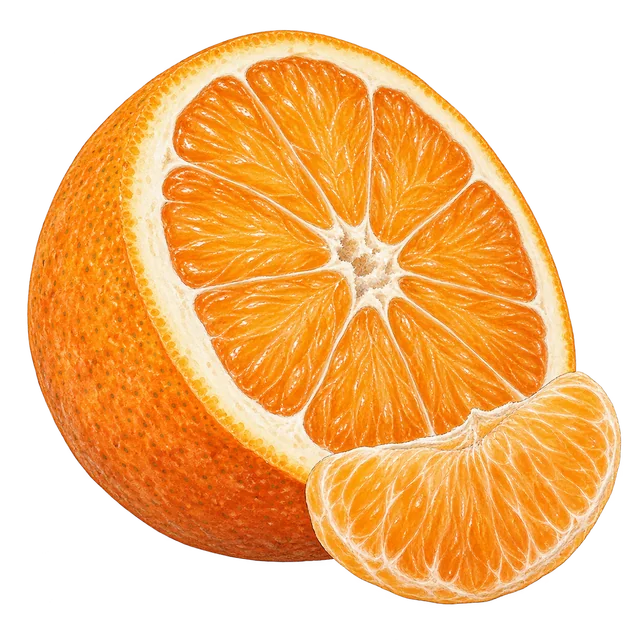
A medium orange supplies close to a full adult day of vitamin C. The body uses it to build collagen, and relies on it to help absorb the iron in plant foods. How it does both is covered in the chapter on what vitamin C does in the body.
The orange is one of the most common members of the citrus family, related to lemon, pomelo, mandarin and lime. It is mostly water and low in calories.
One more thing worth knowing up front: eating a whole orange and drinking a glass of orange juice are not the same thing nutritionally, and the difference is mostly fiber.
Background · The two parts of an orange
What most people call an orange is the sweet orange; navel and blood oranges belong here.
It has two parts: the segmented flesh inside, and the peel with its white pith outside. The flesh gives you water, sugar and vitamin C, while the pith and the membranes between segments hold much of the fiber and flavonoids.
That split decides one thing about how you eat it. Peel an orange and eat it with the white pith still on, and the fiber and flavonoids come along. Juice it, and what is left is mostly the sugary water and vitamin C from the flesh, while the pith and membranes largely end up in the pulp. The chapter on how eating an orange differs from drinking the juice puts this in a table.
Chapter 2
What its vitamin C does in the body
A medium orange supplies close to a full adult day of vitamin C (ascorbic acid) (see Vitamin C). In the body it does three specific jobs:
Building collagen: the enzymes that make collagen need vitamin C to keep working. Without it, collagen fibers cannot be wound tight, which is where the bleeding gums and slow-healing wounds of scurvy come fromHelping plant iron get absorbed: iron in plant foods is mostly the hard-to-absorb ferric form (Fe³⁺), and in the gut vitamin C reduces it to the easier-to-absorb ferrous form (Fe²⁺). It only works when eaten in the same meal as the iron, which is why pairing plant iron with an orange or a bell pepper pays off (see Iron)Taking oxidation: in body fluids it takes the oxidative hit in place of more important molecules Beyond vitamin C, an orange supplies folate, potassium and hesperidin, a flavonoid typical of citrus. Vitamin C is sensitive to heat and oxygen: long cooking, or leaving cut fruit to sit, both drain it, so fresh and raw keeps it best.
Numbers · Which foods carry more vitamin C
Oranges and vitamin C are tied together so tightly that it became a title. But "which food has the most vitamin C" is a question with a checkable answer: look it up in one database.
Per 100 g raw, ascorbic acid:
Food
Vitamin C
vs orange
Orange, raw
53.2 mg
1×
Red bell pepper, raw
128 mg
2.4×
Green kiwifruit, raw
92.7 mg
1.7×
Red bell pepper is not a fruit and never sits on the "get your vitamin C" shelf, yet by weight it carries more than twice what an orange does.
This is not saying "don't eat oranges": an orange is still a fine vitamin C source, and it also brings folate, potassium, fiber and hesperidin, the flavonoid typical of citrus.
It is saying something else: a "king of X" claim can almost always be overturned by one table. Next time a food is crowned for some nutrient, you know what to do: look up the per-100 g figure, then check whether something else quietly beats it. The answer is usually right there; nobody looks.
usda-fdc-bell-pepperusda-fdc-kiwi
Chapter 3
How eating an orange differs from juice
Eat a whole orange or drink the juice: this everyday choice makes a bigger nutritional difference than most people expect.
Juicing does two things. First, it throws away the fiber: what you drink is almost only sugar water plus vitamin C, without the fiber that cushions blood sugar. Second, it gathers the sugar together: a glass of orange juice often takes several oranges, so the sugar you drink in one go is far more, and arrives far faster, than what you would get sitting down to eat one orange.
The result: both come from oranges, but eating and drinking send the body different signals. A whole orange is filling and raises blood sugar gently; juice is fast sugar and easy to overdo. That is why dietary guidelines broadly advise favoring whole fruit and limiting juice (see Carbs & Fiber).
Vitamin C also fades: fresh-squeezed juice left standing, and store-bought juice after heat pasteurization and long storage, both lose vitamin C over time as it oxidizes, so even juice's one advantage, topping up vitamin C, is discounted. If you want what an orange has to offer, eat the whole orange first.
A CLOSER LOOK
Juice comes from segments, but loses structure
Whole segments arrive with their fiber structure. Juicing changes that structure and the amount easily swallowed, not just the fruit's name.
1Intact segment
A whole orange carries fiber and requires peeling, chewing and time, all relevant to fullness.
2Sugar and water
Juicing mainly removes fiber, leaving sugar and vitamin C in liquid. One glass often comes from several oranges.
Illustration for understanding; not to scale. Saved figures include explanations and sources.
Numbers · What juicing takes away
"Fresh-squeezed beats a soft drink" sounds self-evident. Put a whole orange and fresh orange juice in the same table and the difference gets specific.
Per 100 g:
Whole orange
Fresh orange juice
Energy
47 kcal
45 kcal
Vitamin C
53.2 mg
50.0 mg
Dietary fiber
2.4 g
0.2 g
Calories nearly identical, vitamin C nearly identical, and fiber down about 92%.
So juicing barely touches the sugar and barely touches the vitamin C; what it mainly removes is fiber. And fiber is exactly what shapes how fast that sugar reaches your blood: it forms a sticky layer in the gut that spreads absorption over a longer stretch. The sugar is not reduced; its arrival rate changes.
Data from people point the same way. In three long-running US cohorts (Muraki 2013), people who ate more of certain whole fruits had a lower risk of type 2 diabetes, while people who drank more fruit juice had a higher risk. This is an observed association and cannot show that the juice caused it, but it tells the same story as the table above: the same sugar, one slowed by fiber and one not.
In practice: drink it if you want it, but count it as "a sweet drink that carries vitamin C", not as "a serving of fruit". The fruit part stayed in the pulp that was strained away.
usda-fdc-orange-juice
Chapter 4
Can high-dose vitamin C prevent colds
For most people, taking vitamin C regularly does not prevent colds; it only makes a cold slightly shorter. Taking large amounts only after a cold has started showed no consistent benefit in trials.
Many people down effervescent tablets the moment a cold starts, a habit that traces back to a wave of promotion in the 1970s. Decades of since then add up to this: regular vitamin C does not lower an ordinary person's chance of catching a cold, and in people who take it regularly, colds are on average a little shorter, by an amount you would barely notice.
Rather than stockpiling tablets, eat whole oranges and vegetables regularly and treat vitamin C as part of your everyday diet.
Evidence · What the vitamin C and cold trials show
"Vitamin C prevents colds" may be the most widespread nutrition claim of all. Much of it traces to Linus Pauling's promotion in the 1970s, but the decades of research since have not backed him.
A Cochrane systematic review of many (Hemilä and Chalker 2013) looks at three questions:
Prevention: in the general population, taking it regularly every day does not lower the chance of catching a cold.Shortening colds: in people who take it regularly, colds last slightly less long, but the effect is small.Starting once a cold begins: when people started only after symptoms appeared, neither the length nor the severity of the cold improved consistently. There is one exception: among people under brief periods of extreme physical strain, such as marathon runners and soldiers on subarctic exercises, regular vitamin C clearly lowered the risk of a cold in trials.
So the accurate statement is not "vitamin C prevents colds" but "for most people it will not prevent a cold; taken regularly it trims the length a little at most, and megadosing after a cold starts has no evidence behind it."
References · 7
U.S. Department of Agriculture, Agricultural Research Service. (2019). FoodData Central: Oranges, raw, all commercial varieties. A medium orange supplies close to a day's vitamin C; folate, fiber, flavonoids. fdc.nal.usda.gov
National Institutes of Health, Office of Dietary Supplements. (2024). Iron — Fact Sheet for Health Professionals. Fact sheet (updated September 4, 2025; Wayback snapshot 21 September 2026): RDAs 8 mg/day for men and for women 51+, 18 mg women 19-50, 27 mg pregnancy; UL 45 mg/day from age 14; bioavailability about 14%-18% from mixed diets with meat, seafood and vitamin C and 5%-12% from vegetarian diets; serum ferritin below 30 mcg/L suggests iron deficiency and below 10 mcg/L IDA, but inflammation can raise ferritin; supplemental iron of 45 mg/day or more may cause nausea and constipation; people with hereditary hemochromatosis are at risk of iron overload (fact sheet). Heme vs nonheme: heme iron (lean meat and seafood are the richest sources) has higher bioavailability than nonheme iron, and other dietary components affect it less; calcium might reduce the bioavailability of both forms; heme iron is about 10%-15% of total iron intake in western populations. The sheet gives no separate heme and nonheme absorption percentages (fact sheet, Wayback 2026 snapshot). ods.od.nih.gov/factsheets/Iron-HealthProfessional
Muraki, I., Imamura, F., Manson, J. E., Hu, F. B., Willett, W. C., van Dam, R. M., & Sun, Q. (2013). Fruit consumption and risk of type 2 diabetes: results from three prospective longitudinal cohort studies. BMJ, 347, f5001. Across 187,382 participants in three cohorts, higher whole-fruit intake was associated with lower type 2 diabetes risk while higher fruit-juice intake was associated with higher risk; substituting whole fruit for juice was associated with lower risk. Abstract figures (NHS, NHS II, HPFS; 12,198 cases): per 3 servings a week, whole fruit HR 0.98; blueberries 0.74, grapes and raisins 0.88, apples and pears 0.93, bananas 0.95, cantaloupe 1.10; fruit juice 1.08 (1.05-1.11). Observational (abstract, PMID 23990623). 10.1136/bmj.f5001
Hemilä, H., & Chalker, E. (2013). Vitamin C for preventing and treating the common cold. Cochrane Database of Systematic Reviews, (1), CD000980. Regular vitamin C does not reduce cold incidence in the general population; it modestly shortens duration (~8% in adults), with no benefit when started at symptom onset. 10.1002/14651858.CD000980.pub4