Story
Mango
Last updated
In one pass The orange color of mango flesh comes from beta-carotene, which the wall of the small intestine cuts apart and remakes into vitamin A; the more orange the flesh, the more you usually get.
Educational content, not medical advice — consult a clinician.
Story path
Chapter 1
What is mango · varieties and color
Mango and cashew are relatives: both belong to the cashew family (Anacardiaceae). The kinship shows up in the skin. Mango skin holds an oily substance that makes a small number of people's skin go red and itchy after touching it, and the chapter on why mango skin can trigger allergy is about exactly that. If the lips swell or breathing becomes difficult, get medical care promptly.
Mango (Mangifera indica) is native to the Indian subcontinent and is one of the world's most produced and most eaten tropical fruits, with more than 500 named cultivars. Color cannot tell you whether it is ripe: some cultivars (such as Ataulfo) stay yellow when ripe, while others (such as Tommy Atkins) are still green and red when fully ripe. The reliable test is a gentle press with your hand: a slight give means it is ripe.
Mechanism · after it is picked, the mango is still at work
A mango does not clock out when it is picked. It is still breathing, still remodeling itself by a program already written — that program is called ripening after harvest.The trigger is a gas signal: the fruit itself synthesizes ethylene. Once the concentration builds high enough, it is like flipping a switch, and a batch of enzymes is made and put to work. Each enzyme does its own job:
Starch-breaking enzymes: while the mango grew on the tree, it stored energy in the flesh as starch. Starch is, plainly, a long chain of glucose molecules holding hands. The chain itself is not sweet. These enzymes snip the chain, sugar units are released one by one, and only then does the flesh start to taste sweet.Pectin-loosening enzymes: cells stick to cells by pectin, like cement in the joints of bricks. These enzymes soften the cement, and the flesh goes from rock-hard to something you can press.At the same time, organic acids in the flesh are burned off bit by bit as fuel, so the sourness recedes; and pigments of the carotenoid class are made in quantity, so the flesh turns from pale yellow toward orange.
Put these side by side and you see they are not several events, but several faces of the same program: softening, sweetening, becoming less sour, deepening in color — all triggered by that one ripening switch.
Which answers a common question: if a mango tastes sweeter after a few days on the counter, did the sugar increase? No. The sugar was already in there. It was just locked in starch chains the tongue cannot taste as sweet. Ripening takes apart; it does not make new. Add the receding sourness — acid covers sweetness — and the same amount of sugar tastes sweeter.
One step further: this is also why green mango and ripe mango eat like two different fruits, yet are two stages of the same fruit.
In practice · Why pressing beats looking
Once you know this ripening program runs in the flesh, the rule for picking a mango no longer needs to be memorized.The color you see through the skin is the skin's own business: the ground color is set by variety. Some varieties lose their green pigment cleanly; others keep a patch of green and red to the end. Skin color and the flesh's progress were never the same event — that is why color lies. The color of the flesh does carry information, but it tells you about the cultivar: orange-fleshed cultivars (such as Alphonso from South Asia and Carabao from Southeast Asia) are usually sweeter and richer in beta-carotene.
The firmness you feel when you press comes directly from how far the pectin has been loosened, which is the progress bar of the ripening program itself. Pressing is reading the progress directly. Looking is guessing through a layer.
Smelling the stem end is the same logic: aroma molecules made in the flesh during ripening volatilize, and that scar at the stem is the easiest place for them to escape. A clear sweet scent means the work inside is underway.
Push one step further and you can judge something yourself: a mango picked too early can still roughly finish the starch-breaking and pigment-making branches of the program, so after a few days it will soften and yellow; but the sugar and flavor compounds that should have been stored in the flesh during the time on the tree were never accumulated, so there is little to take apart. It is soft, it is yellow, and it is still not sweet enough. Ripening can release what is already there. It cannot invent the share the tree never gave.
Chapter 2
How orange flesh becomes vitamin A
The pigment that dyes the flesh orange is beta-carotene, which is also the raw material for vitamin A. After you eat it, it meets a dedicated pair of scissors (an enzyme) in the cells of the small-intestine wall, which cut this long molecule in the middle; each half is then remade into vitamin A. So the deeper the orange of the flesh, the more vitamin A you can usually get from it. It is one of the very few nutrients you can roughly estimate by eye.
The scissors work on demand: when the body has enough vitamin A they cut less, and the beta-carotene left uncut does not become vitamin A. That is why getting vitamin A from orange-fleshed fruit does not pile up to toxic levels the way swallowing high-dose vitamin A can.
But one condition is often missed: beta-carotene dissolves only in fat. Eat mango on its own and a good part of it passes through the gut unchanged; pair it with a little fat (yogurt, nuts) and absorption is worth it.
Beyond that, mango gives you vitamin C, folate and a moderate amount of fiber. It is not just a bag of sugar.
A CLOSER LOOK
Orange flesh and a dried package
The fresh and dried forms are illustrative, not equal sugar or weight. Flesh pigments and energy density after drying are separate ideas.
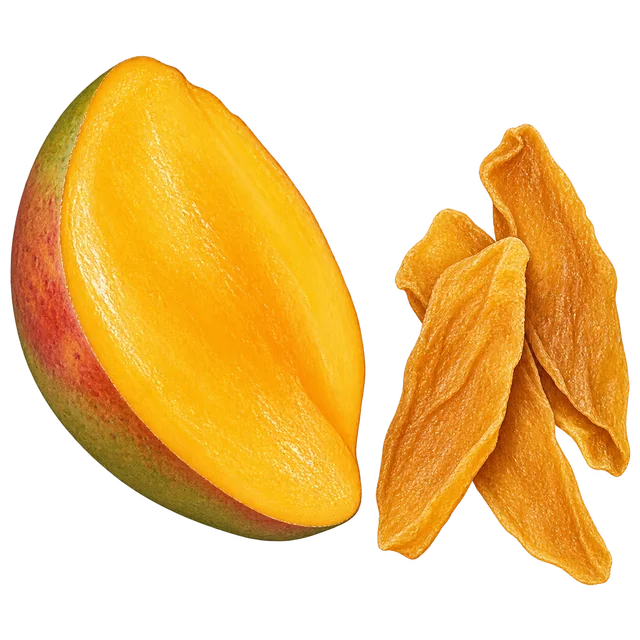
- Orange flesh
- Beta-carotene colors the flesh and can be converted to vitamin A as needed in the body.
- Dried strips
- Drying mainly removes water. For the same weight, sugar and energy are more concentrated while volume is smaller.
Illustration for understanding; not to scale. Saved figures include explanations and sources.
Numbers · what is actually in a serving of flesh
Mango is one of the more nutritionally balanced tropical fruits — not just sugar. The numbers below come from a food composition database; variety and ripeness will move them.Vitamin C: about 36-46 mg/100 g, depending on the variety. A 200 g serving of mango can provide an amount approaching an adult's daily vitamin C need.
Beta-carotene (the raw material for vitamin A): orange-fleshed varieties carry clearly more. By the food composition tables, 100 g of ordinary mango yields only a small part of a day's vitamin A need, and orange-fleshed varieties somewhat more. The deeper the yellow or orange, the more beta-carotene there usually is.
Folate: about 14-43 µg/100 g, meaningful for pregnancy and everyday cell metabolism.
Vitamin B6: about 0.12-0.13 mg/100 g, involved in protein metabolism and neurotransmitter synthesis.
Fiber: about 1.6 g/100 g (moderate), mainly pectin and cellulose.
Calories: about 60-70 kcal/100 g. A whole large mango (350 g) holds roughly 210-245 kcal and 45-50 g sugar — a quantity worth noticing.
This table also has two ways of reading worth keeping.
Vitamin C fears heat and oxygen. It dissolves in water, and heat, air, and sitting around all nibble it away. So for the same mango, this column looks best when you eat it fresh and raw; after boiling, baking, or sitting cut for a long time, it is the first item to drop.
Beta-carotene is the opposite: it is an oily pigment. It tolerates heat a little better, but it needs a bit of fat to get into the gut wall. So the ways of holding onto these two columns are completely different: one depends on not heating, the other on pairing with a little oil.
Mechanism · How an orange pigment becomes vitamin A
Walk this molecule through once and you will see why the how to eat advice is shaped the way it is.In the flesh: beta-carotene is locked in the cells, sitting with other fat-soluble substances. Chewing the flesh is not optional — if the cell walls do not break, the pigment inside never comes out.
In the small intestine: it does not dissolve in water, so it cannot swim on its own in the gut fluid. Bile and fat from the meal have to wrap it into tiny oil droplets; only then can the droplets dock on the gut-wall cells and send it in. Eating it plain versus with a little yogurt or nuts: the absorption difference comes from this step — not mysticism. It simply needs an oil-made vehicle.
In the gut-wall cell: a dedicated enzyme snips this long molecule right in the middle. One becomes two pieces; each piece is remodeled one more step and becomes usable vitamin A. How much gets snipped is not arbitrary: when the body has enough vitamin A, these scissors work less, and the beta-carotene left uncut does not become vitamin A. This is why taking vitamin A from orange pigments in food does not poison you — a valve sits in the middle that can close itself down; high-dose vitamin A swallowed directly has no such valve. What goes in, stays in.
After it enters the body: it is packed into lipid particles, enters the blood via lymph, and most of it is stored in the liver first, released when needed. So vitamin A is a nutrient that has a stock, unlike vitamin C, which has to be eaten and used day by day.
Where it is used: some is sent to the retina of the eye, loaded into the pigment that detects light; when light hits, that pigment changes shape, and only then can the signal leave. When the body lacks it, the first problem is often not seeing well in the dark — because dim light offers the fewest photons, which is exactly when this pigment is most needed. Another part maintains the epithelium, the lining of skin, airways, and gut; that lining is both a physical barrier between the outside and the body, and part of immunity.
Finish this chain, then look back at the more orange the flesh, the better and eat it with a little fat. They are no longer slogans to memorize — you know which link of the chain each one sits on.
Evidence · What backs mangiferin so far
Mangiferin is a polyphenol that mango carries in fair amounts; chemically it belongs to the xanthones, and it is found in both the skin and the flesh. In vitro research shows anti-inflammatory and antioxidant activity; human clinical evidence is very limited, and for now it is only a preliminary signal.The most worth learning in that sentence is not mangiferin. It is the two words in vitro.
In vitro means: researchers grow cells in a dish, then add this compound straight in. The cells in the dish have no mouth, no stomach, and no liver. The concentration they meet is the concentration the experimenter poured in.
When you eat a piece of mango, a whole road sits in between: it is first remade by digestive juices and the gut microbes; only what is left is absorbed at the gut wall; the first stop after absorption is the liver, which tags it so the kidney can clear it. By the time it finally rides the blood to some tissue, the concentration is often far lower than in the dish, and the form may no longer be the original molecule.
So between active in a dish and useful to a person who eats it sits not one step, but a whole road that has to be tested separately. That is not to say mangiferin is meaningless — it is to say it is currently parked at the start of that road, not the end.
Keep this tool. Next time a food component is sold as anti-inflammatory, antioxidant, or anticancer, ask one question first: was this measured in a person, or in a dish? That single question screens out a large share of the claims on the market.
Chapter 3
Why mango skin can trigger allergy
Mango skin, and the sap that oozes out when you cut it, contain urushiol, the same family of compounds found in the lacquer tree and poison ivy. Mango, cashew and the lacquer tree belong to the same plant family, and plants of one family defend themselves with the same kind of chemical.
Urushiol is oily. When it touches skin it does not stay on the surface; it slips straight into the outer layer and then hooks onto your own skin proteins. When the immune system patrols and sees this remodeled protein, it files it as foreign.
So people who are sensitive to urushiol (usually the same people who react to lacquer trees or poison ivy) can get contact dermatitis from touching mango skin or peeling mangoes: red, itchy skin around the mouth or on the hands.
Notice where it lands: symptoms appear only where the skin was touched, and whole-body allergic reactions to eating mango flesh are uncommon. The fix is simple too: cut the mango open with a knife, and do not bite into the skin.
Mechanism · Why the itch comes late and peaks next day
Contact dermatitis has a peculiar tempo, and every one of its traits can be derived from a single fact: urushiol is too small.Step one: it is small enough that the immune system cannot see it. The immune system recognizes large molecules of the protein kind; a small molecule like urushiol drifting on its own is not worth its time. But urushiol is oily, and the outermost layer of skin is precisely an oil barrier — a wall to water, a door to oil. It walks straight in, then binds to proteins in the skin, assembling something half-self, half-foreign. Now the immune system sees it.
Step two: the first contact often does nothing. That pass is filing a record: immune cells take the remodeled protein, register it, and train a batch of cells that specialize in recognizing it, then leave them on standby in the body. So some people eat mango for years and only then suddenly start to itch — sensitivity is accumulated, not a switch you are born with.
Step three: the next contact is when it flares, and it is slow. The standby cells have to be called to the site first; once there they release signals; the signals recruit more cells; local vessels widen and tissue takes on water — redness, swelling, and itch are the result of this chain, not of the contact itself. Calling people in and traveling both take time, so it often does not flare on the spot. It is later, even the next day, that it is most obvious. That is not the same pathway as the kind of reaction that raises hives the moment you eat the wrong thing.
Step four: why only where you touched. Because the antigen is pinned to skin proteins at the contact site. It has nowhere else to go. The immune reaction happens only where it sits, so the shape of the rash often faithfully traces where you touched.
Once you know the troublemaker is oil, you can derive two more things yourself:
Rinsing with water alone does little. Oil needs detergent to leave. After cutting a mango, wash your hands well with soap before you rub your eyes or touch your face.A rash sometimes appears where you clearly never touched the mango. That is usually not it spreading on its own; it is leftover oil on your hands that you carried there.
If the rash is widespread, blisters, or the lips swell or breathing is hard, that is no longer an ordinary contact reaction — seek medical care promptly.
Mechanism · What separates green and ripe mango
Unripe green mango and ripe mango are two very different ingredients in the kitchen. The difference is not variety. It is how far the ripening program has run.Green mango: starch-dominant (lower glycemic impact), sourness from malic and citric acids, high tannins. Thai green mango salad (som tum) uses exactly this character of green mango. Vitamin C is slightly higher than in ripe mango; beta-carotene is much lower (the pigment has not fully developed yet).
Ripe mango: starch already converted to fructose, glucose, and sucrose, sweeter, beta-carotene fully developed. The fiber composition also differs between the two states — soluble fiber increases after ripening.
Read these two columns against the ripening program again, and every row has a source.
Why is the glycemic impact of green mango lower? Not because it has a little less sugar, but because the sugar is still locked in starch chains — starch itself is not sweet, and it needs one more breakdown step before it becomes absorbable sugar. Incidentally, that astringent tannin bite makes you naturally eat less, which is itself a brake.
Why does soluble fiber increase after ripening? This one sounds most like it appeared from nowhere. It is the same event as the flesh going soft: the pectin between cells has been loosened by enzymes. Loosened pectin is soluble fiber — once in the gut it can take on water, turn sticky, and lay down a film that slows sugar absorption. In other words, soft and fiber becoming soluble are two names for the same action.
Why is beta-carotene much lower when it is green? Because those orange pigments are made in quantity only during this ripening stretch. Green mango did not hide the pigment. It has not made it yet.
So do not treat green mango as an unfinished reject. It is another stage of the same fruit, meant to be eaten with fish sauce and chili. It does not have to wait until it is sweet.
Numbers · why dried mango counts as a different food
100 g of fresh mango is about 60 kcal; 100 g of dried mango is about 300-320 kcal, of which sugar is about 55-65 g. That is a 4-5× concentration of both calories and sugar. If you want mango's nutrition, fresh mango is far better than dried.The multiple is not mysterious. Almost all of it comes from water. Water is the largest share of a fresh mango; drying takes the water away, and the sugar and calories stay put. Weigh the same serving and the share of sugar and calories naturally jumps.
The real trouble is not this ratio. It is volume. The part water was holding open is gone, and a whole mango shrinks into a small handful of chips. Eating a fresh mango means sitting down and taking time; the flesh occupies space in the stomach; the stretched wall sends a signal up, reminding you enough. The same amount of sugar as chips is gone in a few bites while you watch a show; the stomach is barely stretched, and that enough signal does not have time to appear.
So the real difference here is not on the nutrition table. It is how easily you can eat too much. Dried mango is not a bad food, but treating it as fruit and treating it as candy are completely different outcomes.
Chapter 4
What it lacks, and managing blood sugar
Its real effect on blood sugar: mango's glycemic index (, a measure of how fast a food raises blood sugar) is about 51-60, low to moderate. Whole fruit brings its own fiber, which slows the release of sugar. For most people without diabetes, a 100-150 g serving has a reasonable effect on blood sugar. People with diabetes can usually eat it with glucose monitoring and a controlled portion (under 100 g at a time), but should follow their doctor's advice.
How to pair it:
With protein and fat (yogurt, nuts, cheese): the sugar arrives more slowly and the blood-sugar curve is flatter, and that bit of fat also carries the beta-carotene inWith acid (lime juice): for green mango, which still carries starch, and the rice served with it, this may slow the sugar a little; it is also the traditional Thai way of dressing itAs the sweet part of a meal, not the main dish: put mango into a meal alongside whole grains and protein foods, rather than eating a big plate of it on its own
Eat the whole fruit; do not just drink the juice. Juicing throws away most of the fiber and concentrates the sugar in a liquid, so blood sugar rises faster.
Mechanism · Why protein and fat flatten the curve
The advice to pair some protein is everywhere, but almost no one says where it acts. It acts at the exit of the stomach.The stomach does not dump food into the small intestine in one pour. There is a gate at the bottom, and the nature of the contents sets how fast it opens. Sugar water alone, and the gate opens fast; the sugar almost rides straight to the small intestine and is absorbed into the blood at once — that is how the glucose spike is made.
Add protein and fat, and the picture changes: when fat reaches the upper small intestine, cells there send a signal back, telling the stomach to release more slowly. The same amount of sugar then enters the blood over a longer stretch of time, and the curve flattens on its own. The sugar did not shrink. What changed is the speed at which it arrives — that is the one sentence that unlocks almost every blood-sugar pairing tip.
Fiber helps at another spot: in the gut it takes on water and turns sticky, laying down a thick gel layer that sugar molecules have to cross before they can reach the wall. So intact fruit and a drink with the same amount of sugar have never been the same event for the body.
As for pairing with acid: an acidic environment inhibits amylase, the scissors that snip starch into sugar. So acid's most direct effect is on things that still carry starch — green mango, and the rice or sticky rice served with it.
One last cheap gain you can pick up on the way: the yogurt or nuts you added to flatten the glucose curve carry fat that is also the oil-made vehicle beta-carotene needs in order to be absorbed. One pairing, two returns.
Mechanism · Whole fruit or juice: where they part
A glass of juice and a piece of fruit may hold about the same sugar, but the body receives two different things. The difference happens at whether the step in your mouth was done for you by a machine.In intact flesh, sugar is locked in cell after cell, and outside each cell is a wall built of fiber. You have to chew; saliva and gastric juice have to take time; the gut still has to take the cells apart bit by bit — the sugar is released slowly. A juicer finishes all of that work in one pass, in advance: the cells are smashed, the sugar floats free in liquid, and the fiber is filtered off as pulp. The liquid left, once swallowed, barely needs any breakdown before it is absorbed.
Another layer is portion. Sit down and eat a mango, and you are looking at about one mango; a glass of juice often takes several, and after you drink it your stomach is barely occupied, so a second glass is easy.
Put the two layers together: juice is faster, plus more.
This rule holds not only for mango. It holds for any fruit. So next time you see a claim like fresh-pressed, no additives, you already know where to ask: nothing was added, that much is true — but what was taken away?
Chapter 5
How to pick, cut and store
How to cut it (and avoid the urushiol on the way): work from the outside with a knife, and do not put the skin in your mouth:
1. Slice: cut down both sides to take off two cheeks of flesh, then cut around the thinnest part of the stone in the middle
2. Score: on each cheek, cut a grid into the flesh, push it inside out into a hedgehog, and scoop the cubes off with a spoon
3. Peel: peel it with a vegetable peeler or a knife, then cut it into pieces
Storing: leave unripe mangoes at room temperature to ripen on their own; keep ripe ones in the fridge and eat them within 2-5 days. Seal cut mango in plastic wrap, refrigerate it and eat it soon, because the cut face starts to oxidize as soon as it meets air.
Mango and milk do not clash: the pair is a standard combination in many tropical desserts, with no nutritional taboo. Mango is a genuinely nutritious tropical fruit that simply has more calories and sugar than most fruit: enjoy it, and keep an eye on the portion.
Mechanism · What the storage rules actually do
The storage rules, taken apart, are doing only two jobs: throttling the ripening enzymes, and blocking air.Why only the fridge once it is ripe. What makes a mango soft and sweet is a batch of enzymes, and enzymes move clearly more slowly in the cold. Putting a ripe one in the fridge is stepping on the brake of this program, so it can last a few more days. Putting an unripe one in is the same brake — it only stalls the ripening with it, and what you wait for is not sweetness, but a fruit stopped halfway. So the unripe ones belong at room temperature, to finish on their own.
Why cut mango should be sealed and eaten soon. A whole mango has a skin holding air off for it; one cut opens a mass of cells, and what was inside meets oxygen directly for the first time. Oxidation starts at that cut face. Wrap blocks the air; cold slows the speed; only both together hold it back.
Why an overripe mango has that water-blister feel. The pectin-loosening enzymes do not stop on their own just because it is soft enough. They keep soaking the glue between cells; once the glue cannot hold, water from inside the cells seeps into the spaces between them — that pocket of water you press is it. So that is not one small spoiled patch. It is the same program run past the end.
Myth · What food-clash claims leave out
X and Y cannot be eaten together is one of the longest-running classes of claim, and almost all of them share the same trait: a conclusion, and no chain.A real interaction can name three things — who meets whom, where in the body, and what then happens. This article already has a worked example: the bit of fat you eat with the mango, in the small intestine, wraps beta-carotene into oil droplets together with bile; the droplets then dock on the gut-wall cells and send it in. Every link points to a place, and every link can be looked up.
Food-conflict claims cannot give any of those three. They do not say which two components, do not say stomach or gut, and do not say what reaction occurs — they only say something will go wrong.
So next time you meet one, you have a cheap method: ask the three questions in order. Which two components? At which site in the body? What reaction, exactly? If the three questions still have no answer, you can mostly set the claim down.
The value of this tool is far larger than one mango with milk. It will help you screen out a large batch of claims that sound reasonable — because inventing a conclusion is easy, and inventing a mechanism chain that survives follow-up questions is hard.
References · 3
- U.S. Department of Agriculture, Agricultural Research Service. (2019). FoodData Central: Mangos, raw (SR Legacy, FDC ID 169910). Per 100 g: 60 kcal; vitamin A 54 µg RAE (1082 IU), coming from 640 µg beta-carotene and 9 µg alpha-carotene - the 640 µg is beta-carotene, not RAE; vitamin C 36.4 mg; folate 43 µg; total sugars 13.7 g. Single-variety Foundation entries differ, e.g. vitamin C 168.1 mg in Ataulfo vs 25.5 mg in Tommy Atkins (FDC IDs 2710834 / 2710833) (FDC API). fdc.nal.usda.gov
- National Institutes of Health, Office of Dietary Supplements. (2021). Vitamin C — Fact Sheet for Health Professionals. ods.od.nih.gov/factsheets/VitaminC-HealthProfessional
- National Institutes of Health, Office of Dietary Supplements. (2025). Vitamin A and Carotenoids — Fact Sheet for Health Professionals. ods.od.nih.gov/factsheets/VitaminA-HealthProfessional