Story
Kiwi
Last updated
In one pass One kiwi has about as much vitamin C as an adult needs in a day, and gram for gram more than an orange.
Educational content, not medical advice — consult a clinician.
Story path
Chapter 1
Green kiwi and gold kiwi
A small number of people are allergic to kiwi, more often people with a latex allergy. If the lips or tongue swell, the throat tightens, or breathing becomes difficult after eating it, get medical care immediately.
The green and gold kiwis in the supermarket are not two different fruits; they are two directions bred out of the same genus. Green kiwi (Actinidia deliciosa) is both tart and sweet, with a fuzzy skin; gold kiwi (Actinidia chinensis 'Hort16A') is sweeter and milder, less tart, and higher in vitamin C. The difference in flesh color is not dye: green kiwi keeps a lot of chlorophyll when ripe, while in gold kiwi the chlorophyll almost disappears and the carotenoids underneath show through.
Background · Where it came from, and two species
From the Yangtze to the shelfKiwifruit is native to China's Yangtze basin. It was taken to New Zealand in the early twentieth century, and after decades of selective breeding there it became the green-fleshed kiwi (Actinidia deliciosa) most common in supermarkets today. The name Kiwi comes from New Zealand's native bird; exporters chose it as a brand name — the chinensis in the scientific name is what still holds its real origin.
So calling kiwi a New Zealand fruit is only half right: the cultivar was picked out there; the fruit itself comes from China.
Green flesh and gold flesh: what actually differs
They are two species in the same genus, not fruit of different ripeness on one plant (that is the Bell Pepper story, not the kiwi story).
Color: after a green kiwi ripens, chlorophyll is still largely retained, so the flesh stays green; when a gold kiwi ripens, chlorophyll almost entirely fades, and the carotenoids that were already in the flesh show through, so it turns yellow. Once the green in front withdraws, the yellow shows — the same thing that happens when leaves change color in autumn.
Taste: sweeter, milder, less tart — these are not three independent traits, but three sides of the same difference. More sugar, less organic acid, and the tongue reads that as sweet without a sting. The sharp acidity of green kiwi is the direct result of higher organic-acid content.
Skin: the fuzz on green kiwi is a hair-like structure grown from epidermal cells; its main jobs are to cut water loss and keep insects off. Gold kiwi skin is smoother, so eating it with the skin on is much easier to accept.
A common mix-up, while we are here
Conventional cross-breeding and genetic modification are not the same thing. The former is repeated pollination between plants that already exist, then selecting the offspring — no step of inserting a gene across species. The genus Actinidia already has many species; breeders are only picking from that natural pool. Seeing a cultivar number and assuming it was made in a lab is treating a number as if it were a process.
Chapter 2
What nutrients kiwi carries
Beyond vitamin C, kiwi supplies:
Vitamin K (about 40 µg/100 g): one of the few K1 sources outside leafy greens, involved in blood clotting and bone metabolism (see Vitamin K1 (Phylloquinone))Folate (about 25 µg/100 g): important for cell division and for neural-tube development in pregnancy (see Folate)Potassium (about 312 mg/100 g): about the same as bananaCopper: involved in iron metabolism and in building connective tissue
Calories are about 61 kcal/100 g, moderately low; the glycemic index (, a measure of how fast a food raises blood sugar) is about 50-52, on the low side; dietary fiber is about 3 g/100 g.
The skin is edible too, with more fiber and folate, but the fuzz on green kiwi puts many people off; gold kiwi's skin is smooth, so eating it skin-on is easier.
A CLOSER LOOK
Flesh inside, fiber in the skin too
This is a green kiwifruit, not a gold variety. Vitamin content varies with variety and fruit size.
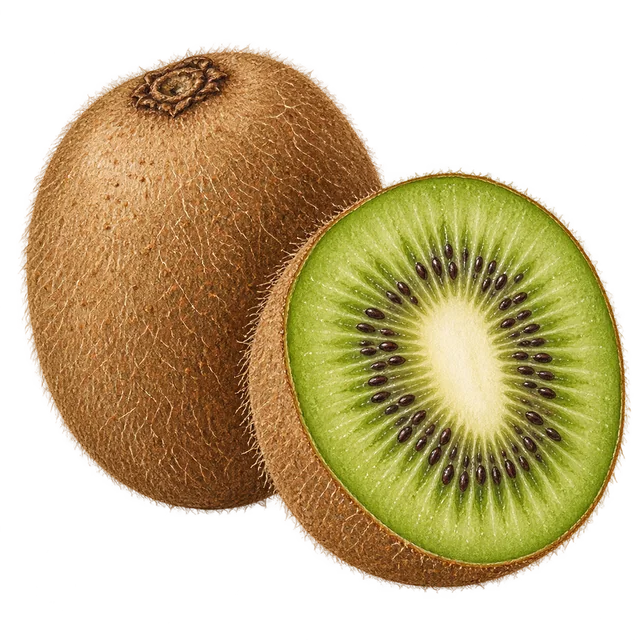
- Flesh and vitamin C
- Kiwifruit is a common high-vitamin-C fruit. Flesh color does not give the exact milligrams in this specimen.
- Fuzzy skin
- The skin contains fiber and folate and can be eaten after washing. Fuzz and texture lead some people to peel it.
Illustration for understanding; not to scale. Saved figures include explanations and sources.
Mechanism · where each of these goes to work in the body
A composition table only says what is there. Below is where each one goes and what it moves — once you know that, you can judge what a shortfall would look like.Vitamin C · an antioxidant, and a battery change for the collagen machine
It is easily oxidized itself, so it takes that hit for more important molecules. A harder job is keeping the collagen-making enzymes turning (the active site of that machine has an iron nested in it; every reaction needs someone to reduce that iron back to a usable form). Collagen is the rope that stitches skin, vessel walls, and gums together, so when vitamin C is severely short for a long time, those are the first places to fail.
Vitamin K1 · giving clotting factors a grip
When clotting factors first leave the liver they cannot hold calcium. The step vitamin K takes part in adds an extra carboxyl group at specific sites; only after that remodel can the site pinch a calcium ion; and calcium ions are the pins that press clotting factors onto the membrane at a wound surface. Without this step, the factors drift in the blood and never reach the scene.
A protein in bone called osteocalcin uses the same remodel to lock calcium into the bone matrix. So a vitamin K gap shows up at both ends: bleeding more easily, and bone metabolism affected. K1 sources outside leafy greens are not many; kiwi is one of them.
Folate · the tray that carries one-carbon units
When the body builds DNA bases, and when it methylates many molecules, it has to keep moving a one-carbon piece from here to there. Folate is that tray. If the tray is short, the fastest-dividing cells stop first — red-cell precursors in bone marrow (so the red cells that come out are oversized and too few, showing up as anemia), and the neural tube that is closing in early embryonic life.
Potassium · the battery across the cell
Potassium mostly stays inside cells, sodium mostly outside; that concentration difference is itself a battery. A nerve firing a signal, a muscle finishing a contraction — both use this battery discharging in an instant. So a potassium gap shows first in the tissues that most need precise discharge: muscles going soft, cramps, an unsteady heart rhythm.
Copper · the switchboard for iron
For iron to leave an intestinal cell into the blood, or to be released from a store inside the body, it first has to be oxidized to the ferric form before the blood's iron-carrying protein will take it. The enzyme that does this step runs on copper. So when copper is short, extra iron still cannot be shipped — a fork in the road that is easy to miss when iron supplements are not working. Copper also takes part in cross-links between collagen and elastin, the step that ties the ropes to each other.
Dietary fiber · volume that depends on water
The soluble part soaks up water into a gel, so stool holds more water and more volume; the insoluble part is not digested and fills volume directly. Once volume is up, the gut wall is stretched, and the peristaltic reflex that pushes things along is called. The first link in this chain is water — enough fiber without enough water and the gel never forms, which can make things more blocked, not less. So fiber and water have to be added together.
Myth · What one fruit a day really covers
The numbers on a composition table are concentration, not intake. Those two are often talked about as if they were the same, and they lead to opposite conclusions.A counter-example: raw chili has a higher vitamin C concentration than bell pepper, but nobody can eat a whole vegetable-sized serving of chili in one meal, so the vitamin C it actually contributes is small. Kiwi sits on the other side: the concentration is high, and you can actually eat the whole fruit — that is when high concentration becomes high intake.
To judge whether a food can cover a nutrient, ask how much you can actually eat.
One step further: why vitamin C has to be there every day, not topped up in one go
Vitamin C is water-soluble. Those two words decide its whole fate.
It cannot be stored: fat-soluble vitamins dissolve into fat and sit in the liver and adipose tissue, so a stretch without them still has a stock. Vitamin C dissolves in water, and the water in the body is filtered and renewed by the kidneys every day, so it has no real warehouse.Absorption saturates: the transporters that move vitamin C across the small-intestine wall are limited in number. Flood them at once and the doors cannot keep up, so the more you eat, the lower the fraction absorbed. What is not absorbed stays in the gut lumen and pulls water in — that is the mechanism behind large-dose vitamin C upsetting the gut.The excess is excreted: once blood vitamin C exceeds what the kidneys can reclaim, the rest leaves in urine. So swallowing a large handful of vitamin C tablets at once mostly ends up in the toilet, not in tissue.
Inference: frequency matters more than a single dose. A daily serving of a vitamin C source you can eat in quantity (kiwi, citrus, bell pepper, broccoli) sits at a scale the transporters can handle at ease; that is also where food is naturally better than a large-dose supplement.
Chapter 3
Its special enzyme, and kiwi at bedtime
The first is its own protein-cutting enzyme, actinidin: put simply, a pair of plant scissors that can snip protein. In the gut it may help break down some of the protein in meat and dairy, and for the same reason kiwi can be used to marinate and tenderize meat, much like papain from papaya and bromelain from pineapple. People with a latex allergy should take note: some proteins in latex and in kiwi look alike to the immune system, so a cross-reaction is possible (latex-fruit syndrome).
The second is sleep. One small study had adults who slept poorly eat kiwi every night before bed, and after several weeks their sleep onset and sleep quality had improved. But it had no control group; it only compared the same people before and after eating kiwi. The authors suggested that serotonin precursors and antioxidants in kiwi might explain it, a step that was never measured directly. So it is a preliminary signal worth studying further, not a verdict: eating a kiwi before bed is fine to try, but do not treat it as a way to treat insomnia.
Mechanism · one pair of scissors, four phenomena
Actinidin is called kiwifruit protease in Chinese. Rather than memorize the name, treat it as a pair of scissors: it cuts the links that string amino acids into a protein chain (peptide bonds). The blade carries a cysteine, which is why it is classed as a cysteine protease.Seen as scissors, four kitchen phenomena that look unrelated become the same event:
Marinated meat turns tender: the chew of meat comes from the connective tissue around muscle fibers and the long protein chains inside the fibers. The scissors shorten those chains, so the teeth have less work to do, and the bite turns tender. Papaya and pineapple tenderize meat for the same reason; they just carry different models of scissors.Over-marinating turns it to mush: the same scissors do not stop on their own. Given enough time, more than the surface is cut; the structure of the whole piece is taken apart, and tender becomes mush. So the point of a marinade is not how much you use. It is a time limit.Stirred into milk, it weeps: casein in milk is suspended as small particles; they stay apart because a layer of protein chains sticking out from the surface pushes them away from each other. The scissors cut those protruding chains; the particles lose their repulsion, clump and settle at once, and a layer of water clarifies on top. The milk is not spoiled; the enzyme is working — which is why yogurt and kiwi should be mixed only just before you eat.Gelatin jelly will not set: gelatin itself is protein taken out of collagen; it sets because those long chains lace into a net. Stir in raw kiwi and the scissors cut every rope in the net; the jelly never sets.
The same chain also gives the fix
The enzyme is itself a protein. Heat it far enough and its three-dimensional structure falls apart, and the scissors are spent. So if you want kiwi jelly, heat the flesh first, or use canned kiwi (the canning process has already heated it). Conversely, if you want it to tenderize meat, it has to be raw.
A claim that is easy to overstate
Some people talk as if actinidin will help you digest a whole meal. The reality: it only works in the short window of time and place where it actually touches the food, and the stomach already has its own full set of proteases. Treating it as a kitchen tool is closer to the facts than treating it as a digestive supplement.
Safety · Mouth sting versus a true allergy
Quite a few people, after eating kiwi — especially underripe green kiwi, or several in one go — feel the tongue and palate go numb and astringent, as if fine sandpaper had gone over them. Most of the time this is not an allergy. It is local irritation from two forces stacked together.One force is the scissors from just now
The surface of the oral mucosa is protein too. The enzyme does a little work there; what you feel is that astringent, tight sensation.
The other is needle-shaped crystals in the flesh
Kiwi flesh contains needle-shaped calcium oxalate crystals. Many plants use them against insects: they are like extremely fine glass grit, and chewing them scores many tiny cuts on the mucosa. Those cuts happen to open a door for the enzyme. So the two help each other — either one alone would not be this obvious; together they sting.
This fits a few common experiences: raw fruit tends to sting more than ripe; the more you eat, the more it stings (dose-related); and a sip of milk or a bite of yogurt often eases it — by the mechanism, the protein in dairy catches some of the scissors in place of your mouth.
How to tell this from a true allergy
Irritation: it is there while you eat, stays inside the mouth, tracks clearly with how much you ate and how ripe the fruit is, fades fairly quickly after you swallow, and eases with milk.Allergy: the immune system has misidentified someone. The reaction often leaves the mouth — swollen lips, a rash on the skin, a runny nose, abdominal pain; in serious cases a tight throat or trouble breathing. A very small amount can trigger it, and ripeness does not matter much.
One group should watch especially
People with a latex allergy. Some proteins in latex and some in kiwi look very alike to the immune system, so the chance of a mix-up is clearly higher; this is called latex-fruit syndrome. The first time these people eat kiwi they should try a small amount and watch the response.
If the lips or tongue swell, a rash spreads, the throat tightens, or breathing becomes difficult, that is already past local irritation — seek medical care immediately.
Evidence · What the bedtime kiwi study shows
The sleep stretch is worth reading slowly, because it is good material for learning how to read a study — once you can, the next time you see a claim that some food works, you can weigh it yourself.What that study did
In 2011, Lin and colleagues took 24 adults who already slept poorly, had them eat 2 kiwis 1 hour before bed every night for 4 weeks, and measured sleep before and after. Time to fall asleep, total sleep time and self-rated sleep quality all improved.
The problem is there was no control group
Everyone ate kiwi. There was no group eating something else, and no group eating nothing. So at least three things cannot be ruled out:
Regression to the mean: the people recruited already slept poorly, and sleep itself fluctuates. Recruited at a trough, they drift back toward the middle after a while — they would improve a little even if nothing was done.Expectation: knowing you are in a sleep study, plus a new fixed action before bed, will itself change how you fall asleep. A large part of what this study measured was subjective scores, which is exactly where placebo is strongest.Routines that changed along the way: to eat fruit before bed, people have to wrap up other activities earlier, leave the screen, and stabilize bedtime. What actually worked could be those, not the fruit.
Add a small sample (only 24 people), and the uncertainty of the conclusion is large by nature.
So how to use this information
Treat it as a low-cost practice with little downside: eating kiwi before bed hurts no one, and if it helps that is a bonus. Do not treat it as a treatment for insomnia, and do not let eating it become an excuse to ignore a real sleep problem — long-standing trouble falling asleep, frequent waking at night, severe daytime sleepiness: those belong with a doctor, not a fruit.
A general judgment you can take away
When a study says a food works, ask first: compared with whom. A before-after comparison with no control group is a signal; it cannot yet carry a conclusion. That is not to say a signal has no value — many important findings start as signals; the right use of a signal is to run the next controlled trial, not to write it straight into your life rules.
Chapter 4
What it lacks and what to pair it with
How to pair it:
To help iron absorption: eat kiwi's vitamin C in the same meal as plant foods that carry non-heme iron (spinach salad, tofu, oatmeal), and iron absorption rises clearly (see Iron). Slicing kiwi into a spinach salad puts this mechanism to work.To marinate meat: actinidin makes meat more tender. Spread kiwi purée on chicken breast, pork chops or steak for 20-30 minutes and the texture turns tender; marinate too long (more than 2 hours) and the meat can turn mushy.With yogurt: yogurt with kiwi gives you both vitamin C and protein. But actinidin breaks down milk protein, so if it sits mixed into dairy it weeps; stir it in just before eating.
One thing to watch: people with a latex allergy should try a small amount the first time and watch for a reaction.
Mechanism · how vitamin C helps plant iron into the gut wall
Slicing kiwi into a spinach salad is not just for looks. This step really changes one thing in the gut — and once you know which thing, you know when it works and when it is wasted.First, tell the two irons apart
Most of the iron in meat, poultry, and fish is wrapped in heme, a ring-shaped cage. The gut wall has a dedicated entrance that takes the whole cage in; absorption is already not low, and other things in the same meal barely interfere.
Iron from plants (spinach, tofu, oats, legumes) is bare non-heme iron. It takes another road, and that road is much pickier.
Where it gets stuck
On the lumen-facing side of an intestinal cell there is a transporter door that only recognizes ferrous iron. Most non-heme iron in food is ferric, so it arrives at the door and cannot go in.
Worse: phytate in grains and beans, and polyphenols in tea and coffee, are very fond of binding ferric iron. Once bound they become an insoluble clump, excreted whole, never even reaching the door.
Vitamin C does two jobs here
It is a reductant: in the lumen it reduces ferric iron to ferrous, so the door can recognize it.It binds iron first into a soluble complex, so phytate and polyphenols cannot grab it, and escorts it to the door.
Time and place are the point
Both of these happen in the time window of the same meal, the same stretch of lumen. Take vitamin C a few hours after the meal and the iron has already gone past — that is why the claim that vitamin C raises iron absorption must add the two words same meal, or the sentence is wrong.
So you can derive the following yourself
Spinach salad with kiwi, tofu with bell pepper, oats with citrus: three writings of the same chain.At a meal of plant iron, strong tea and coffee are better moved to a while after eating.This set does little for heme iron from meat — that iron uses another door and was never much affected by phytate or polyphenols. People who already eat meat do not need to rearrange around this trick.Vitamin C is afraid of heat and water: to use this trick, that meal needs a raw or lightly processed part. Boil kiwi into soup and then expect it to lift iron, and the first half of the chain is already broken.
One last boundary
This raises the fraction absorbed. It does not create iron from nothing. If very little iron went in to begin with, the absolute gain from a better fraction is limited too; and someone already diagnosed with iron deficiency belongs on the path of a doctor and tests, not fruit.
Chapter 5
How to pick, and can you eat the skin
Green or gold: both are high in vitamin C. Gold kiwi is sweeter and milder, good for people who find sour things hard to take; green kiwi is tangier, for people who like a sharp, fresh bite. Nutritionally the gap is small.
How to eat it: the simplest way is to halve it and scoop it out with a spoon. Sliced into yogurt, added to a fruit salad or blended into a smoothie all work. Eating it raw keeps the most vitamin C.
Can you eat the skin: yes, it is harmless for most people, and the skin holds more fiber and folate. The fuzz on green kiwi bothers many people, so brush it lightly with a soft brush; gold kiwi's skin is smooth, so eating it skin-on is easier. Just wash it well.
Kiwi is nutrient-dense, not high in calories and very high in vitamin C: one a day just about covers your vitamin C.
Mechanism · Ripening, and why to eat it once cut
A rock-hard kiwi shut in a paper bag with apples and bananas is soft and sweet two days later. It was not smothered ripe. It was told to ripen.Ethylene: a password inside the plant
Apples and bananas, as they ripen, release a very small gas molecule called ethylene. It is a ripening signal shared between plants and inside a plant. Kiwi's cells have receptors that pick up this signal; once it arrives, the fruit starts its own full ripening program. All the paper bag does is hold the gas in so the concentration can rise.
So ripening is not something from outside drilling into the fruit. It is the fruit starting work itself.
Once the program starts, three things happen in the flesh at once
It softens: pectin is what holds cells up and glues them to each other. The ripening program turns on a set of enzymes that take pectin apart; the glue between cells loosens little by little, and the flesh goes from hard to soft.It sweetens: an unripe fruit stores energy as starch, and starch is not sweet. Another set of enzymes takes the starch apart, piece by piece, into sugar — the sweetness did not come in from outside; it was already inside, only in another form. That is also why a picked unripe kiwi can still sweeten, and a picked watermelon will not: watermelon has no starch stock to take apart.It becomes fragrant: some aroma molecules are only synthesized at this stage. So an unripe fruit has no smell; a ripe one is fragrant the moment you cut it.
The fridge's job is then clear
Cold slows all of those enzymes, and ripening is held. So the right order is ripen at room temperature first, then refrigerate once ripe; put an unripe fruit straight into the fridge and it will stay hard, and once you take it out it will struggle to ripen properly.
Why eat it soon after cutting
Vitamin C's job is to take oxidation for others, so it is itself very easily oxidized into a form that is no longer active. A whole fruit has skin in the way, and little oxygen reaches the inside; the moment you cut, the face is exposed to air, and oxidase enzymes that had been kept apart in the flesh are released and start taking vitamin C apart on the spot.
Note this is not the same loss as in soup: in soup, part of the vitamin C ran into the water (drink the broth and you get some of it back); oxidation after cutting means it is truly gone, and you cannot get it back.
The matching practice is simple: cut and eat; if you need to prepare ahead, keep it whole in the fridge and cut just before eating.
References · 5
- U.S. Department of Agriculture, Agricultural Research Service. (2019). FoodData Central: Kiwifruit, green (Actinidia deliciosa) and gold (Actinidia chinensis), raw. Green kiwi ~61 kcal/100 g; vitamin C ~93 mg/100 g; vitamin K1 ~40 µg/100 g; folate ~25 µg/100 g; fiber ~3 g/100 g; glycemic index ~50-52. Gold kiwi vitamin C ~105 mg/100 g. fdc.nal.usda.gov
- National Institutes of Health, Office of Dietary Supplements. (2021). Vitamin C — Fact Sheet for Health Professionals. ods.od.nih.gov/factsheets/VitaminC-HealthProfessional
- National Institutes of Health, Office of Dietary Supplements. (2021). Vitamin K — Fact Sheet for Health Professionals. Fact sheet (updated March 29, 2021; Wayback snapshot 19 September 2026): free phylloquinone is about 80% absorbed, but absorption from food is much lower - the body absorbs only 4% to 17% as much from spinach as from a tablet; Table 2: natto, 3 ounces, 850 mcg (as MK-7); egg, hard boiled, 1 large, 4 mcg (as MK-4) (fact sheet). ods.od.nih.gov/factsheets/VitaminK-HealthProfessional
- National Institutes of Health, Office of Dietary Supplements. (2022). Folate — Fact Sheet for Health Professionals. ods.od.nih.gov/factsheets/Folate-HealthProfessional
- Lin, H. H., Tsai, P. S., Fang, S. C., & Liu, J. F. (2011). Effect of kiwifruit consumption on sleep quality in adults with sleep problems. Asia Pacific Journal of Clinical Nutrition, 20(2), 169-174. A within-group before-after study (n=24 adults with sleep difficulties); 2 kiwis eaten 1 hour before bed nightly for 4 weeks was associated with improved sleep onset (~35% faster), sleep duration, and subjective sleep quality. No control group; small sample; mechanism proposed involves serotonin precursors and antioxidant compounds. Evidence grade C. pubmed.ncbi.nlm.nih.gov/21669584