Story
Jujube (Red Date)
Last updated
In one pass Jujube, the red date, holds little iron, and what it has is the poorly absorbed kind found in plants, so the claim that red dates build blood does not hold up.
Educational content, not medical advice — consult a clinician.
Story path
Chapter 1
What jujube is, fresh and dried
Jujube is the fruit of the jujube tree, and it holds a high place in Chinese cooking and tradition, often treated as a symbol of nourishment. To understand it, first tell fresh from dried: fresh jujube is crisp, sweet, and juicy, and quite high in vitamin C; what we eat most often, though, is the sun-dried date, and drying pulls out the water and concentrates the sugar while much of the heat-sensitive vitamin C is lost. So although both are called dates, a dried jujube is really closer to a concentrated sweet dried fruit — the same story as grapes turning into raisins.
A CLOSER LOOK
Fresh and dried jujubes differ
The comparison is not an equal-weight portion. Fresh-fruit vitamin C and concentrated sugar in dried fruit belong to different accounts.
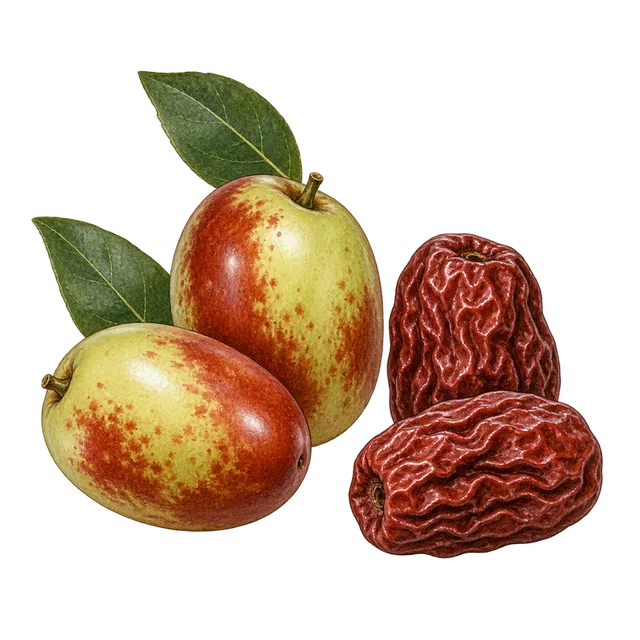
- Fresh jujube
- Fresh jujubes are crisp and juicy; vitamin C is their clear nutritional highlight.
- Dried jujube
- Drying removes water, concentrates sugar and loses much vitamin C. Red color is not blood-building ability.
Illustration for understanding; not to scale. Saved figures include explanations and sources.
Mechanism · What drying removes and what it leaves
Turning fresh jujube into dried is not the same thing shrinking. It is a very asymmetric swap: what leaves and what stays are not the same class of nutrient.Start with the half that leaves — water. Drying pulls out most of the moisture, so in every bite's weight, the share of everything that remains jumps. Sugar is the biggest winner of this concentration: the same mouthful of dried jujube is far denser in sugar than fresh. That is not the dried fruit becoming sweeter. It is the same sweetness squeezed into a smaller volume.
Then the one that leaves as a side effect — vitamin C. It is water-soluble; worse, it is a reducing agent by nature, the kind of molecule that takes the oxidation hit for someone else. Meet heat, meet air, meet metal ions, and it oxidizes first. So on any processing chain it is almost always the first nutrient to fall — and drying happens to supply heat and air together in full.
What stays are the things that do not fear those conditions: fiber, minerals, and the polyphenols that darken dried jujube. They do not leave with the water, and they do not fear heat the way vitamin C does.
So a dried jujube's identity is clear: it is a concentrated portion of natural sugar, carrying fiber and minerals, but missing most of the vitamin C. It is a tasty whole food, yet it is not a portable version of the fresh fruit — the nutrient most worth taking from fresh jujube is exactly the one that will not stay.
One more thing leaves with the water: volume and juice. Fresh jujube takes chewing and occupies the stomach, so you cannot eat that much in one sitting; dried is small, soft, and barely takes space, so handful after handful is easy to overdo. This is the same chain as grapes becoming raisins — what drying really changes is not only the ingredient list, but how much you will eat.
Chapter 2
Rich in vitamin C, low in iron
First, vitamin C: fresh jujube really does hold a notable amount, high among fruits. But drying destroys much of it, so if what you eat is dried red dates, do not expect them to still be a big vitamin C source.
Second, iron, and this is the key one. Jujube is actually low in iron (fresh jujube has less than 2 mg per 100 g; dried dates are more concentrated by weight, but the amount people eat in a day is small), and it is the non-heme kind found in plants, which is poorly absorbed. In other words, jujube is not a high-iron food, and the little iron it has is not absorbed efficiently either.
Put those two facts together and the foundation of red dates build blood is already shaken: how could a food that is low in iron to begin with, and whose iron absorbs poorly, build blood?
Mechanism · Why vitamin C is lost first yet helps iron
Jujube's two nutrition facts — high vitamin C, low iron — look like two lines side by side. They are actually strung together by the same chemical property. String that property through, and the whole story's logic stands.Vitamin C's job is to be a reducing agent. What a reducing agent does is simple: it gives its electrons away and takes the oxidation hit for other molecules. That one property decides both of its fates at once.
The first fate is that it is easy to lose. Since it is built to hand electrons out, the moment pro-oxidant conditions arrive — heat, air, metal ions — it is consumed first. So vitamin C is the most fragile link on any processing, storage, or cooking chain — that notable amount in fresh jujube is largely gone by the time you have dried dates.
The second fate is that it is useful. Iron from plants is mostly ferric iron in the gut lumen, the oxidized form, and the door on the intestinal wall that moves iron into the cell only recognizes the reduced ferrous form. Vitamin C hands over an electron, and ferric is bent into ferrous — the chapters on why jujube does not build blood and on how to eat it to help iron both keep coming back to this.
Lay the two together and it is interesting: vitamin C helping iron is not some special talent. It is the same property that makes it spoil easily. A molecule that loves to give electrons is short-lived in a jar and useful in the gut lumen.
As for the iron itself, count two things separately. Low content means this food never held much iron to begin with; poor absorption means that even what is there, only a small share gets into the body. Those are two independent deductions, and stacking them is the point — the chapter on why jujube does not build blood takes poor absorption apart and says which gates that path actually sticks at.
Chapter 3
Why jujube does not build blood
Treating the most common kind of anemia, iron-deficiency anemia, takes enough iron that can actually be absorbed, so the body can rebuild hemoglobin. Jujube is low in iron, and it is the poorly absorbed non-heme kind, so it supplies too little absorbable iron to carry the job of building blood. This is the same kind of mistake as eating spinach for iron: as Spinach explains, spinach's problem is not the iron content on paper but absorption.
Jujube has cultural value as a traditional food, but there is currently no reliable human evidence that eating red dates treats or prevents anemia. Treating it as a blood-building miracle can delay care for someone who actually needs the cause found and iron replaced.
Mechanism · plant iron: which gates actually stop it
Poor absorption is this whole story's fulcrum, but it is often used as a mere assertion. Walk the path once and you will see that what stops it is not one gate. It is three in a row.Start with the control. Iron in meat is wrapped in a small box called heme; the intestinal wall has a dedicated intake that recognizes that box and takes the whole box in — nothing along the way can snatch the iron inside. Plant iron has no box. It is bare, and mostly in the oxidized ferric form.
First gate: staying dissolved all the way through the lumen. Ferric iron does not dissolve well in the gut environment and easily precipitates out; worse, several things in a meal will actively grab it. Phytate in grains and legumes binds it into an insoluble clump; polyphenols in tea and coffee do the same; a large amount of calcium in the same meal is also competing. The captured share never even reaches the cell door.
Second gate: a bend at the cell door. The surface of small-intestine epithelial cells has a reductase that bends ferric into ferrous; the door that actually moves iron into the cell only recognizes ferrous. Skip that step and even iron that arrived intact cannot get in.
Third gate: the body itself decides whether it wants any. Excess iron catalyzes harmful oxidation, so the body does not take all comers — it opens this gate according to its own iron stores. When stores are sufficient, no matter how much plant iron you eat, the share let in is pressed down.
Stack the three gates and 'red dates build blood' is no longer a one-line conclusion. It is something you can ask ring by ring: content was never high → some of it is locked by phytate and polyphenols in the lumen → what remains has to be bent to ferrous first → and finally the body still has to be willing to take it. Every ring takes a cut, and the starting point was already low.
A more everyday point: in Chinese eating, jujube often shows up with tea — date tea, longan-and-jujube tea. The polyphenols in that cup are exactly the most common lock on the first gate. In other words, the most popular way of eating it narrows a path that was already not wide.
Myth · Why like-cures-like keeps getting it wrong
'Red replenishes red' is not a thought unique to jujube. It is one sample from a whole set of associations: walnuts look like a brain so they nourish the brain; animal kidney looks like a kidney so it nourishes the kidney. This kind of reasoning has a shared shape — it takes looks like as acts like.Why must this reasoning fail in nutrition? Because once food enters the body, shape and color are the first two things to vanish. Chewing and stomach acid take the structure apart; digestive enzymes cut large molecules into small ones; what is actually absorbed into the blood is amino acids, sugars, fatty acids, vitamins, mineral ions — things with no face. The body gets a parts list, not a photograph. Whether a food can replenish anything depends only on what is on the list, and how much of it is actually taken in — and both of those questions have nothing to do with what it looks like.
Color, specifically: jujube's red comes from pigments in its skin (polyphenols); blood's red comes from heme in red cells. Chemically they are not the same thing; and polyphenols in the gut lumen actually grab plant iron, doing the opposite. This association is not merely useless. It points the wrong way.
This misunderstanding is worth taking apart carefully because its cost is asymmetric. Believing walnuts nourish the brain at worst means eating a few extra walnuts; believing red dates build blood can displace something that actually needs doing — finding out where the iron loss is coming from.
Iron deficiency rarely happens in a vacuum. It usually has an exit: heavy menstrual bleeding, chronic blood loss from the gut, a problem at the absorption step, or a sudden jump in demand (pregnancy, for example). These causes point to completely different handling, and none of them is solved by eating a few more dates. Spending the time that should have gone to finding the cause on eating-as-tonic loses more than time — if what sits behind it is chronic gut bleeding, that is the thing that actually needs to be found.
So the right order is: first confirm whether it is anemia, then find out why, and only then talk about how to replenish. Jujube can stay in the meal. The seat it occupies is dessert, not treatment.
Chapter 4
How to eat it to help iron absorb
The vitamin C in fresh jujube can help plant iron in the same meal get absorbed: vitamin C reduces ferric iron to ferrous iron, which is easier to absorb (see Vitamin C and iron). So adding fresh jujube or other vitamin-C-rich fruit and vegetables to a meal rich in plant iron really can make that meal's iron absorb a little better. But this is a pairing effect, vitamin C helping iron, not jujube itself building blood; and dried dates have already lost most of their vitamin C, so this effect shrinks along with it.
So the right way to use it: enjoy jujube as a tasty natural sweet (with dried dates, mind the sugar and calories), not as medicine.
Red flag: if you suspect you are anemic (persistent tiredness, pale skin, dizziness, a pounding or racing heart), what to do is see a doctor, get a blood test, and find the cause (iron deficiency? blood loss? something else?), then treat it under a doctor's guidance — not eat more red dates. This is general education, not a diagnosis.
Mechanism · How vitamin C rescues iron in one meal
The line that vitamin C helps iron absorption is a familiar one, but which step it actually helps is worth making clear — because once it is clear, you will know a very practical limit: it only works in the same meal.Vitamin C does two things, not one.
The first is reduction. Plant iron is mostly ferric, and the door on the intestinal wall that moves iron into the cell only recognizes ferrous. Vitamin C hands electrons over, and ferric is bent into ferrous — this step puts the iron into the form that can be moved.
The second is more important, and more often missed: keeping it dissolved. Vitamin C binds iron into a complex that still stays soluble in the lumen. The point of this layer is to get there first: phytate and polyphenols lock free iron, and the share already held in vitamin C's hand they cannot grab. In other words, vitamin C is not only helping at the cell door. It is already escorting earlier, in the lumen.
Both of these happen in the stretch of time when the same batch of food is sitting together in the lumen. Iron and vitamin C have to meet at the same time, in the same place, or the escort does not hold. So eating an orange two hours after the meal does not help — that vitamin C is absorbed in another window, and that meal's iron has already gone its own way.
Brought down to how you eat, this chain gives very specific advice:
What you are helping is the plant-iron meal: beans, dark leafy greens, whole grains, soy foods. Heme iron in meat already takes a dedicated channel and barely needs this helpThe vitamin C source has to go down with that meal: bell pepper, tomato, or lemon juice mixed in, or citrus or fresh jujube eaten right afterA cup of strong tea or coffee in the same meal points the other way. If you want it, move it. Do not stack it on this meal
Back to jujube, the conclusion is then honest: fresh jujube can play the vitamin C role in a plant-iron-rich meal; but dried dates have already lost most of their vitamin C, so this layer is discounted too. This is vitamin C helping iron, not red dates building blood — a whole chain sits between those two sentences.
In practice · Jujube tea and a handful of dried dates
Put jujube's few mechanisms into some real-life scenes and they stick better.Scene one: a cup of jujube-and-goji tea. The dates are steeped in hot water; you drink the water; the flesh often sits uneaten at the bottom. So what is in that water? Sugar that dissolved, and some of the water-soluble bits; the iron is still mostly in the flesh, and that flesh never held much iron. Worse, if the cup also has tea leaves, that lock (polyphenols) goes down with the iron. So this cup is a pleasant sweet drink, not iron replenishment; and its sugar really does enter the blood.
Scene two: a handful of dried dates as a snack. Dried dates are small, soft, barely need chewing, so you eat them much faster than fresh; and their sugar has been concentrated. Stack those two, and the sugar in a handful often exceeds what you expected. That is not dried dates being unhealthy. It is their density deciding they belong in the dessert column, not as unlimited fruit.
Scene three: a meal of beans with fresh jujube. This is the one that actually uses the mechanism above: beans supply plant iron, fresh jujube in the same meal supplies vitamin C, vitamin C escorts and reduces that iron in the lumen, and that meal's iron absorption does improve a little. Note that all three conditions are required — it has to be fresh, it has to be the same meal, and what is actually helped is that plant iron.
Scene four: iron-deficiency anemia already diagnosed. At this point every pairing trick above steps back. The amount iron-deficiency anemia needs to make up, and the extra bit one meal absorbs better, are not in the same order of magnitude; and the more urgent job is finding where the gap came from. That step can only go to a doctor. Food is a supporting role here.
Line the four scenes up and jujube's place is clear: it is a tasty natural sweet with cultural weight; in a particular meal, fresh jujube can also lend a small hand. That is already a respectable seat — it just is not the same thing as a blood-building miracle.
References · 4
- U.S. Department of Agriculture, Agricultural Research Service. (2019). FoodData Central: Jujube / Chinese date (raw and dried). Fresh jujube is high in vitamin C but low in iron (about 0.5 mg/100 g raw and about 1.8 mg/100 g dried, non-heme); drying concentrates sugar and loses much of the vitamin C. fdc.nal.usda.gov
- National Institutes of Health, Office of Dietary Supplements. (2021). Vitamin C — Fact Sheet for Health Professionals. ods.od.nih.gov/factsheets/VitaminC-HealthProfessional
- National Institutes of Health, Office of Dietary Supplements. (2024). Iron — Fact Sheet for Health Professionals. Fact sheet (updated September 4, 2025; Wayback snapshot 21 September 2026): RDAs 8 mg/day for men and for women 51+, 18 mg women 19-50, 27 mg pregnancy; UL 45 mg/day from age 14; bioavailability about 14%-18% from mixed diets with meat, seafood and vitamin C and 5%-12% from vegetarian diets; serum ferritin below 30 mcg/L suggests iron deficiency and below 10 mcg/L IDA, but inflammation can raise ferritin; supplemental iron of 45 mg/day or more may cause nausea and constipation; people with hereditary hemochromatosis are at risk of iron overload (fact sheet). Heme vs nonheme: heme iron (lean meat and seafood are the richest sources) has higher bioavailability than nonheme iron, and other dietary components affect it less; calcium might reduce the bioavailability of both forms; heme iron is about 10%-15% of total iron intake in western populations. The sheet gives no separate heme and nonheme absorption percentages (fact sheet, Wayback 2026 snapshot). ods.od.nih.gov/factsheets/Iron-HealthProfessional
- Hallberg, L., Brune, M., & Rossander, L. (1989). The role of vitamin C in iron absorption. International Journal for Vitamin and Nutrition Research. Supplement, 30, 103–108. Short review: ascorbic acid has a key role in non-heme iron absorption by preventing insoluble, unabsorbable iron compounds and by reducing ferric to ferrous iron. The abstract gives no dose-response numbers (e.g. no mg of vitamin C or fold increase) (abstract, PMID 2507689).