Story
Cherry
Last updated
In one pass The deep red of a cherry comes from anthocyanins, and only a small part of the anthocyanins you eat is absorbed in the small intestine; most of it has to wait for bacteria in the large intestine to break it into small fragments before it reaches the blood.
Educational content, not medical advice — consult a clinician.
Story path
Chapter 1
Sweet cherries and tart cherries
Cherries in stores come in two kinds. Sweet cherry is the one we eat fresh as fruit. The big imported sweet cherries are the ones sold in China as che-li-zi; they are the same kind of fruit as domestic cherries, and che-li-zi is only a transliterated trade name, with no real difference in nutrition.
Tart cherry (such as the Montmorency variety) is too sour to want to bite into. It is mostly juiced, dried, or baked, and it is the star of the tart cherry juice for sleep research.
Mechanism · sweet and tart: why they are studied separately
Under the same name sit two fruits, and the difference is not only on the tongue.As a sweet cherry ripens on the tree, the flesh piles up sugar. A tart cherry walks the same process, piles up less sugar, and keeps more organic acid, so the first thing in the mouth is sour. That one fact decides where each one goes: sweet cherries are sold as fresh fruit; tart cherries are sent to the juicer, the dryer, and the filling plant.
What they share is that deep red — both kinds are rich in anthocyanins, a class of pigment molecules.
Why this is worth knowing: the cherry helps you sleep claims you scroll past online are almost all done on tart cherry, and on concentrated tart cherry juice at that. Whether that conclusion can be lifted onto the box of fresh sweet cherries in your hand is a question that needs its own answer — the chapter on tart cherry and sleep answers it head-on.
More generally: when you see a claim that fruit X does Y, ask first which kind of that fruit the study used, and in which form. Those two questions alone will filter out most of them.
Chapter 2
Nutrition · anthocyanins and moderate sugar
The next step is one most people have never heard of: of the anthocyanins you eat, the small intestine lets only a small part through. The large remainder does not disappear. It travels on to the large intestine, where the bacteria living there break it into smaller phenolic fragments, and those fragments are the form that enters the blood in quantity.
So inside you it acts more like a signal than a batch of raw material: it sits at very low concentrations outside cells and gently nudges a few pathways linked to inflammation and blood vessels. That also explains why claims like cherries fight inflammation and prevent disease still stand at the level of mechanisms and a few blood markers; evidence on actual disease in people is thin and weak.
For sugar, sweet cherries sit in the middle tier, and the whole fruit carries fiber, so a sensible portion is kind to blood sugar. It is not a superfood, but it is well worth enjoying.
A CLOSER LOOK
Deep red is pigment, not potency
Sweet cherries illustrate color and flesh; they are not interchangeable with the tart-cherry concentrates used in sleep studies.
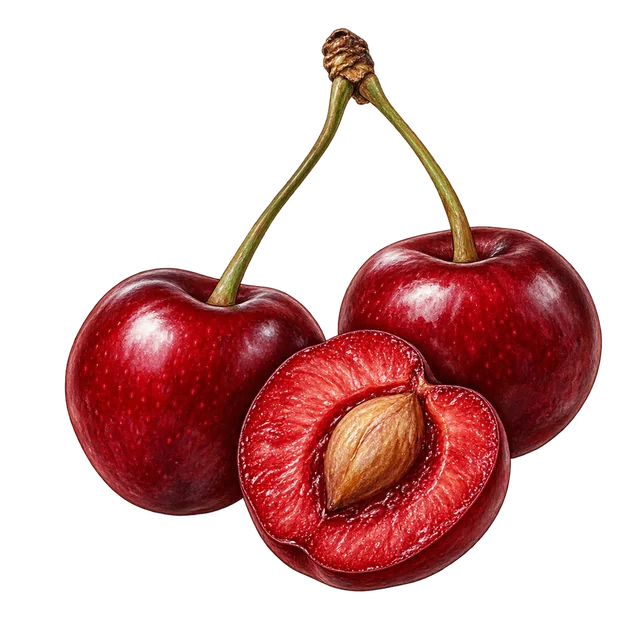
- Skin and flesh
- Cherry anthocyanins occur in skin and flesh. Deep red is their visible color.
- Intact flesh
- Whole fruit packages sugar, water, fiber and pigments together. Juicing changes that structure.
Illustration for understanding; not to scale. Saved figures include explanations and sources.
Mechanism · from skin to blood, the path anthocyanins take
Split this path into four stretches, and you can judge most antioxidant fruit claims yourself.First stretch, in the flesh. Anthocyanins are pigments the plant makes for itself, sitting in the flesh cells; the riper and deeper red, usually the more of them. Their job here was never about you — they block ultraviolet light for the plant, and the color happens to invite animals that eat the fruit.
Second stretch, in the small intestine. You chew the flesh, the pigment is released, and it rides the chyme into the small intestine. The bottleneck is here: these molecules are bulky, still wearing a sugar, not a shape the gut wall likes to let through, so only a small fraction crosses into the blood. The little that does get through is quickly remodeled by the liver and sent out. Eat a lot of cherries in one sitting, and the anthocyanin level in blood still only lifts briefly.
Third stretch, in the large intestine. The large unabsorbed share does not vanish. It keeps going down, to the large intestine, where a lot of bacteria live. The bacteria take these large molecules apart into smaller phenolic fragments — and once they are smaller, they cross the gut wall more easily. So what you can measure in blood is mostly not cherry pigment as it arrived, but products the microbiome has already remodeled.
Fourth stretch, outside the cell. These fragments sit at very low concentrations, too low to take part in chemical reactions in the blood at any real scale. They work another way: they stop at the cell's door and lightly nudge a few signaling pathways inside that have to do with inflammation and blood vessels.
Once the path is laid out, two confusing facts make sense. One is strong in the test tube, weak in a person: the tube pours pure pigment straight onto cells, at a concentration the human body never reaches. The other is the same cherries, different responses: one step on this path is handed to gut bacteria, and the bacteria living in each person are not the same.
An analogy: an in-vitro antioxidant assay measures whether a piece of cloth itself keeps water out. What your body actually wears is whatever is left after that cloth has been taken apart and remade. A handsome score for the fabric still tells you nothing about how it wears.
Myth · How far the anti-inflammatory label goes
Anti-inflammatory is the most useful word in food marketing, because it sounds like a conclusion when it is usually only a middle marker.Studies of this kind often look like this: a group of people eat some dark fruit for a stretch of time, then give blood, and a few inflammation-related markers are checked for a downward move. If they move, the paper will honestly write inflammation-related markers improved. From that sentence to eating it means fewer illnesses, several steps still have not been walked for you: whether the drop is large enough, whether it holds, and — the key one — whether real disease then becomes rarer once the markers come down.
Why is that last step hard? It asks you to follow people for many years and count heart attacks, strokes, and cancers that actually happened, not numbers in blood. Those studies are expensive, slow, and often never get done. So the evidence for most anti-inflammatory foods stops on those middle steps.
Cherry and the other dark berries sit exactly here. Kalt 2020, a review of blueberries and anthocyanins, sums it up the same way: anthocyanins are poorly absorbed, act more like signaling molecules, and the evidence on disease outcomes in people is limited. That is not the same as saying they do nothing. It is saying that it helps, as the sentence stands now, does not weigh the same as a sentence actually held up by disease-outcome evidence. So whenever a claim of this kind comes up, it is worth saying how far the evidence has actually gone.
How to use this layer? Turn it around. Next time you see a claim that food X is anti-inflammatory, ask three questions yourself: did they measure markers in blood, or diseases that actually happened? How many people, and for how long? Was it the food itself, or an extracted, concentrated component? Ask those three, and most of the ads fall apart on their own.
In practice · Whole cherries versus juice
Sweet-cherry sugar sits in the middle tier among fruits, but how much sugar is only half the question. The other half is how fast that sugar reaches your small intestine.Eaten whole, the sugar is locked inside flesh cells, wrapped in a structure fiber built. Your teeth can only chew part of it open; the rest the gut has to take apart slowly. Fiber also makes the contents of the gut a little more viscous, so the step where sugar molecules squeeze to the wall is slower. The same serving of sugar then arrives in batches.
Juice it, and you have taken that structure apart in advance: cell walls smashed, fiber filtered off or beaten into fine pulp, sugar sitting free in the liquid — and you do not chew; a cup goes down in a few swallows. The same serving of sugar, this time, arrives almost all at once.
So juice is as healthy as fruit drops exactly this dimension: speed. That is not a ban on drinking it. It is saying that when you drink it, count it in your head as flavored sugar water, not as a serving of fruit.
One common puzzle, while we are here: why the advice is always eat the fruit, not supplement the anthocyanins. A whole cherry gives you the full set — sugar, fiber, pigment, and water — and the fiber in that set is exactly the ration for the bacteria in the large intestine that take the pigment apart. The large-intestine stretch of the anthocyanin path runs on them.
Chapter 3
Tart cherry and sleep · preliminary evidence
Melatonin (see melatonin) is a signal released deep in your brain after dark. Its job is not to knock you out but to tell the whole body night has come, so the body starts tipping toward sleep. Tart cherries (especially the Montmorency variety) naturally contain a little melatonin, plus some polyphenols that may affect how tryptophan is processed, and tryptophan is the very raw material you use to make your own melatonin. What might happen when you drink it is that a small outside it is dark now signal is stacked on top of your own rhythm.
The evidence is still thin: the human trials are small and short, they used tart cherry juice concentrate rather than whole cherries, and what they measured was only a modest improvement, so certainty is low. It is fine as a low-risk experiment, but do not expect it to fix real insomnia: the first-line treatment for insomnia is cognitive behavioral therapy for insomnia (, see CBT-I & Sleep Hygiene), not a juice.
Evidence · what that trial actually did
The core study holding this claim up is a small (Howatson 2012, n=20): participants drank tart cherry juice concentrate for a week; urinary melatonin metabolites rose, and total sleep time and sleep efficiency also improved modestly. It used a crossover design — the same people went through a drink phase and a no-drink phase, each as their own control.Look at those results separately, and you can see what it proved and what it did not.
Urinary melatonin metabolites rose means the melatonin that was drunk did enter circulation and was then metabolized. That is evidence that it arrived, not evidence that it put you to sleep. In retellings those two are often fused into one sentence.
Modest improvements in total sleep time and sleep efficiency are the part that actually touches sleep. But with so few people, and a stretch of only one week, a study of this size can show a direction; it cannot hold up a conclusion — which is why it only counts as preliminary evidence of low certainty.
One gap is often skipped: the trial used concentrate, not a plate of fresh cherries. Behind one cup of concentrate sit many tart cherries, juiced and then concentrated. So eating cherries to sleep and drinking tart cherry concentrate are not the same event at the level of dose, and the first was never tested directly by this study.
Say the last line in the open: a small, short trial, however tidy the results look, has not reached the point of changing how you handle a sleep problem. What it can change is, at most, whether you try a cup tonight.
Mechanism · melatonin is a timing signal, not a sedative
Many people drink it, feel nothing, and write it off as a tax on the gullible. A more accurate reading: the place it acts may not be the reason you cannot sleep at all.Melatonin's job in the body is to tell the time, not to put you under. You have a master clock in the brain, and it sets itself by light: bright daylight through the eyes tells it this is day, so melatonin is held down; after dark the hold lifts, melatonin rises slowly, and every tissue that can read the signal knows to switch into night mode. What it does is nudge the hands forward one notch. It does not switch the light off.
Push that logic one step, and you can sort three kinds of bad sleep yourself:
The problem is a shifted rhythm — long nights of staying up, sleepiness arriving later and later. An early it is dark now signal is pointed the right way, and it has a chance to help a little.
The problem is a mind that will not stop after you lie down — stress, anxiety, the day's events looping. A timing signal cannot handle this: the clock is not broken. Something else is.
The problem is being interrupted — pain, frequent waking, breathing that does not run smooth, or the afternoon coffee still working. Those are not timing jobs either.
In a real person these three often sit mixed together, which is exactly why the average effect in trials of this kind is always modest: only some people in the group have a problem that happens to sit in the class melatonin can help, and the average is diluted.
So the smarter question is not does it work. It is where, exactly, is my sleep stuck. Once that is answered, the thing to reach for is often not a cup of juice.
In practice · If you try it, what counts as a test
If you decide to try it, a few things can make the trial actually produce information, instead of turning into another round of mysticism.Drink it in the window from evening to bedtime. What you want to give the body is the it is dark now signal, and a signal's meaning lives entirely in its timing — too early or too late, and you might as well not have sent it.
Give it several days in a row, not one night. A rhythm will not reroute because of one cup on one evening; the studies also drank it for a stretch before they measured a change.
Write down a few simple things. Roughly when you lay down, roughly how long until you slept, whether you woke in the night. No device needed — continuity is. Without a record you will only remember the nights that left the strongest impression, and those nights are usually the least typical.
Count this cup's sugar into the day. Concentrate is still sugary juice; anyone watching sugar especially needs that line on the books.
No change after the trial, stop — that is not a failure. That is a clean test you ran on your own body, and from here you do not have to spend money or worry on this again. And if bad sleep is already affecting how you function in the day, that is worth seeing a doctor for, not hunting the next answer on a shelf.
Chapter 4
Pricier cherries are not more nutritious
Imported cherries are expensive because of air freight, cold-chain shipping, the variety, and a brand premium. Your body, though, does not read the place of origin or the price tag; it reads molecules. The color in dark fruit comes from the same class of pigment, and once it reaches the gut it takes the same path: the small intestine lets a little through, most of it is broken apart by bacteria in the large intestine, and a small share of the fragments enters the blood. Switch to another dark fruit and you change the taste and the price; not one step of that path changes.
So if cherry freedom is out of reach, your nutrition does not suffer at all: a handful of in-season domestic cherries, a box of blueberries, or a few grapes gives you the same class of thing.
Cherries are a good fruit, so eat them if you like them, but do not treat the pricey imported kind as an irreplaceable health necessity. The truly economical approach is to rotate among dark fruits by season and by price.
Myth · Do rankings of the strongest berry mean much?
Every so often a dark fruit is pushed into the strongest antioxidant seat. Once you know the path the pigment takes inside the body, you can weigh rankings of this kind yourself.What the lists usually compare is two things: how much pigment this fruit holds, or how those pigments score on an antioxidant assay in a test tube. From fruit to your cells, the steps in between are almost the same for every dark fruit — the small intestine lets only a small fraction through, most of it waits on bacteria in the large intestine to take it apart, and only then do the fragments get a turn in the blood. The bottleneck sits on those steps, not on which raw material costs more.
More interesting still: one step on this path is handed to someone else — the bacteria in your gut. The mix living in each person is different, so two people eating the same box of cherries will not end up with exactly the same things in blood. That explains something very common — the same superfood, one person feels as if it did a little, another feels nothing, and neither is lying.
So what is worth caring about is not the rank. It is two much plainer things.
One: can you keep eating it, for a long time. Buy by season, buy by price. The few that can sit steadily on your table through the year mean more than an expensive fruit you buy twice a year — this pathway's action was always the long, mild, keep-giving kind.
Two: are you eating the whole fruit. The whole fruit gives you the full set of pigment, fiber, and water, and the bacteria that take the pigment apart eat the fiber. Buying only an extracted pigment supplement is skipping the ration those bacteria were meant to get.
In other words: rather than agonizing over which one to buy, let dark fruit become ordinary in your house. That sentence sounds plain. It is also exactly the conclusion this pathway gives.
References · 3
- U.S. Department of Agriculture, Agricultural Research Service. (2019). FoodData Central: Cherries, sweet and tart/sour (raw). Anthocyanin-rich; tart cherry contains small amounts of melatonin. fdc.nal.usda.gov
- Kalt, W., Cassidy, A., Howard, L. R., Krikorian, R., Stull, A. J., Tremblay, F., & Zamora-Ros, R. (2020). Recent research on the health benefits of blueberries and their anthocyanins. Advances in Nutrition, 11(2), 224-236. Anthocyanins are poorly absorbed and act more as signaling molecules; human disease-outcome evidence is modest. 10.1093/advances/nmz065
- Howatson, G., Bell, P. G., Tallent, J., Middleton, B., McHugh, M. P., & Ellis, J. (2012). Effect of tart cherry juice (Prunus cerasus) on melatonin levels and enhanced sleep quality. European Journal of Nutrition, 51(8), 909-916. Small randomized crossover (n=20): tart cherry juice concentrate raised urinary melatonin and modestly improved total sleep time and sleep efficiency. Preliminary evidence. 10.1007/s00394-011-0263-7