Story
Blueberry
Last updated
In one pass The blue-purple color of blueberries comes from a class of pigments in the skin called anthocyanins.
Educational content, not medical advice — consult a clinician.
Story path
Chapter 1
What is blueberry · the blue is anthocyanins
Anthocyanins sit in the skin, not in the flesh. In the same bite, the smaller the berry, the larger the share of skin, and the more pigment comes with it.
Two kinds dominate the shelves. Cultivated (highbush) blueberries are large, thin-skinned, and sweeter; wild (lowbush) blueberries are smaller and more intense in flavor, and often higher in anthocyanins, again because of the share of skin.
Words like superfood and anti-aging berry are marketing, not conclusions from nutrition science. Blueberry is a fruit that is fairly low in sugar and worth eating often, but it does not cure disease, slow aging, or detox you.
A CLOSER LOOK
Blue skin, pale flesh
Anthocyanins are concentrated in the skin. The cut face explains color distribution, not the size of an effect in the body.
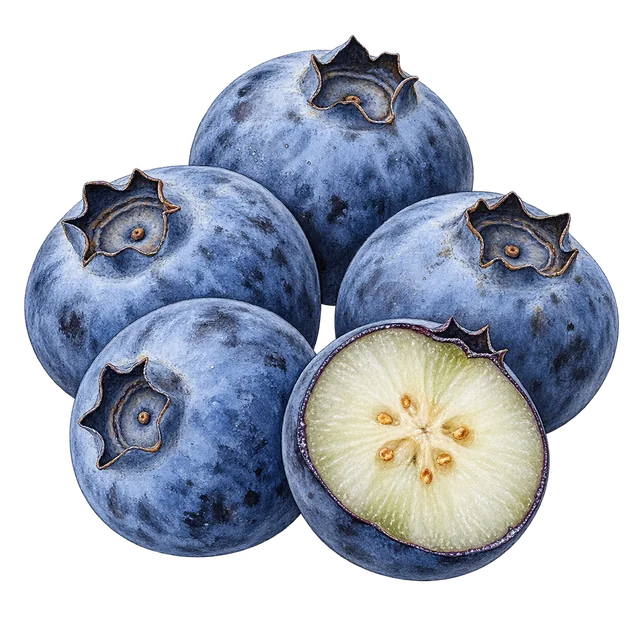
- Dark skin
- Blue-purple anthocyanins sit in the skin. Smaller berries have more skin relative to their flesh.
- Pale bloom
- The pale surface bloom and the thin dark-purple edge of the cut skin are visibly distinct.
Illustration for understanding; not to scale. Saved figures include explanations and sources.
Mechanism · this layer of color: who the plant made it for
Anthocyanins were not made for you. They were made for the blueberry.Once produced, they sit in a small water sac (the vacuole) inside the skin cells, and they only pile up in quantity at the last stage of ripening. For the plant they do at least two jobs: one is to soak up the shorter, higher-energy wavelengths of sunlight, so the cells underneath take less of a beating; the other is to dye the fruit a color birds can spot from far away — a bird eats the fruit and, along the way, carries the seeds somewhere else. So turning blue only when ripe is itself an advertisement.
Two inferences you can use right away:
Color is a rough ripeness signal. In the same batch, the ones whose color sits deeper and darker are usually riper.It bleeds color because it is water-soluble. The pigment is locked in the skin cells; once a cell breaks — mash, freeze, heat — it runs into the water around it. A smoothie going purple, yogurt taking on a stain, frozen blueberries thawing into a puddle of purple juice: all the same event. That is not dirt. That is the part you paid for.
Myth · superfood is a shelf label, not a science
Nutrition science has no superfood category. No agency has set a standard for it, and no line says this side counts and that side does not. It is a word invented by retail and media to lift one food out of a balanced diet and sell it on its own.The recipe is usually the same three steps:
Measure a handsome number in a test tube, such as antioxidant capacity N times that of XSkip the middle step: after a person eats it, how much actually reaches the bloodPresent the test-tube number as a benefit to the body
The skipped step is exactly the key to the blueberry story; the chapter on whether anthocyanins actually help walks through it one link at a time.
The value of learning this move is not about blueberries. Next time you see any claim on a shelf that starts with super, you can ask that middle step back.
Chapter 2
Low in sugar, with vitamins C and K
Its sugar also enters the blood fairly gently, for two reasons at once. There is not much sugar to begin with. And fiber soaks up water in the small intestine and thickens, so sugar has to cross that sticky layer before it reaches the gut wall; blood sugar rises slowly instead of surging (see Carbs & Fiber).
For vitamins it is balanced rather than top-tier: per 100 g, about 9.7 mg vitamin C and about 19 µg vitamin K, with clearly less vitamin C than citrus or bell peppers (see Vitamin C · see Vitamin K1 (Phylloquinone)).
What really sets blueberry apart is anthocyanins, a kind of polyphenol (a large family of plant pigments and bitter compounds). In a test tube they are genuinely strong at clearing free radicals, which is where the antioxidant label comes from. But strong in a test tube is not the same as strong in the body, and that is the thing about blueberries most worth getting straight.
Mechanism · how fiber flattens the blood-sugar slope
The phrase fiber soaks up water and thickens opens into this chain.Part of blueberry's fiber is soluble fiber (the pectin kind). Once it reaches the small intestine it takes on water and makes the chyme around it stickier and thicker. Three things follow:
Gastric emptying slows: thick material leaves the stomach more slowly, so sugar does not pour into the small intestine in one rush. It arrives in batches.Sugar has a harder time reaching the gut wall: the small intestine absorbs sugar through transporters on the surface of the wall cells; a sugar molecule has to diffuse across and dock before it is moved into the blood. A sticky layer in between makes that trip slower.The peak is shaved down: the same amount of sugar enters the blood over a longer stretch of time, so the blood-sugar slope gentles, and the pancreas does not have to send out as much insulin in one go.
What changed here is the shape, not the total. The sugar did not shrink. It just arrived slowly.
You can push one step further yourself: juice the blueberries, and that structure is broken up, so the sugar walks in bare. Even if the grams of sugar are identical, eating the whole berry and drinking the juice are not the same event in your body. By the same logic, stir blueberries into yogurt or oats, and the slope gentles a little more: protein, fat, and more fiber all pull in the same direction.
Mechanism · what its vitamin C and K actually do
Vitamin C: its most solid job is not the vague claim of boosting immunity. It is helping a few enzymes that build collagen. Each of those enzymes holds an iron atom; after one round of work the iron is oxidized and can no longer be used; vitamin C hands it an electron, reduces the iron back to a usable state, and only then does the enzyme do the next round. When collagen is built poorly, vessel walls and gums fail first — they bleed at a touch. That is what scurvy looks like.It also has a job you can use at the table: iron in plants is a form the body does not recognize well, and vitamin C in the same bite can convert it into a form the gut-wall transporter will accept. So pairing blueberries with beans, dark leafy greens, and other iron-containing plant foods lets iron absorb a little more smoothly.
Vitamin K: its main battlefield is the liver. The proteins used in clotting come off the line as half-finished products that cannot grab calcium; an enzyme in the liver needs vitamin K to weld a calcium hook onto those proteins, so they can catch calcium, stick to a damaged vessel wall, and plug the gap. The same calcium-hook method is used by a protein in bone (osteocalcin), which pins calcium into the bone matrix.
One practical line: blueberry is not a main source of vitamin K. Dark leafy greens sit much higher. But if you are on an anticoagulant (warfarin), the point was never don't eat it. It is eat it steadily — those drugs work by suppressing vitamin K's recycling, and intake that jumps up and down makes the dose hard for a doctor to tune. How to eat in your case is for your doctor to say.
Chapter 3
Do its polyphenols actually help?
On the population side, large prospective cohorts (studies that first record what a big group of people usually eat, then follow them for many years) found that people who ate more anthocyanins had a slightly lower risk of heart attack, and people who ate berries often had slightly slower cognitive decline. These are observed associations and cannot show that blueberries caused the difference: people who like blueberries also tend to live healthier lives overall. The effects are also mild, nothing like a reversal.
A reasonable conclusion: as part of a healthy diet, blueberries may bring a modest benefit. The evidence is mostly observational studies plus short, small human trials, so certainty is low. Superfood has no definition in nutrition science. Blueberries are not medicine; for any specific illness, ask your doctor.
Mechanism · where the anthocyanins you swallow actually go
This is the chain most worth remembering in this article. Walk it in four stretches.Stretch one · the small-intestine door, it barely squeezes through. Anthocyanin is a fairly bulky molecule, with a sugar still hanging on it, and it is very hydrophilic. The cells of the small-intestine wall prefer to let through small, fat-loving molecules; of the large, water-loving anthocyanins, only a small fraction crosses in intact form.
Stretch two · almost all of the rest keeps going down, to the colon, and is handed to the gut bacteria. The bacteria first chew off that sugar, then crack the remaining ring skeleton into a batch of much smaller fragments, collectively called phenolic acids.
Stretch three · the fragments are small, so the gut wall lets them through. They are absorbed into the blood, tagged in the liver with a label that makes excretion easier, then ride the bloodstream around the body. They stay in the blood much longer than the original intact anthocyanin.
Stretch four · which yields a counterintuitive conclusion. What is actually hanging around next to your cells is mostly not that blue molecule from your mouth. It is the fragments your gut bacteria took apart for you.
This chain also explains something often skipped: everyone's gut microbiome is different, and so is the efficiency of the breakdown. The same handful of blueberries can send quite different things into two people's blood — one reason results in this field never line up cleanly.
Mechanism · where it lands: the vessel's inner lining
A blood vessel is not an inert pipe. The innermost lining of the channel is a thin sheet of cells called the endothelium, one cell thick, sitting directly in the bloodstream. Outside the endothelium sits a ring of smooth muscle: when that ring tightens, the tube narrows; when it lets go, the tube widens.One of the endothelium's jobs is to release a gas signaling molecule, nitric oxide (). NO diffuses into that outer ring of smooth muscle and makes it relax, so the tube widens, resistance to flow drops, and the heart spends a little less effort pushing the same amount of blood. The other way around: when the endothelium is in poor shape, less NO is made and what is made is more easily oxidized, so the vessel sits tighter and the inner wall is more likely to build up deposits.
Polyphenol metabolites appear to help a little at this layer: making the endothelium more willing to produce NO, or letting the NO already made be oxidized a little less. Watch the verb here: it is a nudge, not turning on a new switch.
What short-term human trials can measure is usually how this layer performs. A common method: wrap a cuff around the arm, hold back the blood flow for a while, then release it; the vessel widens on its own, and a larger widening means a more responsive endothelium. After people ate berries, small improvements on this kind of measure have been reported.
But stop here: that is a (an in-between measure you can read early, which is not the same as the real outcome), not an endpoint. Between a slightly more responsive endothelium and one fewer heart attack lie decades and a pile of other factors.
Mechanism · why poor absorption fits a mild effect
Many people treat extremely strong antioxidant capacity in the lab and only a slight benefit in the cohorts as two sentences that fight each other, and then decide either that the research was done wrong or that the marketing is lying. They are actually two faces of the same thing.The antioxidant number from the test tube is measured by soaking anthocyanins directly in a solution, at a concentration the experimenter chooses — as high as they like.
Your blood cannot reach that concentration. The reason is the absorption chain above: the intact molecule cannot get in, the little that does is quickly tagged by the liver and cleared, and what actually circulates is the fragments the bacteria already took apart.
The same molecule, at two concentrations, tells two stories. So the right reading is this: the test-tube number did not lie. It was simply measured at a dose your body will never reach. If the dose cannot get there, the effect cannot get large. The mild, real, and in no way drug-like effect in the cohorts is exactly what this absorption chain should produce.
You can carry this reasoning straight over to other superfoods. Next time you see antioxidant capacity N times that of X, ask three questions:
Was this number measured in a test tube, or in a person?After a person eats it, how much actually reaches the blood?Did anyone measure a (such as heart attack or dementia), or only a ?
The reverse also holds, and is more worth watching: if someone stresses that a plant extract has extremely high absorption and extremely high blood levels, that is when you should ask one more question about safety. Something that can reach drug-level concentrations in the body usually also carries drug-level side effects and interactions.
Evidence · what cohort studies can and cannot show
The heart-attack study and the cognition study are both prospective cohorts: first record what a large group of people usually eat, then follow them for many years and see who has an event and who does not. The heart-attack study followed young and middle-aged women, and those who ate more anthocyanins had a slightly lower risk of heart attack (Cassidy 2013). The cognition study found that people who ate berries often had slightly slower cognitive decline (Devore 2012).The strength of a cohort is that it sits close to real life and runs long enough. Its weakness is only one, but it is serious: people choose what they eat; the researcher does not assign it.
That leaves a problem that is almost impossible to dodge, called the healthy-user effect: in these cohorts, people who eat more anthocyanins also tend to eat more vegetables, smoke less, exercise more, get checkups more often, and often have higher income and education. Statistics can subtract the factors already measured, but not the ones that were never measured or were measured poorly. The part that is not fully subtracted is called residual , and by nature it tilts toward making healthy habits look more useful than they are.
What would actually settle it? Randomly assign people to two groups, one eating blueberries long-term and the other not, and follow them all the way to such as heart attack and dementia. Those trials are very expensive, take many years, and with food it is hard to keep participants from knowing which group they are in. Across all of nutrition science, that kind of study is extremely rare.
The evidence stops at observational studies not because blueberry is suspect, but because this kind of question is hard to turn into a long-term randomized trial in the first place. That sentence holds for almost any single food; keep it, and you can use it on any news story that says food X prevents disease Y.
So how to use this conclusion: do not count on blueberries to cancel out something else; but if you were going to eat some fruit anyway, choosing this one costs little and carries almost no downside.
Mechanism · why the brain claim is plausible but thin
Brain protection is the line blueberry marketing loves most. It is also the one that is most plausible on mechanism and thinnest on evidence. The plausible part first.The brain depends on blood flow to an extreme degree: it is a small share of body weight, yet it takes a large share of the heart's output and of oxygen, and it stores almost no energy. Cut the supply and things go wrong within minutes. What feeds the neurons is a tree of ever-finer small vessels, and the innermost lining of those small vessels is the same endothelium described above.
So the path connects on its own: if polyphenol metabolites really do let the endothelium work a little more smoothly and make a little more , the small vessels in the brain are within range of the benefit. Steadier flow means steadier glucose and oxygen for the neurons. That is the only chain in the brain-protection claim that stands up.
Now the thin part. Between slightly looser small vessels and a better memory, too much sits in the way: sleep, blood pressure, blood sugar, exercise, education, social life — each of those moves cognition at least as much as a handful of berries. The berries-and-cognition cohort saw slightly slower decline in people who ate them often, and like the heart-attack study it is observational, so the same residual- problem applies unchanged.
So there is only one honest sentence: the mechanism is plausible, there is a little signal in the population, but there is currently no evidence that blueberries can prevent or treat dementia. Placing them as part of a vessel-friendly everyday diet is solid; treating them as a brain-protecting supplement crosses the line.
Chapter 4
Choosing it: fresh or frozen
Eating: eat them as a snack, stir them into yogurt and oats, or blend them into a smoothie. Baking loses some of the vitamin C and anthocyanins, but the flavor stays. They are fairly low in sugar, so most people, including people watching their blood sugar, can eat a moderate amount. The evidence that organic blueberries are more nutritious is weak; organic mainly affects pesticide residue, not nutrient density.
A few pairings: unsweetened yogurt or milk (adds protein and calcium); oats or whole grains (a breakfast that keeps you going longer); nuts (adds fat and keeps you fuller).
Blueberry is a good fruit worth eating often. Treat it as a balanced member of your everyday diet, not as medicine or a rescue.
Mechanism · the bloom, and why frozen holds up
That bloom is wax the fruit itself secreted, sitting on the outside of the skin, to slow water loss and keep some microbes off. Once it is rubbed away it does not grow back, so bloom still there usually means this batch was not handled over and over from the branch to your hand. A side note: wash blueberries just before you eat them. Wash the wax off early and the fruit softens faster.Why frozen does not lose points starts from where the pigment is locked. Anthocyanins sit inside the skin cells; when the fruit freezes, water forms ice crystals, and the crystals rupture the cell walls. So after thawing the pigment runs out more easily — which both explains why frozen berries sometimes measure slightly higher (they extract more readily) and why thawed frozen blueberries leak a puddle of purple juice. That juice is not dirt. It is the most valuable part of the berry. Do not pour it away. Eat it with the fruit.
The other half of the reason is time. Fresh fruit that has to travel far is often picked before it is fully ripe, and anthocyanins pile up in quantity only at the last stage of ripening; fruit destined for freezing is picked fully ripe and frozen on the spot. So the intuition that fresh is always better than frozen does not hold for blueberries.
Mechanism · what heat takes away, and how to take it back
Vitamin C fears three things: heat, oxygen, and water. Its actual job is to hand electrons away (that is what antioxidant means), so in a pan it easily reacts with oxygen first, and that bite is wasted. Anthocyanins also fear heat, and they are water-soluble — heat breaks the cells and the pigment runs into the liquid around them.Which gives a useful inference: wherever the pigment ran, that is what you should eat.
Baked muffins: the pigment went into the batter, and it is still in your mouthCooked jam: the pigment went into the syrup, and it is still there, but you also ate a lot of the sugar that was addedBoil and pour the liquid away: that is the real waste
A common kitchen observation, while we are here: blueberries turn blue-green when they meet baking soda. Anthocyanin color shifts with the acid-base of its surroundings — redder when more acidic, blue-green when more alkaline. That tells you it is a class of molecule easily changed by its environment — the same temperament as not staying long in your body.
Myth · organic is richer, dried fruit equals fruit
Organic is more nutritious: how many anthocyanins a berry holds is decided mainly by variety, ripeness, sunlight, and how it is handled after harvest, not by whether synthetic pesticides were used while it grew. Organic certification governs how the crop is grown. It affects residue and the environment, not the nutrient density inside the fruit. If you want to lower residue, rinsing under running water before you eat is more direct.Dried fruit equals fruit: once the water is pulled out, the same bite carries much more sugar than the fresh fruit — the volume shrank, the sugar did not; and most commercial dried blueberries have sugar added on top. Fine as a snack, but do not count it as today's fruit.
Juice is the same: juicing breaks up the fiber's structure, so the way fiber flattens the blood-sugar slope is gone, and the same sugar reaches the blood faster.
The three are really one thing: each step further into processing, what you get sits closer to sugar and farther from the intact fruit.
References · 6
- U.S. Department of Agriculture, Agricultural Research Service. (2019). FoodData Central: Blueberries, raw. ~57 kcal/100 g; relatively low sugar for a fruit; vitamin C, vitamin K1, fiber, anthocyanins. fdc.nal.usda.gov
- National Institutes of Health, Office of Dietary Supplements. (2021). Vitamin C — Fact Sheet for Health Professionals. ods.od.nih.gov/factsheets/VitaminC-HealthProfessional
- National Institutes of Health, Office of Dietary Supplements. (2021). Vitamin K — Fact Sheet for Health Professionals. Fact sheet (updated March 29, 2021; Wayback snapshot 19 September 2026): free phylloquinone is about 80% absorbed, but absorption from food is much lower - the body absorbs only 4% to 17% as much from spinach as from a tablet; Table 2: natto, 3 ounces, 850 mcg (as MK-7); egg, hard boiled, 1 large, 4 mcg (as MK-4) (fact sheet). ods.od.nih.gov/factsheets/VitaminK-HealthProfessional
- Cassidy, A., Mukamal, K. J., Liu, L., Franz, M., Eliassen, A. H., & Rimm, E. B. (2013). High anthocyanin intake is associated with a reduced risk of myocardial infarction in young and middle-aged women. Circulation, 127(2), 188-196. Observational; ~93,600 women over 18 years. 10.1161/CIRCULATIONAHA.112.122408
- Devore, E. E., Kang, J. H., Breteler, M. M. B., & Grodstein, F. (2012). Dietary intakes of berries and flavonoids in relation to cognitive decline. Annals of Neurology, 72(1), 135-143. Observational; higher berry intake tracked with slower cognitive decline. 10.1002/ana.23594
- Kalt, W., Cassidy, A., Howard, L. R., Krikorian, R., Stull, A. J., Tremblay, F., & Zamora-Ros, R. (2020). Recent research on the health benefits of blueberries and their anthocyanins. Advances in Nutrition, 11(2), 224-236. Anthocyanins are poorly absorbed and act more as signaling molecules; human disease-outcome evidence is modest. 10.1093/advances/nmz065