The thing most worth remembering about apples is pectin. This soluble fiber forms a gel in the gut that slows sugar on its way into the blood, feeds your gut bacteria, and carries off a little bile acid along the way. That is why eating an apple whole, skin on, and drinking it as juice are two different things in the body. Where exactly the gel does its work is covered in the chapter on what pectin does.
The apple is the classic pome fruit, a close relative of pear and quince: a soft core holding a few seeds, wrapped in crisp, juicy flesh. A medium apple weighs about 180-200 g and is roughly 85% water, which is the main reason its calorie count stays low.
A CLOSER LOOK
Skin, flesh and a seed-bearing core
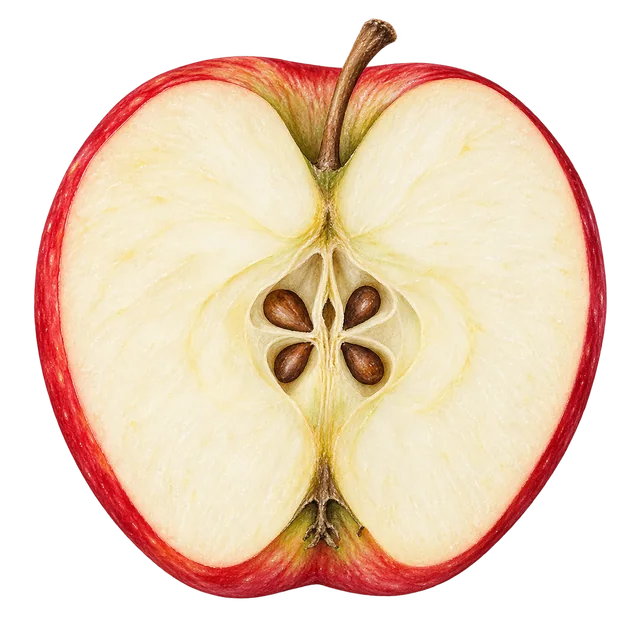
Apples and pears are pomes. This cut face separates flesh, thin skin and central core to show the structure of whole fruit.
1Thin skin
Color sits mainly in the outer layer. Skin and nearby flesh carry a share of the apple's plant compounds.
2Juicy flesh
The flesh is mostly water, with sugar and fiber. Eating it whole keeps this structure.
Illustration for understanding; not to scale. Saved figures include explanations and sources.
Background · What variety and color change
Variety shapes texture and the balance of sugar and acid. Sweeter apples (Fuji, Red Delicious) are good eaten fresh; tart ones (Granny Smith) are crisper and good for baking.
Color, from green to red, mostly reflects polyphenols and anthocyanins in the skin. These pigments and polyphenols sit mainly in the skin and the thin layer of flesh just under it, so whatever the variety, peeling throws a large share of them away. The chapter on what apples are rich in goes into what the skin holds.
In other words, which variety you pick is mostly a matter of taste. What matters more for nutrition is whether you eat the skin, and whether you eat the apple whole or drink it as juice.
Chapter 2
What soluble fiber (pectin) does
Among an apple's fiber is a soluble type called pectin. We cannot digest it, and when it dissolves in water it turns into a thick gel.
The same sugar, dragged along by that gel or poured down as a liquid, does not reach the blood at the same rate. As the gel travels down the gut it leaves a different result in three places: in the stomach and small intestine it slows the sugar, in the large intestine it feeds gut bacteria, and along the bile route it trims blood cholesterol a little (see Carbs & Fiber).
Mechanism · Three places one gel lands
Pectin is not taken apart and used by you. It travels down the gut carrying water and leaves a different result at each stop (Boyer and Liu 2004, a review: pectin is a soluble fiber, and the polyphenols, separately, are concentrated in the skin).
Stomach and small intestine. The gel slows stomach emptying and puts a sticky buffer on sugar absorption in the small intestine. The sugar is not reduced; its arrival rate is. So a whole apple raises blood sugar more gently than the same sugar drunk as juice.
Large intestine. Only here is pectin actually broken down: gut bacteria ferment it into short-chain fatty acids (such as butyrate), which fuel the cells lining the gut (see Gut microbiome). You do not absorb the pectin itself. You absorb what the bacteria make from it.
Bile. The gel can trap bile acids in the gut and carry them out, so the body has to use cholesterol to make new bile. Over time that helps blood cholesterol a little: the effect is small, but the direction is clear. It is not a cholesterol drug. It simply lets part of a material that would normally be recycled leak out through the gut.
One mechanism, three results: slower sugar, fed bacteria, less cholesterol. When juicing strains the gel away, all three disappear together, which is where the chapter on whole apples versus juice picks up.
An apple is not a heavyweight for vitamins and minerals. Its highlight is plant compounds such as polyphenols, and most of them sit in the skin. Vitamin C is about 4-6 mg per 100 g, far below citrus or kiwi (see Vitamin C), so an apple a day does not rest on vitamin C.
The honest placement: an everyday fruit that is low in calories, rich in fiber, and has its polyphenols concentrated in the skin, not a vitamin bomb. Wash it and eat it with the skin on; that beats peeling.
In practice · Why the skin is worth eating
Polyphenols are most concentrated in the apple's skin and the flesh just beneath it; quercetin and procyanidins are among them. The antioxidant capacity measured for apples in the test tube comes mainly from these compounds. Peeling throws a large share of them away, so washing the apple and eating it with the skin on is the better deal.
The little vitamin C an apple has is modest; if you want fruit for vitamin C, citrus and kiwi do the job better. An apple's value is being everyday, steady and eaten whole: pectin plus the polyphenols in the skin, not a peak in any single nutrient.
Chapter 4
How whole apples differ from juice
The same apple, eaten whole or drunk as juice, is two different events in the body. Juicing barely touches the sugar; what it mainly removes is the pectin gel. The sugar is still there, the thing that held it back is gone, so the rate at which sugar reaches the blood changes, and the feeling of fullness goes too.
Data from large groups of people point the same way. In three large US cohorts, people who ate more whole fruit had a lower risk of type 2 diabetes, and people who drank more fruit juice had a higher risk. That is an observed association, but it fits the mechanism. So a glass of apple juice is closer to a sweet drink that tastes of apple than to a serving of fruit.
Mechanism · What juicing takes away is the gel
Juicing does three things: it strains out the fiber (pectin especially), breaks up the intact cell structure, and turns sugar from a solid into a liquid you can swallow fast. USDA's entry for raw apple with skin is plain: about 52 kcal / 100 g, soluble fiber (pectin) and polyphenols in the skin, and only a modest amount of vitamin C.
It still looks like apple in the glass, but the three results described in the pectin chapter are taken apart together. With no gel, stomach emptying is no longer slowed, gut bacteria lose their fermentation material, and bile acids lose one route out. Fullness goes too: chewing an apple takes time, takes up room in the stomach, and tells your brain "I am eating". A glass of juice goes down in a few gulps with the same sugar and almost no signal of fullness. That is why juice is easy to overdo.
100% juice is no exception. "No added sugar" only means no extra sucrose was put in. Once the fiber is gone, the apple's own sugar acts on blood sugar more like a sugary drink than like a whole fruit. An occasional small glass is fine; for the gel and the fullness, eat the apple whole, skin on.
Evidence · Whole fruit and juice point opposite ways
Muraki 2013 (BMJ) pooled three prospective US cohorts, 187,382 people in all. People who ate more whole fruit had a lower risk of type 2 diabetes; people who drank more fruit juice had a higher risk. Swapping juice for whole fruit also went with a lower risk.
This is not "apple juice is poison". It is the same sugar, one portion slowed by fiber and one not. A cohort study sees a long-term direction, not the lab result from one glass on one day, and on its own it cannot prove the juice caused anything. But it fits the pectin mechanism: with the gel, sugar arrives slowly; with the gel strained out, it arrives fast.
In daily life, count a glass of apple juice as "a sweet drink that tastes of apple", not as "a serving of fruit". The fruit part is in the pulp you threw out and the skin you peeled off.
References · 4
U.S. Department of Agriculture, Agricultural Research Service. (2019). FoodData Central: Apples, raw, with skin. ~52 kcal/100 g; soluble fiber (pectin) and skin polyphenols; modest vitamin C. fdc.nal.usda.gov
Boyer, J., & Liu, R. H. (2004). Apple phytochemicals and their health effects. Nutrition Journal, 3, 5. Apple polyphenols concentrate in the skin; pectin is a soluble fiber. 10.1186/1475-2891-3-5
Muraki, I., Imamura, F., Manson, J. E., Hu, F. B., Willett, W. C., van Dam, R. M., & Sun, Q. (2013). Fruit consumption and risk of type 2 diabetes: results from three prospective longitudinal cohort studies. BMJ, 347, f5001. Across 187,382 participants in three cohorts, higher whole-fruit intake was associated with lower type 2 diabetes risk while higher fruit-juice intake was associated with higher risk; substituting whole fruit for juice was associated with lower risk. Abstract figures (NHS, NHS II, HPFS; 12,198 cases): per 3 servings a week, whole fruit HR 0.98; blueberries 0.74, grapes and raisins 0.88, apples and pears 0.93, bananas 0.95, cantaloupe 1.10; fruit juice 1.08 (1.05-1.11). Observational (abstract, PMID 23990623). 10.1136/bmj.f5001