Story
Resistance training basics
Last updated
In one pass When you lift something heavy enough, your muscle fibers are pulled taut.
Educational content, not medical advice — consult a clinician.
Story path
Chapter 1
Progressive overload
The catch is that the body only pays for a difficulty it has not yet adapted to. Train with the same weight for a few weeks and you get stronger; the weight stops being hard for you, the signal into the cell weakens, and progress stalls. To keep getting stronger, one training variable has to get a little harder every week or two. That is progressive overload, the core principle of strength training.
Where is the floor for heavy enough? When the last few reps of a set are clearly hard and start to slow down, the fibers that grow the most have been called in. A set you put down easily barely counts for building muscle.
A CLOSER LOOK
The load is a stimulus; the body adapts
One lift illustrates load and adaptation; a still image does not replace complete exercise instruction.
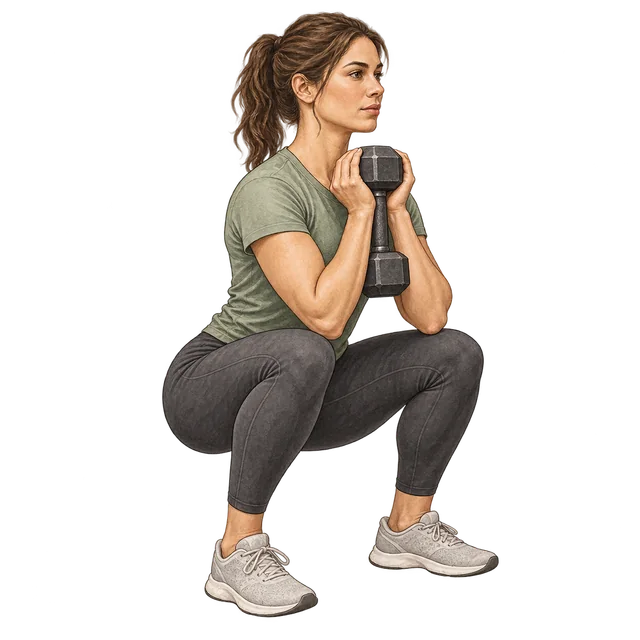
- Training load
- Once you adapt to the same weight, it becomes easier and its stimulus weakens.
- The body's adaptation
- To keep progressing, gradually make one training parameter more demanding.
Illustration for understanding; not to scale. Saved figures include explanations and sources.
In practice · Which variables can get harder
There are 4 variables you can make harder, ranked by how easy they are to control:1. Load: same exercise, same reps, add 2.5-5 kg
2. Reps: same exercise, same load, do 1-2 more reps
3. Volume: do 1 more set per week
4. Exercise difficulty: for example, move from push-ups to band-resisted bench press, then to barbell bench press
The trap is trying to raise all four at once; recovery cannot keep up. Changing 1 variable a week is enough, which is why strength programs usually add load step by step each week, or run in four-week blocks.
Mechanism · How a load becomes a command
In the few seconds you lift a load, three things happen in order inside the muscle fiber.Force is felt first. A muscle fiber is not a lone filament floating on its own. It is wrapped in a membrane studded with fasteners that stitch the cell to the connective tissue outside. When you produce force, that force travels through tendon and connective tissue to these fasteners and tugs on them; a waiting chain of enzymes sits on the inner side of each fastener and switches on the moment it is tugged. In that instant, a purely physical quantity is translated into a chemical signal. This is the most-studied explanation so far, and some of its middle steps have not been fully confirmed in human muscle.
The signal then reaches the master switch. That chemical cascade travels station by station toward the cell's interior and stops at a switch called . mTOR decides whether the cell will expand its output: on, and the protein-assembly machinery starts work, stitching amino acids into myosin and actin — the two filaments that can produce force; off, and the assembly line sits idle.
New filaments are laid in last. The finished filaments do not pile up in a corner of the cell. They are laid down, layer by layer, beside the contractile units already there, so the fiber thickens and the force you can pull goes up with it. The process is slow: the rise in synthesis after one session lasts only a day or two, so muscle is stacked up across tens or hundreds of sessions, not grown by one hard workout.
See these three steps and you see why the same weight will eventually stop working. What decides how far the switch opens has never been the kilograms printed on the bar. It is how hard that weight is relative to what you can do right now. Once the fiber is thicker, the same load is spread across more filaments, each one is tugged less, the fasteners pull less hard, and the signal that travels up naturally weakens. The body is not slacking off. It is reporting honestly: this no longer counts as hard.
So progressive overload is not an optional advanced trick. It is the only way to push signal strength back into the 'hard enough' band. Read the other way, it also means this: the stronger you are, the more weight you need to make a signal of the same intensity — which is the physical reason progress slows the further you go. How the three stimuli, mechanical tension, metabolic stress, and muscle damage, rank against each other is the subject of the story Hypertrophy mechanisms.
Chapter 2
The five compound lifts
Squat: legs, glutes, coreDeadlift: the muscles along the whole back of the body, plus gripBench press: chest, front of the shoulders, back of the upper arm (triceps)Row: lats, back of the shoulders, front of the upper arm (biceps)Overhead press: shoulders, triceps, core
A beginner can train like this for the first 3 months: 3 lifts per session, 3 sets each, 5-8 reps per set, 3 days a week. No isolation work, and no need to split the body into parts on different days. Getting started is that simple.
Why not do a big 24-exercise full-body circuit? When time is limited, what counts is how much effective stimulus you get per minute. One compound set works several more muscles than an isolation set, so the same stimulus takes far less time.
Mechanism · Why one lift trains a whole chain
Why does one squat train the legs, glutes, and core at the same time, while a machine leg extension only trains the front of the thigh? The difference is how far the force has to travel.When you squat down and stand back up, the ground's reaction force enters through the soles, travels up through ankle, knee, and hip one joint at a time, and finally presses on the spine, where the core muscles hoop the trunk so it does not collapse. On every joint along that chain, the muscles on both sides have to stabilize that segment and drive it to rotate, or the force never makes it further. So recruitment is not a figure of speech: every muscle is contributing force to the same load, and what they receive is different shares of the same mechanical tension.
An isolation exercise does the opposite. It deliberately locks the chain and leaves only one joint free to move. The upside is that muscle cannot hide; the downside lives in the same place — only that muscle can produce force, so the weight you can put on the bar is capped by that one muscle's ceiling, and the moment it fatigues the lift is over. Compound-lift load is shared across a whole chain, so the system as a whole is already under high tension while any single muscle is still far from failure. That is why, in the same time, it can produce more effective stimulus.
There is a less intuitive bonus: a compound lift trains more than muscle. It also trains the nervous system's ability to coordinate those muscles. Firing order, when the stabilizers brace, when the antagonists let go — all of that is a skill you can learn. Once learned, the skill transfers directly into everyday moves like carrying something, holding a child, or climbing stairs. Strength built on a machine at a single joint transfers much less of itself.
Evidence · How many days a week works better
As long as the total sets in a week stay the same, how many days you spread them across makes little difference to muscle growth; hypertrophy is mainly decided by the total. Schoenfeld 2016 pooled studies that held total volume fixed: training a muscle 2 times a week grew about 3.1% more muscle than training it once, a moderate difference; whether 3 times beats 2, there were too few studies to say.In a training plan: 12 sets a week split across 2 days (6 sets each) is slightly better than all 12 sets in one day, but that gap is far smaller than the gap between 12 sets and 6 sets a week.
So should each muscle be trained 1 or 3 times a week is a secondary question. What matters most is total sets, and how close each set comes to failure (RIR, reps in reserve: how many more reps you could still do).
In beginner practice: full-body training 3 days a week, 3 sets per exercise. That adds up to 6-9 sets per muscle per week, recovers more easily than a body-part split, and trains each muscle more often than once a week.
Chapter 3
Compound and isolation lifts
Compound lifts are the foundation, for three reasons:
Efficiency: one set of squats trains the front of the thigh, the glutes, the core, and more at the same time, which saves time over doing several isolation exercises separatelySquatting, pushing, pulling, lifting, and stepping are the basic movements of daily life, so training them carries straight over into everyday lifeThe load is shared by a whole chain of muscles, so you can keep adding weight; while any single muscle is still far from failure, the system as a whole is already under high tension, which means more effective stimulus in the same time
Isolation work is not useless. It is fine-tuning, not the main course. The cases where it really earns its place: filling in a weak link (for example, a bench press that always stalls just before lockout points to weak triceps, so you add a triceps exercise); training muscles the compound lifts miss (biceps, the side of the shoulders, calves, forearms); shaping one particular muscle; rehab, or correcting a strength imbalance between the two sides.
Mechanism · How a weak link stalls the whole chain
The phrase 'weak link' is worth unpacking, because it is the one use of isolation work that is truly irreplaceable.A compound lift is a force chain strung together, and a chain is only as strong as its weakest ring. Near lockout on a bench press, the changing moment arm makes the triceps take a sharply larger share; if the triceps happen to be the weakest ring on that chain, you stall at the same height over and over — not because the chest is not strong enough, but because the chain broke there. A deadlift that dies just above the knee, a squat that tips the torso forward halfway up: same class of signal. One link hits its limit first, and the whole lift's ceiling is locked by it.
The trouble is you cannot feed that one link by itself through the compound lift. When you add weight, force is still split along the old ratios, the strong muscles keep getting stronger, and the weak one — always shielded by the others — only falls further behind. Isolation work has a very specific job here: lock the chain, leave only that one joint free to move, force the weak link to take enough tension on its own, and let it catch up alone.
So the right use of isolation is not doing a bit more. It is targeted makeup work. The tells are equally specific: where in the lift you always stall, whether one side is strong and the other is not, which muscle never gets sore after a session. Once the weak link is filled in, the compound lift's load unlocks with it — and that is when you notice those triceps-pushdown sets were actually raising the bench press.
In practice · Splitting time between the two
How to split time between compound and isolation lifts depends on your goal. The usual coaching practice looks roughly like this:Strength first (for example, powerlifting): nearly all the time goes to compound lifts, with isolation work taking only a small sliceMuscle size first (bodybuilding): compound lifts still come first, but isolation work can take a clearly larger shareBeginners (first 1-2 years): almost entirely compound lifts
A simple rule for beginners: spend most of each session on the 5 compound lifts, then use the time left for 1-2 isolation exercises, either to fill in a weak link or to work on shape. Filling a whole program with 12 isolation exercises from the start wastes time and makes progress hard to see.
One claim marketing often exploits: train a spot to lose fat there (sit-ups to lose belly fat, for example) does not hold up. Fat is mobilized across the whole body; it does not come off one area first just because you trained the muscle next to it.
Chapter 4
Reps per set and rest time
For maximal strength: 1-5 reps per set with a heavy load of 85-100% of (the most you can lift once), resting 3-5 minutes between setsFor muscle size: 6-12 reps per set at 65-85% of 1RM, resting 2-3 minutesFor muscular endurance: 15-20 reps or more per set, below 65% of 1RM, resting 1-2 minutes
A pooled analysis comparing light and heavy loads found that as long as each set is taken close to failure, anywhere from 6 to 20 reps grows about the same amount of muscle. So 8-12 reps for muscle growth is a rough pointer, not a hard rule.
Rest between sets should not be too short, or the load or reps in later sets drop and your effective volume falls with them: the fast-charge battery in muscle, creatine phosphate, takes about 3 minutes to mostly recharge.
A beginner default: compound lifts at 8-10 reps per set, 2-3 minutes of rest, 3 sets.
Mechanism · What the body replenishes between sets
Rest between sets is not waiting for your mood. It is waiting for a battery to recharge.Muscle has only one direct fuel for producing force: . The ATP stored inside a fiber is tiny — enough for a second or two of all-out contraction. What actually carries a heavy set is the fast-charge battery next to it: creatine phosphate. Its job is simple — hand its phosphate group to used-up ADP and turn it back into ATP on the spot. The reaction is so fast there is almost no lag, so how many reps you get in a set, and whether the last one still has anything left, is largely decided by how much charge that battery has.
At the end of a set, that battery has been drained very low. Recharging it depends on aerobic metabolism slowly making ATP, then running the reaction in reverse to recharge creatine phosphate — which needs oxygen, needs blood flow, and needs time, and it is fast first, slow later: the first half comes back quickly, the last sliver comes back slowest.
That is the physical reason cutting rest drops the load: you start the next set before the battery is full, usable instant energy is lower, and you either do fewer reps or have to cut the weight. The part that drops is exactly the most valuable slice of effective volume. The other way around, stretching rest forever is not 'longer is better' either — the return on waiting further keeps shrinking, and the session itself gets dragged out.
Mechanism · Why the rep range can be this wide
The same muscle, heavy weight for few reps versus a moderate weight for many reps — why does the muscle that grows out of them end up about the same?The answer is how the nervous system assigns the work. It does not call up every fiber at once. It goes small to large: first the endurance-strong, force-small group; when that is not enough, it calls up the thicker, stronger, quicker-to-fatigue group. The thick ones are only called near an all-out effort, and they are exactly the ones that grow the most.
With a heavy load, the first rep already has to call every thick fiber, so you enter that state fast. With a moderate load, the first few reps are only the thin fibers working; but as they tire out one by one, the nervous system has to keep adding more hands, and by the last few reps the ones being called are the same thick fibers. Two routes, same destination — provided you actually get close to not being able to do another rep.
That is why training close to failure matters far more than which rep range you pick. It also explains something else: stop a light set while it still feels easy, the thick fibers were never woken, and that set barely counts for growing muscle. For pure maximal strength, heavy loads are still better — because strength also includes the nervous system's ability to fire this group of fibers at the same time, a skill you only train by actually moving heavy weight.
Chapter 5
Volume & frequency
The reason is simple. What tells a muscle fiber time to expand is how many sets of heavy-enough pulling it takes in total; whether those sets are packed into one day or spread over two or three days of the week makes little difference to a single fiber. Frequency does have a floor, though: at the same total, training each major muscle at least 2 times a week is somewhat better than once; whether 2 or 3 times is better, there is not enough research to say.
So the so-called optimal frequency is closer to a marketing line. The real order is: first decide how many sets you want to do in a week, then look at how many days you can get to the gym.
Numbers · How many weekly sets are enough
The frequency floor comes from Schoenfeld 2016's pooled analysis: at the same total volume, the more frequent groups had an effect size of 0.49 and the less frequent groups 0.30 (P = 0.002), and the authors' own wording is train the major muscle groups at least 2 times a week.Volume itself has a clear dose-response (Schoenfeld 2017's volume analysis, 15 studies, 34 groups): for each muscle, each extra weekly set added about 0.37% to the gain in muscle size; when sets were split into a lower and a higher band, the higher band gained about 3.9% more. What this analysis saw was a steady rise. It did not find where a plateau sits, and it gave no upper limit such as 20 or 30 sets. The 10-20 sets a week golden zone and junk volume are later rules of thumb from coaches, not conclusions of this paper.
Once volume is set, 12 sets of chest a week can be done as 12 sets in one session, 6 and 6 across two, or 4 each across three. Beginners or people short on time: full-body training 2-3 times a week, 6-10 sets per muscle per session, adding up to 12-20 sets, is plenty. Advanced lifters or people with more time: a push, pull, and legs split 6 times a week, spreading the same total thinner.
Mechanism · Why this curve bends
More volume grows more muscle — but this line flattens at some point, and further along it can even turn down. Why?Because the two things a session pushes up at the same time grow in completely different ways.
The first is stimulus. Every effective set nudges protein synthesis a little higher, but that nudge has a ceiling: the cell only has so many assembly machines that can run at once, the first few sets have already woken almost all of them, and each added set wakes fewer still. So the stimulus line is steep first, then flat.
The second is fatigue, and fatigue almost honestly accumulates by set count: central tiredness, micro-damage in the fibers, the total impact on connective tissue and joints — none of that discounts because you have already done a lot of sets. So the fatigue line is basically straight, all the way up.
Stack the two lines and the result is clear: early on, stimulus rises faster than fatigue, and every added set is worth it; at some point stimulus has already flattened while fatigue is still climbing, and further sets are only digging a hole for the next session — you start the next session still carrying fatigue that has not cleared, the weight you can lift drops, and the effective stimulus you collect is actually smaller. That is what ineffective volume really means: it is not wasted work. It is debt.
To tell which stretch of the curve you are on, you do not need any instrument. Two things are enough: whether the load on the same lift is still climbing steadily; whether the soreness and fatigue between sessions have cleared before the next one. Both yes, you are still on the worthwhile stretch; either one no, do not add volume yet.
Myth · Tired is not the same as overtrained
The word overtraining gets overused. Pathological overtraining is rare in ordinary recreational lifters; it usually takes several months of heavy volume in a row, on top of too little food and too little sleep. Most people who say they are overtrained are actually overreaching: short-term fatigue that has piled up and clears after 1-2 weeks of lighter training.Two states to tell apart:
Functional overreaching: after 4-8 weeks of heavy volume, strength dips for a while, then rebounds after a lighter week, sometimes above where it was. This is a normal part of a training cyclePathological overtraining: you reach that point and keep adding instead of backing off, and you get lasting fatigue, poor sleep, low mood, and strength that keeps sliding. Recovery takes weeks to months. It is rare, but serious
A few rules of thumb coaches use: if you have felt badly worn out for several days in a row, back off that day; if the same weight has stalled for several sessions, schedule a lighter week; if irritability, insomnia, and loss of appetite last for many days, suspect real overtraining and talk to a coach or a doctor. How often to schedule a lighter week varies: beginners can go longer between them, and the longer and harder you have trained, the more often you need one.
Chapter 6
First 3 months
Day A: squat 3×8, bench press 3×8, row 3×8Day B: deadlift 3×5, overhead press 3×8, pull-ups for 3 sets, each set taken until you cannot do another rep (AMRAP)
Lay the week out as A, rest, B, rest, A, rest, rest; the next week flips to B, rest, A, rest, B, rest, rest.
Loading rule: if last week you finished every set and still had at least 1 rep left in reserve at the end of each (RIR ≥ 1), add weight to the main lifts this week, 2.5 kg for upper-body lifts and 5 kg for lower-body lifts. If you did not finish every set in a given week, do not add weight; repeat that week.
What usually happens after 12 weeks:
The neural side of adaptation is mostly done, and strength has risen a lotMuscle growth starts to take over, and changes in your shape begin to showThis is a sensible time to move to a slightly more complex program (for example, an upper/lower split, or adding a few isolation exercises)
Do not switch programs too often; give one program 8-12 weeks or more. Muscle confusion is a marketing idea, not science, and the story Hypertrophy mechanisms explains why.
Mechanism · The first three months, the change is neural
A beginner's strength jumps in the first few weeks are almost absurd: the muscle often looks unchanged while the load keeps climbing. That is not an illusion, and it is not muscle growing in secret — what is actually changing is the nervous system.To lift a weight, the brain has to do three things at once: wake enough muscle fibers, make them fire more densely, and release the brake it usually keeps pressed. That last one is the easiest to miss: the body defaults to conservative, antagonists habitually tense to protect the joint, and some of your force is canceled by you. After enough practice, the nervous system confirms the movement is safe and the firing order is familiar, and only then will it let the brake off and ignite more fibers together. Same muscle, more force you can actually put to use.
This also explains why strength gains are strongly movement-specific: you trained the squat, so what rose is mainly the ability to recruit in that squat pattern. Switch to a lift you have never done and the number is noticeably lower, while you have not lost a scrap of muscle.
Hypertrophy takes over later. The rise in synthesis has to stack across many sessions before a shape change is visible, so early on the mirror shows little, but the assembly line has been running the whole time. Once that neural shortcut is used up, muscle size becomes the main source of further strength — which is why a starter program has to be given enough time, rather than switched the moment you see a stall.
While we are here: do not change exercises often. Changing the lift zeroes that neural learning curve and restarts it, and you also lose the only reliable progress ruler. Same movement, same reps, is the load still going up — that is the plainest and most honest feedback. Swap movements around and the numbers cannot be compared; you will think you are progressing when you are only relearning a new lift over and over.
References · 6
- American College of Sports Medicine. (2018). ACSM's Guidelines for Exercise Testing and Prescription (10th ed.). Wolters Kluwer. www.acsm.org/education-resources/books/guidelines-exercise-testing-prescription
- Schoenfeld, B. J., Grgic, J., Ogborn, D., & Krieger, J. W. (2017). Strength and hypertrophy adaptations between low- vs. high-load resistance training: A systematic review and meta-analysis. Journal of Strength and Conditioning Research, 31(12), 3508-3523. Despite the id, this is a low- vs high-load meta-analysis, not a training-frequency one (the frequency meta is schoenfeld-2016-frequency-meta): 21 studies comparing low loads (≤ 60% 1RM) with high loads (> 60% 1RM), all sets to momentary failure, at least 6 weeks. Hypertrophy was similar between conditions; 1RM strength gains were greater with heavy loads; isometric strength did not differ (abstract, PMID 28834797). 10.1519/JSC.0000000000002200
- Schoenfeld, B. J., Ogborn, D., & Krieger, J. W. (2017). Dose-response relationship between weekly resistance training volume and increases in muscle mass: A systematic review and meta-analysis. Journal of Sports Sciences, 35(11), 1073-1082. Meta-regression of 34 treatment groups from 15 studies: each additional weekly set was associated with a 0.37% larger gain in muscle size, and higher- vs lower-volume groups differed by 3.9%; as a three-level variable (< 5, 5-9 and 10+ sets per muscle per week) the effect was only a trend (P = 0.074). The authors conclude a graded dose-response; the abstract reports no plateau or upper limit (abstract, PMID 27433992). 10.1080/02640414.2016.1210197
- Krieger, J. W. (2010). Single vs. multiple sets of resistance exercise for muscle hypertrophy: A meta-analysis. Journal of Strength and Conditioning Research, 24(4), 1150-1159. Meta-regression of 8 studies (19 treatment groups): multiple sets per exercise were associated with 40% greater hypertrophy effect sizes than 1 set, in trained and untrained subjects (ES 0.24 for 1 set, 0.34 for 2-3 sets, 0.44 for 4-6 sets; 2-3 vs 4-6 sets not significantly different). It compares numbers of sets, not exercise variation (abstract, PMID 20300012). 10.1519/JSC.0b013e3181d4d436
- Schoenfeld, B. J. (2010). The mechanisms of muscle hypertrophy and their application to resistance training. Journal of Strength and Conditioning Research, 24(10), 2857-2872. 10.1519/JSC.0b013e3181e840f3
- Vanderka, M., Longová, K., Olasz, D., Krčmár, M., & Walker, S. (2016). Improved maximum strength, vertical jump and sprint performance after 8 weeks of jump squat training with individualized loads. Journal of Sports Science & Medicine, 15(3), 492-500. Demonstrates that compound-lift training transfers to power and sprint performance better than isolated-muscle protocols.